
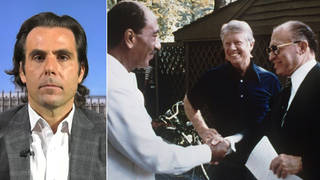
The late President Jimmy Carter presided over a key landmark in the Arab-Israeli peace process, the 1979 Camp David Accords signed by Egypt and Israel. Carter’s lifelong interest in resolving the Israel-Palestine conflict is an analog for his complicated legacy in foreign policy and human rights. As Seth Anziska, a professor of Jewish-Muslim relations at University College London, explains, while on one hand Carter believed that Israel’s treatment of Palestinians constituted apartheid “far worse” than what he had seen in South Africa, on the other, his deep Christian faith made him fundamentally sympathetic to religious beliefs framing Israel as a Jewish homeland. “He was the first U.S. president to talk about the idea of a Palestinian homeland alongside his commitment to Israeli security,” says Anziska, who argues that the failure of the Camp David Accords in promoting lasting peace lies in their “perpetuation of Palestinian statelessness.”
This content originally appeared on Democracy Now! and was authored by Democracy Now!.