
Janine Jackson interviewed Nation guest editor Rayan El Amine about voices from Gaza for the February 6, 2026, episode of CounterSpin. This is a lightly edited transcript.
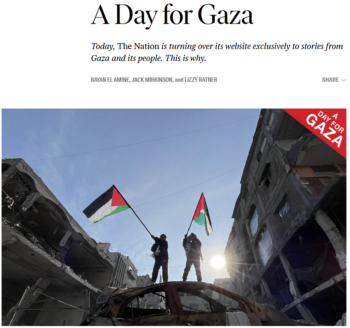
The Nation (2/3/26)
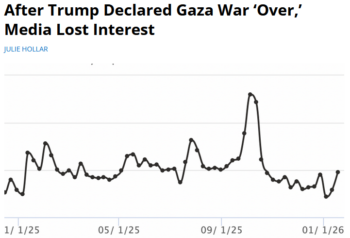
Janine Jackson: Donald Trump declared that the “War in Gaza is over” on October 13 of last year. Trump says weird and untrue things every day, but corporate news media seemed to take this one as fact. As FAIR’s Julie Hollar found, coverage of Gaza in US news sites has plummeted since that time.
The Nation magazine dedicates its current issue entirely to the crisis the corporate news say isn’t happening, or is being controlled, featuring reflections on a number of facets: personal stories, history, literature, maps…. It’s called “A Day for Gaza,” but it represents, of course, more than that.
The issue was put together by our guest. Rayan El Amine is a writer and editor from Beirut, as well as a translator for Drop Site News and an editor at the Cleveland Review of Books. He joins us now by phone. Welcome to CounterSpin, Rayan El Amine.
Rayan El Amine: Hey, Janine. Good to be here.
JJ: Well, the first piece in the issue is by Mohammed Mhawish, and it talks about ceasefire, and I think that’s a good place to start. It’s a key way to talk about the divide between what’s really happening in Gaza and Palestine, and the story that US media are telling people. The New York Times, February 3, referred to a “shaky ceasefire,” but still. Are we wrong in our understanding of what “ceasefire” means, and that that is not what’s happening right now?
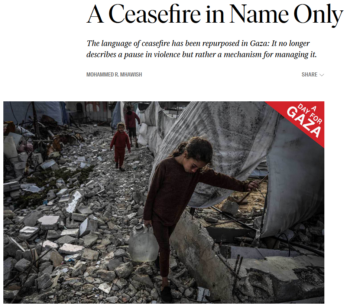
The Nation (2/3/26)
REA: It’s a good question, beginning with the kind of framing that the Trump administration has put forward, and that many mainstream media outlets, like the New York Times, have adopted. And they’re not wrong necessarily, in the sense that the ceasefire is functioning exactly as the Trump administration is intending. And that’s why Mohammed Mhawish’s piece, I think, is so important in leading the project. Rather than speak for him, I’ll just read a short sentence from the piece that I think encapsulates the argument well. He writes in the second paragraph:
The distance between that official narrative and the facts on the ground reveals how the language of ceasefire has been repurposed. It no longer describes a pause in violence, but rather a mechanism for managing it, sanitizing ongoing military force under the guise of restraint.
And this is a model that we’ve seen Israel adopt, primarily in South Lebanon, and is now being taken up in full force in Gaza.
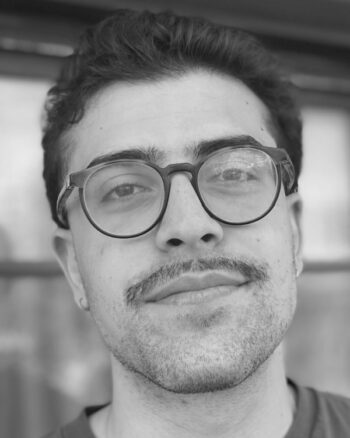
Rayan El Amine: “The only way that such a—I would call it what it is—colonial project could go unnoticed is under this project of ceasefire.”
Essentially what we’re seeing, I would call it a sort of occupation via ceasefire. The introduction of this foreign “Board of Peace,” which I think in the coming months will begin what is effectively a bidding war to turn Gaza into Trump’s Riviera-ic imagination. And in many ways, that’s the impetus for this project. The only way that such a—I would call it what it is—colonial project could go unnoticed is under this project of ceasefire.
In part, Israel’s violence, because it was broadcast to the world, and because of the courage of many of the journalists, it was difficult for them to move forward with these diplomatic and bureaucratic colonial proceedings, that actually, I would say, preceded the genocide by many years—thinking about the Abraham Accords, and Oslo Acords in the ’90s long before that, this slow fracturing and destabilizing of the Palestinian Territories into separate entities. And it’s the responsibility of us working in media to not just challenge that, but to uplift the voices on the ground, to give them a sort of self-determination.
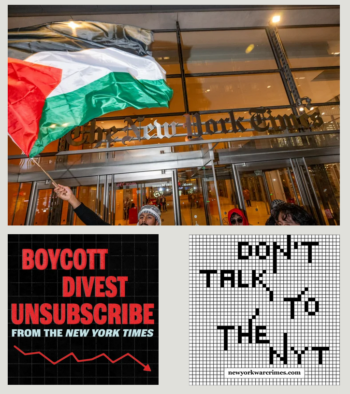
And I’m glad you began with the Times, and quite critical of what the Times has done. And I would say what they’re doing is, at this point, misreporting. And in that case, I often turn to an organization like Writers Against the War in Gaza, which has grown exponentially over the last few years, and is engaged in a boycott, demonstrating tangibly the material relationships that people in the New York Times editorial board have with the Israeli government, the falsification of objectivity that continues to persist.
And I say that to say it’s not an accident that the language is being muddied. And what I hope we achieved a little bit, at least with our editors’ note with the framing of the project, is a kind of clarity, what we’re witnessing is a genocide sustained, and is an attempt to, I think, continue to ethnically cleanse Palestinians from their land.
JJ: I also lifted up that very sentence from Mohammed Mhawish, about the redefining of ceasefire as no longer describing a pause in violence, but rather a mechanism for managing it. And that’s my fear, as a media observer, and it’s what you’re talking about, is that news media will simply define us away from seeing and responding to what’s happening. Because, after all, we are not international lawyers or diplomats. And so if someone says, “Oh no, it’s different. It’s not the horror show you saw last year. Now it’s a different situation, and there’s a new term for it,” the narrative turns us away from the reality.
And as Mhawish says, this is now going to represent the definition of success. The current state in Gaza, which involves killing, which involves genocide, which involves hunger, is going to be called a success. Sometimes media critics are joked about for caring so much about narrative, or about words. But in this case, and cases like this, it’s going to very much determine what people think is happening, and how they think they should feel about it.
Justice Everywhere (3/10/25)
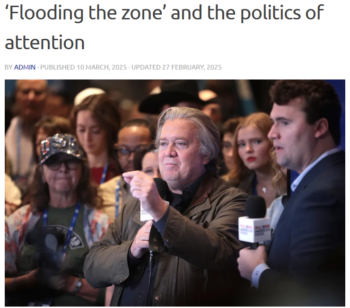
REA: A hundred percent. And this question of narrative you bring up is really important. The editors who worked on this project were cognizant of the driving narratives of the moment. And by that, I’m referring principally to the ongoing horrors in Minneapolis, this invasion or I would call it an abduction in Venezuela, what’s currently happening in Iran…. I would argue the Trump administration is working on all of these in conjunction. And it’s a term that they call “flooding the zone.” I’m sure you’re familiar with it, but it’s this idea of inundating us, as media and culture workers—and more importantly, as viewers and readers—with so much horror that our capacity to be desensitized increases with every ensuing attack, every ensuing violation. Because the Trump administration is so…. They’re not willing to wait for the judicial proceedings that already exist in place, there is no legal order that can slow down this project.
It’s up to us, those of us at institutions that are great, like FAIR, and I believe are great, like The Nation, to slow down this pace. And so it’s not an accident that this was released in the midst of the ongoing violence in Minneapolis, because, in part, the intervention we want to make is a willingness to say, no injustice will pass by our publication without being heavily interrogated, without being closely noticed, and without it beginning from the ground.
An editors’ note released the day before on February 2 had specifically to do with the people of Minneapolis rising up against the ongoing ICE and state repression. And that’s the kind of thing that makes me really proud that those two editors’ notes coexist side by side at the moment.
JJ: And I was thinking that very same thing. And you hear pundits talk about competition for attention: “Well, people can’t care about Gaza when we’ve got Minneapolis”—or the Epstein files, or whatever.
And I don’t really hear regular folks say that so much. We’re emotionally exhausted and sad and angry. But I don’t hear people saying, “Oh, I can’t care about Gaza, because now there’s Minnesota.” I actually hear people seeing, oh yeah, commonality, seeing the connection among these things, which is the opposite of what I think Trump is trying to achieve, but seeing, actually, more ground for solidarity across borders, and across “issues.”
The Nation (3/23/15)
REA: This sort of solidarity extends in the inverse. It comes from Gaza. I remember, it’s funny, when Mamdani was elected, a number of journalists, —some of whom are featured in this issue—texted me, congratulating me on his election, which was a strange kind of invert of attention. And so, yeah, the network of solidarity among people who are oppressed has been rigid for a long time, and I think will continue to be.
JJ: I want to talk about the push behind the issue itself. You’ve talked about it, but The Nation has been reporting on Palestine for many years now. So why this issue, right now in particular? Has it been in the works for a while, or what’s the impetus in February 2026?
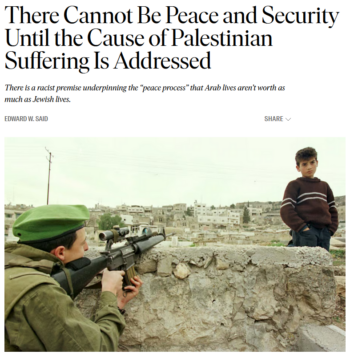
REA: It’s a good question. And I think, in part, it begins with the history of the publication. Edward Said was a longtime contributor. Mohammed El-Kurd was the publication’s first Palestine correspondent, and Jack Mirkinson, who worked on this issue, has been leading the magazine’s coverage for a long time. In truth, it would be nice to formulate a particular thematic answer, but like a lot of things, ultimately, it was pragmatic, the reason that we chose this date. I mean, this project was many, many months in the making.
And in part what I want to highlight is that the particular pieces chosen were chosen for a reason, as were the writers. And so, thank you again for the opportunity to speak about it, because one of the challenges that I would make to other publications is to understand that, actually, the construction of this project, for us on the editorial side—and maybe I’m speaking only for myself when I say this—was relatively easy.
The Nation (2/3/26)
And by that, I mean the ability to connect with journalists on the ground is not difficult. They are excited to work, they’re extremely diligent. They submit their articles on time. They’re very welcome to being edited, and this in what is, in effect, a war zone, even after the ceasefire. And so we were very careful with the kind of editing we were doing.
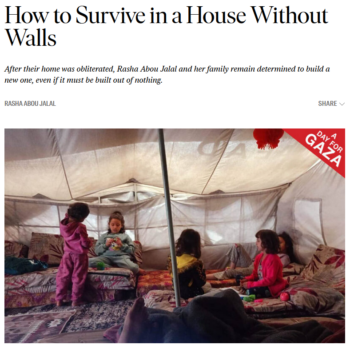
And because the situation is really dynamic, often we were in search for a piece that can encapsulate what’s happening. And the piece that ultimately we settled on doing was Rasha Abou Jalal’s piece on “How to Survive in a House Without Walls,” which for me is, I would say, one of the standouts. And if one was going to read this issue sequentially, after Mohammed Mhawish’s framing, I would turn to this one, because it presents the ceasefire situation as it is.
And one might notice, in reading a lot of these, there’s an intense temporal shift. Some of the essays really focus on events that happened in August. And, truthfully, that’s actually because they were commissioned then. But the authors were diligent and patient and welcome to this long and arduous editing procedure.
The Nation (2/3/26)
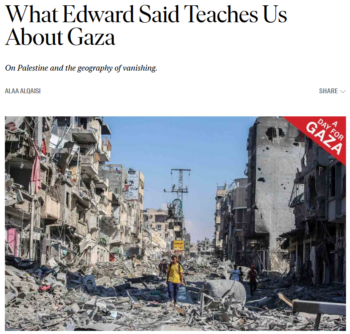
And the translation work needed to be delicate, I think. Many of these writers submitted in Arabic, but many of them also submitted in English. Alaa Alqaisi has a piece on reading Edward Said during the genocide. She is, in my mind, one of the most brilliant English-writing authors that is being published right now.
And so, I don’t know, it would be easy to sit here and brag and say, “We uncovered all of these special writers,” but they’ve been there. They’ve been working for three years now.
And I go back and forth on why big media institutions, with a lot of money, refuse to look to them. And I think the answer is, frankly, in some parts, a little bit racist, a little bit of the value put on foreign journalists and the guise of objectification. But I think anyone could do this project, any publication.
JJ: Right. When we do introductory speeches, I often talk about how the fact that media is a business interferes and conflicts with journalism as a public service. And one of the things that seems like a small little thing is, “Well, we’re not going to hire translators anymore. We’re going to send correspondents to Tehran, to Gaza, but we’re not going to pay for translators.”
And so then, well, what does that do? That’s a cost-cutting decision that, of course, affects who you speak to, who gets heard, whose voices are included. Translation is a real straightforward way to represent the conflict if you’re just a cost-cutting corporation, as opposed to if you are really a journalistic institution.
One of the things—and it’s just building on what you just said—a factor of this [Nation] issue is, we see Palestinians as actors and not as subjects, because even in mainstream news that is sympathetic or whatever, or critical of the Trump administration, so often Gazans, Palestinians in general, are discussed as really pawns—pawns of Hamas, pawns of Israel—but not people. And so just that fact of having these writers speak with their own, if you will, voices shifts that. And I think that’s crucial.
The Nation (2/6/26)
REA: That’s such a terrific point. It makes me really happy that it comes out in the project. In part, I think the other thing we wanted to do is—what you’re describing is, I would call this a sort of objectification of these Palestinians, right? They can only exist if they are in the hands of some other party or administration that we actually see as holding legitimate power.
But another consequence of that is the Palestinian has been a very idyllic subject, as a subject only worthy of sympathy as perfect, as absence of contradiction, as absent of even frustration. And for two years, because there’s this constant pleading with the world to move, we see them only in this sympathetic light, as if they are patiently waiting for us to save them, and they are doing the best that they can, giving us almost a divine quality.
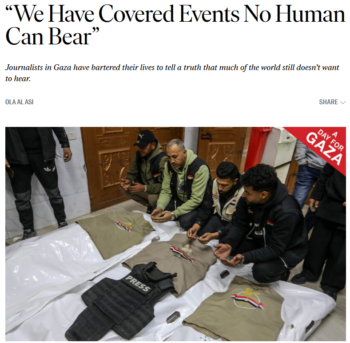
And that’s what Ola al Asi’s piece, I think, does tremendously. She says, “Look, I knew all of you were going to betray us.” And she’s speaking to the Western leadership, to the Western audience. She said, “I knew when I was going to stay in the North and continue my work,” without what she calls purported protection of a press pass and a helmet, “I knew the world would still do nothing about it. ” And that is, I think, a much more interesting question, actually.
If Gazans—and they should—have come to this conclusion, actually, that the world is unmoved, or not moved enough, by their position, why do they sustain the work? And one of the things in a media landscape in the West is, if we just look at the Washington Post layoffs today, that it’s increasingly easy to be cynical. One thing that I’m always awestruck by—and even now I’m sort of applying an idyllic quality to them, but I do really believe this—is that they really believe in the dutiful quality of journalism. I mean, they believe that journalism has specific ethics, that they are required to follow them, despite them being in a war zone.
A story I tell often, prior to this issue, I commissioned a writer, Abubaker Abed, while he was still in Gaza to write a story for me about being thrust into war correspondence. And he sent me a message, because he was late in submitting his piece, saying, “Hey, I’m so sorry. I am actively being flooded, and I don’t have time to write this piece.”
And I responded, saying, “Of course, take all the time you need, but also, do you want us to pay you now ahead of schedule, so you can use the money to find somewhere to stay at least for a little while?”
And he said, “Absolutely not. I refuse to get paid until the piece is out, just like you would any other reporter working for you. ” And I’m always, as someone who’s quite cynical, sometimes, of journalism’s dutiful quality, it’s really remarkable. This is a special crop of reporters and story tellers and writers.
JJ: Finally, I found the piece by Ola al Asi very moving, just talking about being a reporter in Gaza: “We have covered events no human can bear.” That piece, along with the rest of the pieces, it really brought home for me, brings home were it needed, how precious journalism is, how much reporting is about witnessing, and sitting with, and expressing complexity, and how little it’s about cocktail parties and getting access to rich people. It really does bring home how precious and how sacred real journalism is in the world today.
And there are many takeaways from this issue, but that is certainly one of them. It’s not necessarily making—I mean, it is making heroes, of course, of Palestinians, and anyone reporting from war zones at tremendous risk to themselves, to get out stories that we would not hear otherwise. I also obviously get cynical, but journalism really is a public service, and this brings that home.
FAIR.org (1/28/26)
REA: I think that’s really incredibly put. And I agree. I think that is, if not the primary takeaway, the secondary one, with the primary being the thing we’ve discussed the entire time, is that: Listen to them. They continue to be actively attacked and killed and threatened. Just today, 38 Palestinians were martyred in the last 24 hours. It’s a tremendous loss of life.
And in great part, I want to thank FAIR for quantitatively contextualizing that loss, because it’s something we all feel, but then, there’s an element of dissonance, maybe, and you’re saying, “Well, maybe I’m not looking hard enough.” But no, I would say for anyone reading this, my answer is: Let this be a start of your continued commitment to reading and listening to Palestinian voices. Do not let it be encapsulated in this single issue, because there are hundreds of writers like them, and I hope we can publish them all eventually.
JJ: We’ll end it there for now. We’ve been speaking with Rayan El Amine, guest editor of The Nation magazine’s current issue,”A Day for Gaza.” Rayan El Amine, thank you so much for joining us this week on CounterSpin.
REA: Oh, it was an honor, Janine. Thank you for having me.
This content originally appeared on FAIR and was authored by Janine Jackson.