
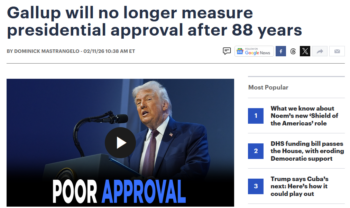
Gallup (The Hill, 2/11/26) said its decision to stop measuring presidential approval “reflects an evolution in how Gallup focuses its public research and thought leadership.”
The Gallup Poll announced this month it would no longer measure presidential approval or other national leadership ratings. It was a surprise to pollsters and journalists who report on public opinion, because George Gallup was the pollster who initiated presidential approval ratings in the 1930s. Over the past nine decades, the organization has developed the most extensive database available, allowing journalists to compare approval ratings among all presidents since Franklin D. Roosevelt at various stages of their tenure.
In fact, that very ability may have been the catalyst for Gallup dropping the ratings. Last November, Gallup (11/28/25) reported President Donald Trump’s approval rating as the lowest in his second term (36%), just barely above his lowest rating ever in January 2021, after he fomented the insurrection in an effort to avoid leaving office. His average approval rating in his first term was the lowest of any president since such polling began.
The November report also noted that Trump’s net approval ratings had dropped significantly on several items since the previous February/March: immigration (-9 points), situation in the Middle East (-7), economy (-6), federal budget (-12) and the situation in Ukraine (-10).
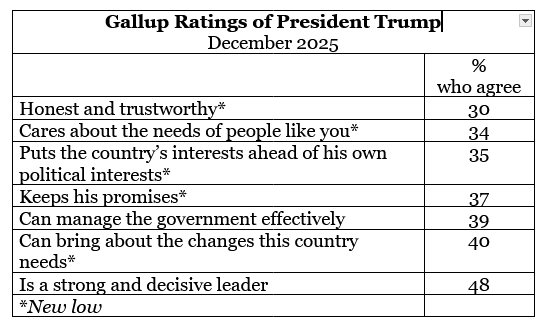
The December report (12/22/25) was not any better. Trump’s approval rating remained at 36%, while ratings on seven other personal characteristics were at a new low or near a new low:
Also problematic for Gallup was that its approval ratings consistently showed numbers below the average of other polls. Across ten approval ratings Gallup published in 2025, the net rating averaged 8.7 points lower than the average that Nate Silver (formerly of 538 and now of Silver Bulletin) compiled from other polls.
These are especially bad numbers. Trump doesn’t like bad numbers. He still has a lawsuit against an Iowa pollster whose pre-election numbers he didn’t like. And Gallup has extensive contracts with the federal government. It’s a no-brainer to infer that Gallup’s polling results may have caused the Gallup organization to re-evaluate the utility of continuing to report numbers that Trump hates.
No one knows if the White House let its dissatisfaction be known, or if the leaders at Gallup evaluated the zeitgeist on their own and took steps to mitigate possible financial problems with the US government. When asked by the Hill (2/11/26) “if Gallup had received any feedback from the White House or anyone in the current administration before making the decision,” the organization’s spokesperson apparently did not deny such an intervention, but said, “this is a strategic shift solely based on Gallup’s research goals and priorities.” Sounds like a yes to me.
The decision feels like the exclamation point marking the end of the Gallup Poll as envisioned by its founder.
The rise of Gallup
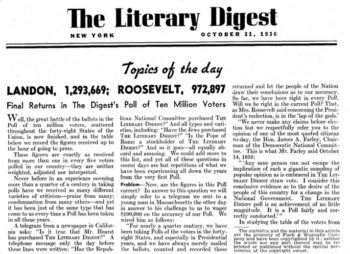
The Literary Digest (10/31/1936) predicted that Alf Landon would get 370 electoral votes and defeat Franklin Roosevelt in the 1936 election. He won eight, and did not.
On October 20, 1935, the Washington Post published a new column, “America Speaks!” by Dr. George Gallup, who had recently founded the American Institute for Public Opinion. (See Chapter 2, “America Speaks,” in David W. Moore, The Superpollsters, 1995.) It would report on the first “scientific” measurement of the voters’ minds. And, Gallup guaranteed, he would predict the outcome of the 1936 election between Alf Landon and President Franklin Roosevelt closer than the famed, and highly respected, Literary Digest poll.
While the latter poll based its results on responses from 10 to 20 million ballots it had sent to voters across the country, those voters had been targeted because their names were on a “tel-auto” list—a marketing list of people who owned cars and telephones. Gallup surmised that those voters would be disproportionately of the upper socioeconomic strata, potentially biasing the results in favor of Republicans. The “scientific” sampling he used was intended to identify voters all across the socioeconomic spectrum, to obtain a truly representative sample of the whole population. Based on his knowledge of statistics, he recognized that such a sample need not be as gargantuan as the Literary Digest sample.
As it turned out, Gallup’s prediction was indeed closer than that of the Literary Digest poll. As were the results of two other “scientific” pollsters—Elmo “Bud” Roper and Archibald Crossley. The Literary Digest poll predicted a landslide victory for Alf Landon, while the three upstarts all correctly predicted a landslide victory for Roosevelt. The “scientific” method of sampling had shown that relatively small samples of voters, chosen carefully to include all varieties of voters, could accurately represent the larger population.
All three pollsters had their own organizations, but Gallup was the most aggressive advocate for this new way of polling. More so than the others, he engaged in frequent polling on policy matters, and thus became the leader of the new public opinion polling industry. Newspapers subscribed to his columns, and for four decades, his polling results were the most significant influences in defining what the public was thinking on major issues.
Of course, he continued his election polling as well, because he believed that accurate election predictions were essential to developing public confidence that polls could represent public opinion more generally. And he developed ratings of political leaders, initiated in 1938 with his presidential approval rating question: “Do you approve or disapprove today of Franklin Roosevelt’s job as president?”
Election polling, public policy polling and leadership ratings were the three signature aspects of the Gallup Poll.
New owner, new strategy
In the mid-1970s, the three major broadcast networks began to develop their own polls, each partnering with a major newspaper—ABC with the Washington Post, CBS with the New York Times and NBC with the Wall Street Journal. In the ensuing decade, other national polls emerged as well, such as the Los Angeles Times poll, and occasional polls by Time and Newsweek.
By the late 1980s, the Gallup Poll had all but disappeared from national news stories. Few major newspapers continued to subscribe to Gallup’s polling service, because most newspapers got their poll results for free, recycled from the newspapers and television networks that conducted their own polls. George Gallup had died in 1984, and his two sons—Alec and George, Jr.—did not have the charisma or business acumen of their father. They waited until their mother had passed, in 1987, and then put the Gallup Poll up for sale.
The company that eventually bought Gallup was founded by Donald O. Clifton, a psychology professor at the University of Nebraska in Lincoln, who designed questions that would help match people with specific types of jobs. Based on his research, he eventually founded Selection Research Inc. (SRI) to help companies hire employees. (See pp. 19-21, David W. Moore, The Opinion Makers, 2008.)
Among Clifton’s four children there was one son, Jim, who became president and CEO of the new Gallup Organization. One of his most brilliant moves came shortly after he assumed his new position. He was able to persuade Ted Turner, owner of CNN, to have the network join in a one-year polling partnership with Gallup for the 1992 election. The agreement included USA Today, which had been an occasional CNN partner.
It was an ideal arrangement for all three organizations. Gallup was finally back in the news, because its poll results were immediately published by both partners. And the two media organizations benefited from the credibility of the Gallup Poll. The arrangement worked well during the campaign, and subsequently was renewed in a multi-year contract.
(It was at this point, March 1993, that I joined Gallup as a vice president and managing editor of the Gallup Poll. My immediate supervisor was Frank Newport, editor-in-chief of the Gallup Poll. I remained with Gallup until April 2006.)
With Gallup back in the news, the company’s marketing business took off. When SRI acquired Gallup, it was like one guppy eating another—the annual revenues from SRI were only slightly larger than the annual revenues from Gallup (in the $12–15 million range). A decade later, SRI-Gallup’s revenues were estimated to exceed $200 million.
The strategy was clear: The “Gallup Poll” part of the company—the part that conducted opinion polls, as opposed to the marketing business of the new Gallup Organization—was the advertising that helped bring in clients. If the “Poll” were to lose credibility, that could hurt the business. And, slowly, the “Poll” did begin to lose credibility.
‘Gallup vs. the World’
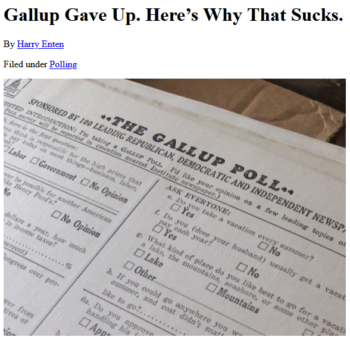
Harry Enten (538, 10/17/15) noted that when Gallup stopped doing electoral polling in 2015, it took away the best tool for judging the accuracy of its opinion polling.
Despite the extensive public policy polling and widespread dissemination of Gallup’s results, its election polling was often controversial. In 2012, Nate Silver wrote an analysis, “Gallup vs. the World” (New York Times, 10/18/12), describing numerous times when CNN/USA Today/Gallup’s results significantly diverged from the average of other polls, and even from final election results. From the beginning of the partnership, the election polling was erratic, he noted, with results showing “implausibly large swings in the race.” As he wrote, “In 1996, Gallup had Bill Clinton’s margin over Bob Dole increasing to 25 points from nine points over the course of four days.”
Then in 2000, it found “a 26-point swing toward Mr. Gore over the course of a month and a half. No other polling firm showed a swing remotely that large.” Silver pointed out that Gallup’s polling swung again, back toward Bush, putting him 13 points ahead on October 27―”just 10 days before an election that ended in a virtual tie.”
The problems continued. In 2015, 538‘s Harry Enten (10/7/15) wrote that Gallup had suffered
two consecutive elections in which its results were way off. Gallup’s final generic congressional ballot in 2010 had Republicans winning by 15 percentage points; they won by 7 points.
He also noted that in 2012, Gallup’s final poll showed Romney winning by one point. Obama won by four.
The partnership had begun to break apart in 2006, when Gallup dropped CNN. USA Today and Gallup continued working together, but in 2008, 2010 and 2012, the final elections polls on Real Clear Politics list results under Gallup’s name alone, despite earlier polls in those years when the results were listed as USA Today/Gallup. The official breakup came in early 2013, when Politico (1/18/13) announced that “USA Today and Gallup, the polling organization, have announced a mutual decision to end their 20-year partnership.”
Gallup’s decline
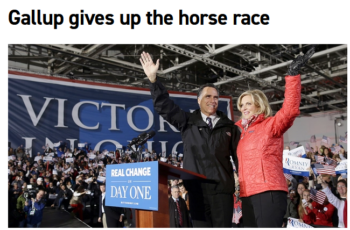
“We believe to put our time and money and brainpower into understanding the issues and priorities is where we can most have an impact,” Gallup editor-in-chief Frank Newport told Politico (10/7/15) in 2015.
That wasn’t the only bad news. In 2012, the Gallup Organization was sued by the federal government for bilking it out of millions of dollars, and for violating the Procurement Integrity Act by agreeing to hire a federal employee only if he could first increase the size of a government contract for Gallup.
In July 2013, the suit resulted in Gallup having to pay a $10.5 million fine for its transgressions, and—according to the Omaha World Herald (8/17/13)—removed Clifton from “authority over the company’s government division” as part of an agreement that allowed the company to “continue to compete for federal contracts.” It’s ironic that after such success in reviving the Gallup brand, Clifton was the one to tarnish it so profoundly.
After a bad election year in polling and the overbilling and procurement scandal, Gallup ultimately decided to give up election polling altogether. As Politico (10/7/15) wrote:
After a bruising 2012 cycle, in which its polls were farther off than most of its competitors, Gallup told Politico it isn’t planning any polls for the presidential primary horse race this cycle. And, even following an internal probe into what went wrong last time around, Gallup won’t commit to tracking the general election next year.
And it didn’t.
With no media partner, Gallup’s public policy polling also declined. It’s rare these days when Gallup conducts a poll that gets cited about some current national issue.
But Gallup did continue with regular polls on presidential approval and favorability ratings of political leaders. Until now. With the recent announcement, it no longer does regular election polling, public policy polling or leadership ratings—the three signature characteristics of George Gallup’s original vision of “American Speaks.” America continues to speak, but with respect to voter preferences, citizens’ views on controversial public policy issues, and how they view their leaders—Gallup is no longer listening.
The Gallup Poll still functions, of course. Its extensive data base is still available to journalists. It continues to conduct polls of Americans related to its Social Series, started in 2000. The surveys track attitudes in a variety of areas over time, but they do not focus on current controversial public policy issues.
No questions, for example, about Epstein, tariffs, immigration enforcement and ICE, war with Iran, the capture of Venezuela’s president, vaccine mandates, housing policy, the war in Gaza, ways to address “affordability,” the use of presidential pardons, healthcare subsidies, Ukraine, crypto currency, and other policies that ask respondents to take a position in favor or opposed. Gallup apparently doesn’t want to offend, so virtually all of its questions are general in nature. It has become a shadow of its former self.
‘A big deal’?
“Gallup’s…88 years of data give historical context to what amounts to a monthly snapshot of Americans’ views,” wrote the New York Times (2/11/26). “Political and news media analysts have come to rely on the poll to understand shifting trends in the country over time.”
Does it matter?
Some media observers think so. The Washington Post (2/11/26) called it “a big deal,” with the paper’s polling director saying Gallup is “leaving Americans with a dimmer view into our politics.” Ruth Igielnik of the New York Times (2/11/26) bemoaned the loss of Gallup’s “high-quality surveys” and “record of accuracy.” Both cite Gallup’s long history and its use of telephone, rather than online, surveys.
But telephone surveys’ primacy is no longer undisputed (Data for Progress, 3/11/21; Pew, 4/19/23). Indeed, while the Gallup Poll is still a high-quality polling organization, it is not the leader in the industry. Nate Silver rates polls by comparing their predictions with actual election results; Gallup gets a B+, better than average, but Silver finds at least 25 pollsters to be more accurate.
Despite their disappointment with the Gallup announcement, both Clement and Igielnik note that the New York Times tracked 51 polls measuring Trump’s approval rating in January—so many, Clement concludes, “that poll watchers may not have noticed the absence of Gallup’s monthly figures.”
When Gallup announced it would no longer conduct pre-election polls in 2015, Harry Enten (538, 10/7/15) gave a similar reaction:
There are still plenty of good polls, and Gallup’s decision, by itself, doesn’t change the overall polling landscape that much…. ABC News, CBS News, CNN, Fox News and NBC News have all published live-interview primary polls in the past couple of months. (They all have a better track record than Gallup, according to our ratings.)
The Gallup Organization is a highly successful business, with an estimated annual revenue of $500 million, employing over 2,000 employees. The Gallup Poll was always, as Silver notes, a “loss-leader,” essentially the organization’s advertising for its business. After SRI bought the Gallup name and its reputation, the Poll—focusing on George Gallup’s vision of election polls, public policy polls, and leadership ratings—was instrumental in stimulating business. Over the years, the controversies surrounding the Poll’s performance and results seemed to have hurt the business more than help it. Abandoning Gallup’s vision of “American Speaks” was a logical business decision.
The truth is, with all the other polls that exist today, hardly anyone seems to notice. Except, perhaps, the president of the United States. The “big deal” about Gallup’s announcement, then, has much less to do with the loss of one poll than with the pressure a US president is apparently exerting on the polling industry.
Featured image: Gallup’s presidential approval polling going back to 1945.
This content originally appeared on FAIR and was authored by David W. Moore.