
Janine Jackson interviewed the National Center for LGBTQ Rights’ Shannon Minter about the Supreme Court “conversion therapy” ruling for the April 3, 2026, episode of CounterSpin. This is a lightly edited transcript.
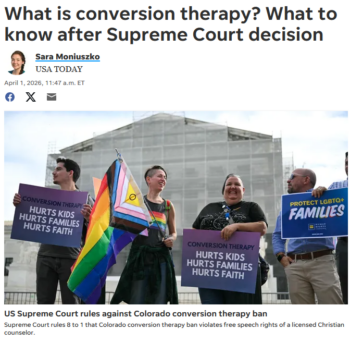
USA Today (4/1/26)
Janine Jackson: The Supreme Court ruling in Chiles v. Salazar held that a Colorado law that prohibited some medical health practitioners from practicing what’s called “conversion therapy” on minors violates the First Amendment.
I was struck by a USA Today headline: “What Is Conversion Therapy? What to Know After Supreme Court Decision.” With no offense to the reporter, who describes the practice up top as “pseudoscientific and discredited practice that attempts to force LGBTQ+ individuals to change their sexual orientation or gender identity,” one could imagine that readers would benefit from serious grounding on issues before the highest court rules on them.
But while it seems hard not to take away something disheartening from this ruling, from this Court (the New York Times calls it a “major win for conservatives,”) some people, including our guest, encourage a focus on ways forward, and what is still possible.
Shannon Minter is legal director at the National Center for LGBTQ Rights. He joins us now by phone. Welcome to CounterSpin, Shannon Minter.
Shannon Minter: Thank you so much. So happy to be with you.
JJ: I see confusion around some basic elements, so I will ask you: What did the ruling say, specifically, and, maybe more importantly, what didn’t it say, if you would?
SM: Yes, there is a lot of confusion about that. The Court did not say that conversion therapy is safe, effective, appropriate, ethical. The Court did not dispute that it can be terribly harmful. The Court did not say that it is now legal. There’s no message like “greenlight, go. Any therapist who wants to engage in conversion therapy can now do so protected by the First Amendment.” No, no.
The Court, they were just looking at a particular statute in Colorado that says that state-licensed therapists in Colorado cannot subject a minor patient to conversion therapy. And the Court was concerned with the specific way that statute was drafted. There’s language in the statute that the court thought reflected a bias towards people who want to affirm or support gay or transgender identity, and it disfavored the beliefs of people who don’t want to do that.
And the Court was troubled, honestly, just really by the wording of the statute, which they thought amounted to “viewpoint discrimination.” That’s the technical term under First Amendment law. And you can never have a law that discriminates against a particular point of view.
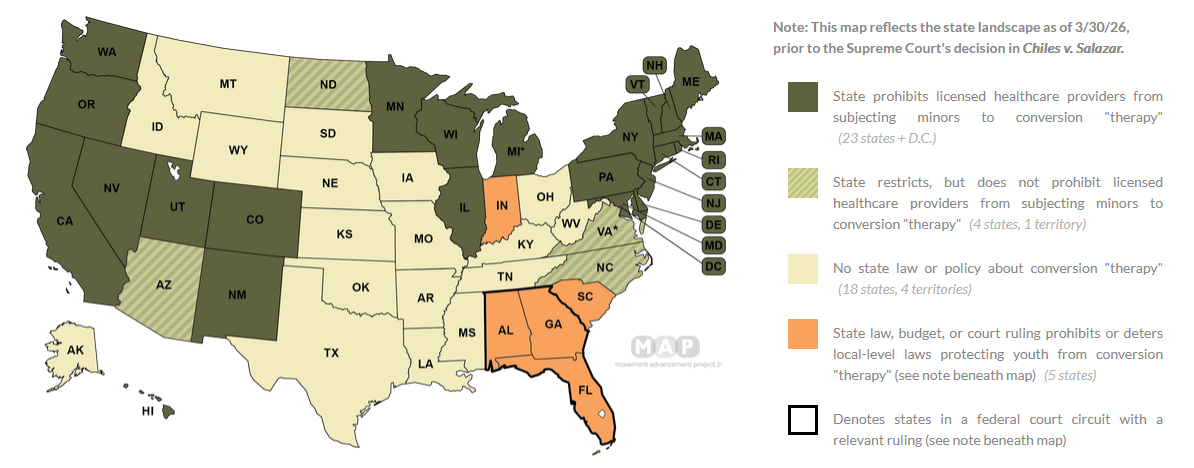
The bad news is they held that Colorado’s law likely violates the free speech protection of the First Amendment. And there’s a bunch of other state laws that are very similar to Colorado’s. About 25 states have similar laws, and they’re very important, because these practices are so harmful. So it’s rather alarming to have all of those laws suddenly thrown into question. That’s the terrible part of this ruling.
The silver lining here, though, is that the Court appears simply to be saying, “If you want to address these harmful practices, you have to go back to the drawing board and redraft these statutes to be more evenhanded.” So the path is still open to do that. So that is the good news.
JJ: We’re in a legal landscape here, and I wonder, how does this ruling fit with United States v. Skrmetti, where the Supreme Court upheld Tennessee’s ban on gender-affirming care for minors? There, the Court upheld the power of states to ban doctors from prescribing hormone therapy or puberty inhibitors as part of gender-affirming care. Is that because conversion therapy is just speech? Is that the difference there? Because it sort of seems like these rulings are kind of fighting one another.

Shannon Minter: “the Court literally just held that if Tennessee wants to ban transgender healthcare for minors, it can do so. And then here, not even a year later, they’re saying, ‘Oh, but if Colorado wants to ban conversion therapy for minors, it cannot do so.'”
SM: Yeah, they sure are fighting one another. And that was part of what is so infuriating and disappointing about this decision. And it’s hard not to wonder, is the Court being affected by the subject matter of these different cases, because the court literally just held that if Tennessee wants to ban transgender healthcare for minors, it can do so. And then here, not even a year later, they’re saying, “Oh, but if Colorado wants to ban conversion therapy for minors, it cannot do so. ”
There’s no getting around it. There’s something just squarely inconsistent and in conflict about those two decisions, and it’s very troubling. It troubles me greatly, but the Court’s rationale for why they’re different is, yes, as you suggest, they’re like, “Well, this is talk therapy. It’s literally the use of words or verbal counseling. That is speech in some literal sense.” Their concern is that Colorado’s law appeared to target the sort of expressive aspects of talk therapy, that it disfavors therapists who hold certain viewpoints, and favors therapists who hold other viewpoints. That’s the rationale.
Firstly, for what it’s worth, I think that is wrong. I think that this Colorado law is not about regulating a viewpoint. It’s not about regulating expression. It’s about regulating a mental health treatment that happens to consist of verbal counseling, yes, but it is still a treatment, and it should have been treated, in my opinion, as a regulation of professional treatment or conduct, but the Court just was not buying that.
And so they were very swayed by the fact that this is talk therapy, and that’s words and that’s speech. And I will say, anybody who wants to hear the contrary view, Justice Jackson wrote a beautiful, clear, powerful dissent where she took the majority to task, and said exactly what I’m saying now. This is not a regulation of speech. It’s a regulation of a mental health treatment.
JJ: And called it, we’re treating it differently when “substandard care comes by speech instead of scalpel,” like we’re saying that somehow it’s not treatment if it’s just the words you’re speaking into a person’s head, which I think, just at a kind of common sense level, folks can see the problem there.
SM: Yeah. It’s wrong. I mean, you can tell that this is a Court that is not really clear on the concept of what therapy is. I think they seem to mistakenly have some idea that therapy is just two people sitting around having a discussion or a conversation, whereas, no, therapy is part of a highly sophisticated profession that’s based on carefully diagnosing and evaluating people’s mental health issues and applying evidence-based treatments and techniques to deal with those issues.
I mean, therapists are not in there to express their own point of view. They’re supposed to be providing effective treatment. You wouldn’t think so from reading the majority opinion. You would think it was just more of a conversation between two people.
JJ: I know that everything old is new again in some circles. “Measles? Well, maybe that’s a cool thing.” “Airline safety rules? That’s just a trick.” But maybe, just once more for the record: It isn’t that science and medical professionals have not considered or thought about “conversion” or “reparative” or “reorientation” therapy. It’s not that they haven’t thought about it, seriously and at length. They have, and they have conclusions about it.
SM: Oh yeah, of course. Yeah. I mean, there was a time before the ’70s, that changed probably around the mid-1970s, when the predominant view in the mental health profession was that being gay or transgender was a disorder, was a kind of pathology, and we should try to change people, try to prevent people from being gay or transgender, and tried everything under the sun.
I mean, everything from behavior modification to medication to all kinds of counseling, and people had these psychoanalytic theories that the reason someone was gay or transgender was because of something about your upbringing, or you had a maladaptive relationship to your same-sex parents, or perhaps you had suffered some form of sexual trauma or abuse as a child. They really tried every possible theory and technique and methodology to try to get people to not be gay or to not be transgender.
And then they began to be studied. Those techniques were subjected to very rigorous research and testing, and they found, “Wow, this does not work, and it causes very serious harm, like really debilitating harm.” It is a science-based profession, so they adapted to that new information and research and knowledge, and were like, “OK, these treatment modalities don’t work and they’re quite harmful to people, so do not do them.”
All these laws do is reflect what is, by this point in time, an incredibly strong, really unanimous professional consensus and scientific consensus that there is no therapeutic technique that can change someone’s sexual orientation or gender identity. It’s just not something that can be done.
Mother Jones (7–8/24)
JJ: Finally, let me just ask you about public information, what some folks who are not close to the set of issues might be consuming. I know that there are people doing work on this. I’m thinking about Madison Pauly at Mother Jones, Erin in the Morning. I know that there are lots of others out there. If you seek out a counter-narrative or critical information on this, you can find it, but I just wonder, what is your overall sense of the messaging coming out of so-called traditional or legacy news media, on not just this ruling, but this whole set of issues?
SM: It’s been very disappointing. I think we’ve seen our legacy media fall prey to really aggressive propaganda campaigns–attacking, particularly, medical care for transgender youth, and just literally manufacturing a fake medical debate out of thin air, very similar to what was done by the cigarette industry not that long ago, where even though the medical evidence was so clear that smoking is bad for you, and causes cancer and other things, the cigarette manufacturers managed for several years, for quite a while, to make it seem like there was some medical uncertainty or debate about that.
FAIR.org (7/19/24)
We’re seeing those same kinds of underhanded tactics used now to create and manufacture a supposed medical controversy about the safety and efficacy of medical care for transgender young people. And, oh my gosh, I mean, the New York Times, the mainstream press, they have fallen for it, hook, line and sinker. It’s so devastating and painful to see.
But I will say that one positive thing that has come out of this Supreme Court case is we are seeing more and more conservative, religious parents, and very conservative, religious therapists, who are also competent, ethical people, coming forward to say, “Whoa, conversion therapy is very harmful. Do not do it. ”
One of the most powerful amicus briefs in front of the Supreme Court, which I don’t think they even read, was by a very conservative Catholic therapist in Colorado. Her specialty is seeing LGBTQ young people from very conservative Catholic families. She herself is a very conservative Catholic person, and she has been part of a group of people developing alternatives to conversion therapy for helping those young people, that do not try to coerce them, that don’t ignore all the science, that simply help them navigate what may be a pretty serious conflict between their sexual orientation or gender identity and their religious faith and upbringing.
That’s a challenging situation for families and children, and they’re providing competent, supportive therapy that just helps these young people become stronger and more resilient, helps them build stronger relationship with their families, helps in recognizing that it’s not the role of therapy to tell someone how to live their life or who to be, just trying to help those young people be as strong and healthy as they can. And then they’re the ones who have to decide how they’re going to live their lives, and how they’re going to identify and that kind of thing.
But there’s so many positive alternatives to conversion therapy that are very respectful of conservative religious families and beliefs. And I do feel like one thing that’s happening is those voices are starting to have a little bit more visibility and more of a platform. And I really pray that parents across the country will begin to be able to find that information, and not just be directed towards these incredibly devastating practices that, unbeknownst to them, are going to cause grievous harm to their children.
JJ: All right. We’ll end on that note for now.
We’ve been speaking with Shannon Minter from the National Center for LGBTQ Rights. They’re online at NCLRights.org. Thank you so much, Shannon Minter, for joining us this week on CounterSpin.
SM: Thank you so much. I really am glad to be here with you.
This content originally appeared on FAIR and was authored by Janine Jackson.