
The UN just released its 2025 Global Climate Report, and, predictably, the outlook for our earth is incredibly dire. The past 11 years were the 11 warmest on record, and Earth’s energy imbalance—the amount of solar energy absorbed versus the amount Earth radiates back into space—is also the highest on record. Greenhouse gas emissions continued to increase through 2025, despite the world crossing the 1.5°C threshold marked in the Paris Agreement above which the worst effects of global heating will take place.
There is no shortage of urgent climate news right now. The scientific consensus that we need to phase out fossil fuels fast has not changed, despite President Donald Trump’s anti-climate policies rolling back environmental protections and clean energy growth. But data shows coverage about climate change in US news outlets has plunged.
Downward trend
FAIR’s research has found that online news coverage of climate change has been trending down. A search of the term “climate change” in Media Cloud’s US–National dataset, which indexes 248 online outlets, found that there was almost 32% less climate coverage in 2025 than 2024.
This trend is similar in TV news. A recent Media Matters (3/4/26) study found that climate coverage on major US commercial broadcast TV networks was down 35% in 2025.
Zooming out to the past five years to date, results show a steep downward trend. In 2021, 2.4% of US online news pieces in MediaCloud contained the phrase “climate change.” In 2025, that percentage was 1.3%, which is a nearly 46% decrease.
This trend continues in 2026. Between January 1 and March 31 2026, climate stories made up 1.1% of total US news coverage. That’s a 42% decrease compared to the same period in 2021, when climate stories made up 1.9% of coverage.
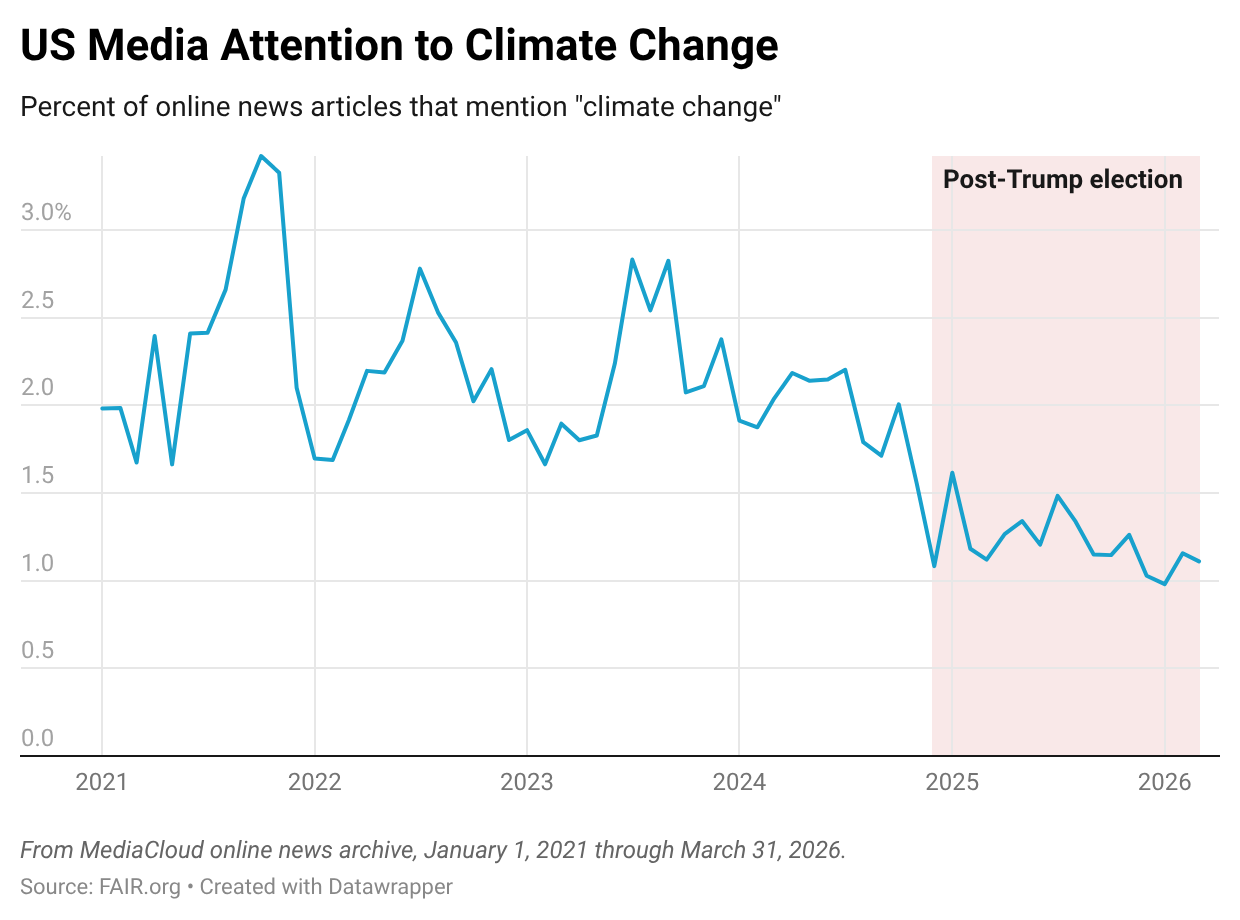
Coverage of climate change in MediaCloud’s US news database peaked at 3.4% of content in October 2021. This was in the runup to the COP26 climate conference in Glasgow (10/31/21–11/13/21), and was at the time the world’s fourth-warmest October on record, although now it’s only the seventh-warmest. Coverage reached its nadir in January 2026, at just under 1%, and as of March 31, 2026, sat at 1.1%.
The unlabeled ‘crisis’
The term “climate crisis,” which carries with it a more urgent connotation than the more familiar “climate change,” has nearly disappeared from media lexicon. The term, which averaged 0.4% of coverage in 2021, reaching its peak in November 2021 at 0.7%, has averaged 0.1% of content in the first quarter of 2026.
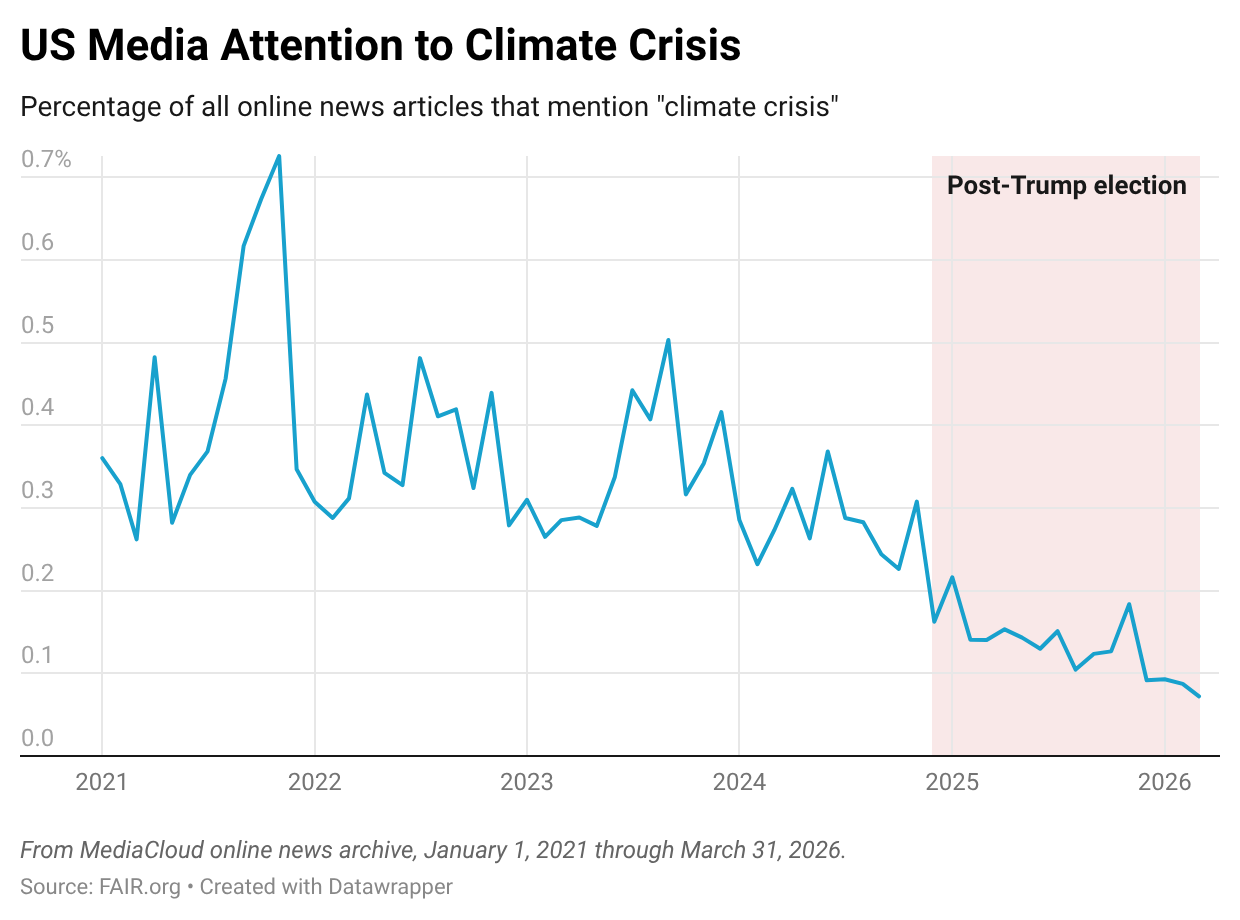
Though it has never approached the usage of “climate change,” there was a time when the terms “crisis” or “emergency” to describe the heating planet were popularized in media and political lexicon (Public Citizen, 6/22/19). In 2019, activist Greta Thunberg (Twitter/X, 6/4/19) declared:
It’s 2019. Can we all now please stop saying “climate change” and instead call it what it is: climate breakdown, climate crisis, climate emergency, ecological breakdown, ecological crisis and ecological emergency?
Months later, the Guardian (10/16/19) changed its style guide to “introduce terms that more accurately describe the environmental crises facing the world.” The editors explained:
Climate change is no longer considered to accurately reflect the seriousness of the overall situation; use climate emergency or climate crisis instead to describe the broader impact of climate change.
In 2026, this terminology is arguably more applicable now than it has ever been. The years 2015–25 were the hottest on record. Yet while the Guardian continues its policy, it appears increasingly isolated.
Trump and climate silence
 Under a president who called climate change a “con job” at the UN, and whose EPA edited its “Climate Change Science” page to blame global heating on debunked “natural causes” theories like changes in Earth’s orbit and volcanic activity, news media should be redoubling their efforts to tell climate change stories with accuracy.
Instead, one cannot help but notice a correlation between Trump’s second presidency and dwindling media attention to the climate. From January 2021 through November 2024, climate pieces were an average of 2.2% of total news content per month. From December 2024, after Trump was elected, through March 2026, climate pieces averaged more than 46% lower, at 1.2%.
The lack of recent coverage is not for lack of newsworthy climate stories. In addition to the release of the 2025 UN report, in March alone:
- The University Corporation for Atmospheric Research filed a lawsuit charging that the Trump administration shut down the Colorado-based National Center for Atmospheric Research to get back at Colorado Gov. Jared Polis, whom Trump has clashed with (NCAR/UCAR, 3/16/26).
- Scientists found that March’s record-shattering heatwave in the Western US would have been “virtually impossible” without the climate crisis. The heatwave included the hottest March days on record in the US, with two 112°F days in Arizona (NBC New York, 3/30/26).
- The Trump administration paid a French energy giant $1 billion to cancel its offshore wind projects and invest in fossil fuels instead (Grist, 3/25/26).
- More than 160 environmental and public health groups called for the firing of EPA administrator Lee Zeldin, who has rolled back national environmental regulations, including air quality standards, pollution limits for oil and gas drilling, and regulations on power plant and vehicle emissions (Earth.org, 3/26/26).
- An oil spill in the Gulf of Mexico began in late March, killing wildlife and damaging reefs (Al Jazeera, 3/27/26).
Iran War and climate
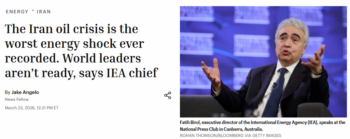
Fortune (3/23/26): “The losses already accrued are far worse than those from the 1970s oil crises and the Ukraine War.”
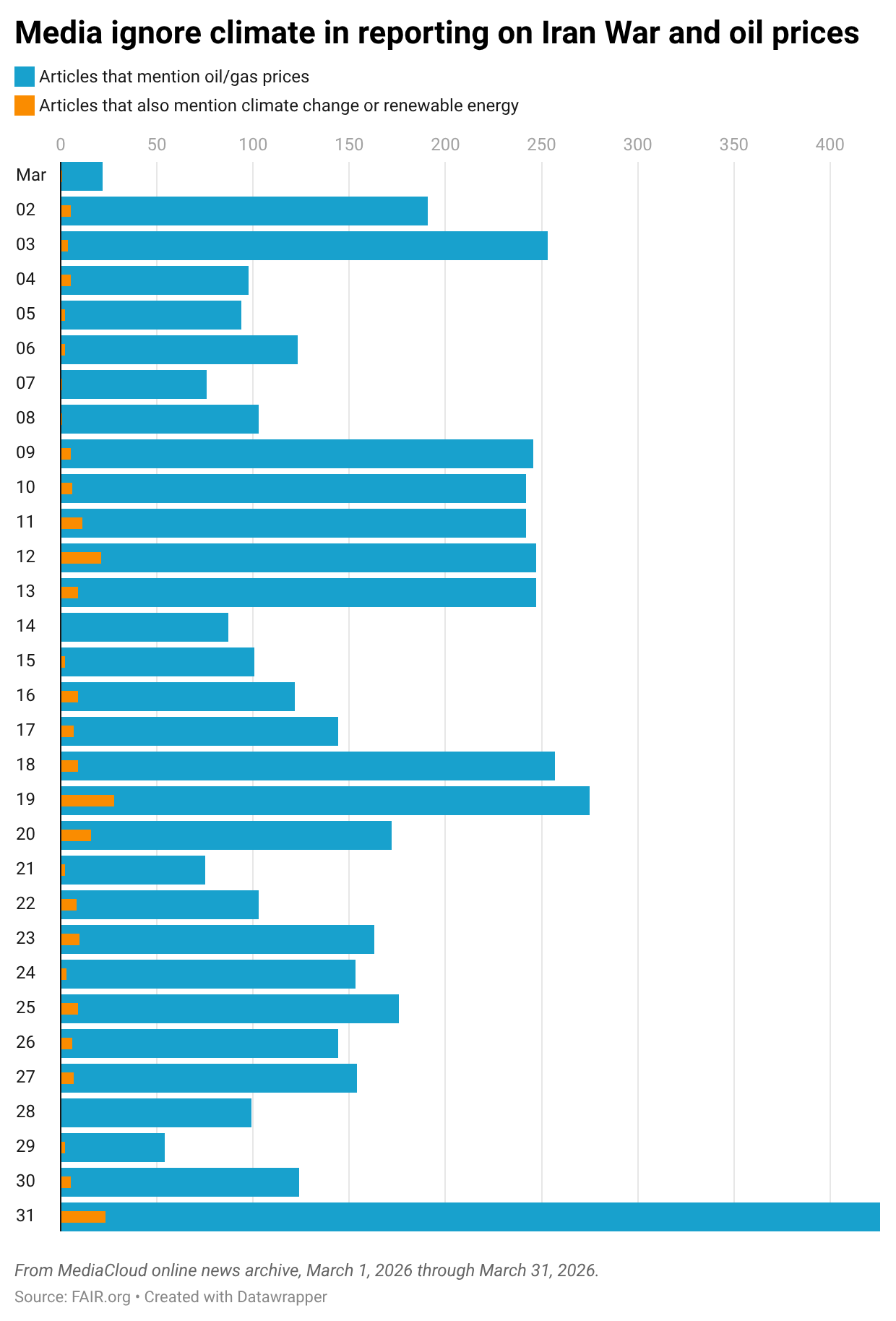
The US and Israel’s unprovoked war on Iran is causing global oil and gas price shocks—and is being reported as the worst energy crisis in history, topping the crises of the 1970s and the Ukraine invasion of 2022 (Fortune, 3/23/26). With the war dominating headlines—the terms “Iran” and “war” made up 10.5% of US news coverage in March, per MediaCloud’s data—there were plenty of opportunities to discuss the war’s impact on climate.
While 5,012 stories in MediaCloud’s US news database mentioned Iran and oil or gas prices during March 2026, only 219 (4.4%) mentioned those topics in relation to renewable energy or climate change.
Simon Stiell, executive secretary of the UN Framework Convention on Climate Change, spoke at the 2026 Green Growth Summit in Brussels, explaining that a just transition from fossil fuels is not only an environmental imperative, but also an economic and national security one:
Sunlight doesn’t depend on narrow and vulnerable shipping straits, wind blows without massive taxpayer-funded naval escorts [and] renewable energy allows countries to insulate themselves from global turmoil and to side-step might-is-right politics.
Renewables like solar and wind are less beholden to geopolitics than fossil fuels, which are vulnerable to volatile shipping lanes and international relations in the specific regions of the world they are produced. Once solar panels and wind turbines are installed, they allow for energy to be produced locally and predictably. As a result, their prices remain stable over time (Global Witness, 4/2/26).
Solar and wind have also been cheaper than fossil fuels for quite some time. A 2025 Lazard report found that utility-scale solar and wind have been the lowest-cost generation sources for 10 years, even without tax subsidies.
This is not the first time in recent years the corporate press failed to make the connection between war-inflated gas prices and the need for renewable energy. In June 2022, after Russia invaded Ukraine, UN sanctions on Russian oil led to a global shortage, causing the national gas price average to top $5 a gallon. Out of 93 nightly news episodes in June 2022 that discussed gas prices, only 18 made even a passing climate connection, and only one made a pro-climate argument (FAIR.org, 7/29/22).
Impacts of climate
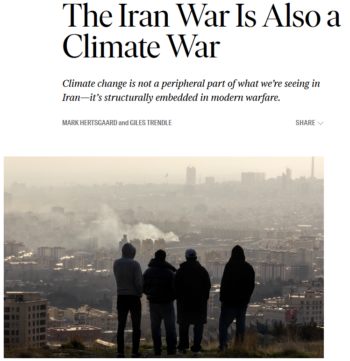
The Nation (3/5/26): “The climate implications of this new war are not the center of attention at the moment, but they are essential context for understanding what’s at stake.”
What’s more, as Mark Hertsgaard and Giles Trendle wrote for The Nation (3/5/26), “Modern warfare is inextricably linked with climate change.” Whether or not a war is fought over oil, the authors note, it cannot be fought without it. If the world’s militaries were a country, they would have the fourth-largest national carbon footprint.
Modern warfare emits astronomical amounts of carbon, which cause extreme heat and other dangerous weather events that impact livelihoods and destabilize economies—conditions that lead to more war.
And warfare also has immediate environmental and public health impacts, some directly linked to fossil fuels. After Israel attacked Iran’s oil facilities, black rain fell in Tehran. The heavy metals and toxic chemicals unleashed have the potential for major public health ramifications, leaching into food supplies and waterways in addition to air. Health risks from this pollution include lung problems, heart problems and cancer.
Climate change does not occur in a vacuum. It is relevant to virtually everything that happens on Earth, from natural disasters to your weekly expenses. Studies show that 80–89% of people worldwide want to see stronger action on climate change from their governments.
It is news media’s responsibility to reflect reality and to address the concerns of the communities they serve, regardless of the priorities of the administration in power. Failing to mention climate change where it is relevant will not stop it from occurring, but inattention will surely make it worse.
This story is part of the 89 Percent Project, an initiative of the global journalism collaboration Covering Climate Now.
This content originally appeared on FAIR and was authored by Olivia Riggio.