
After stepping away for seven years, how does it feel to return to music at this point in your life and what have you learned during your hiatus?
I’ve been thinking about this a lot, and I don’t know if it feels like returning because I’ve definitely done a lot musically that people may not have seen—across galleries, artist collaborations, installations, and a few scores. Within the seven years between Blood and So Help Me God, I’ve definitely changed my relationship to how I make things. I’m more interested in understanding why I was drawn to making music like this in the first place. There was a lot of fear and the questioning of why? Because it meant really letting go of certain structures or identities that felt stable. This process has been shaped by learning how to stay with that uncertainty and allowing things to take longer, letting them be unresolved. I think that’s where the growth comes from. My spirit animal is definitely a snail. I move at my own speed, and for me, music is home.
Are you scared of expectations?
I think I’m more scared of my own expectations than the expectations of others. I can be really hard on myself. My classical background taught me a level of perfectionism that isn’t always sustainable. Those are things that I needed to let go of, for sure.
Your new album is called So Help Me God. What does this mean to you and how does spirituality play a role in your work?
So Help Me God is a sort of a cry for help, but the help is one that comes from within. I think we all have the source within us. This process, for me, has been about taking time to reconnect with myself, to trust myself, my decisions, my intuition, and my gut. Many of us look outside ourselves for answers. While many things can serve as beautiful guides, I believe that, at our core, we are made from beauty and love. Being able to return to that source feels deeply important, especially now.
So Help Me God comes from that moment when you feel like you cannot take it anymore, like you are on the verge of something—some action, some breaking point, some transformation. It is a cry for help, a plea to make it through to the other side. That cry may be spiritual, ancestral, or deeply personal. Throughout the album, I am having many different conversations, and a lot of them are with myself.
Do you think making this album helped you make it through to the other side? Did you find some sort of personal reckoning you were looking for?
The themes explored in the album definitely revealed themselves throughout the process of making it. When I’m making it, I’m just in it. But toward the end, things begin to reveal themselves, and I start to find the answers I was searching for. It all came from a place that was much more instinctual, almost subterranean. Rituals were a way of moving through it and the reckoning felt inevitable. I was confronting patterns, histories, and inherited beliefs that live in my body as much as in the mind. And the album became a space where all of that could surface without needing to be resolved.
What are some of your favorite songs on the album? My heart holds a special place for “Only The Lonely” and “Running to Pain.”
They change. I’m not great at playing favorites with anything. They each hold such different memories and hold a different space. I think “Reaper” is one that feels so special because it feels like the thesis of the album, in a way. It moves through so many different spaces and storylines. There’s this liminal place in the middle that brings you into this; it just lifts you up into this place of hope again. I really love that one. “Running to Pain” is also a favorite. Also “Comfort.” “Cutting Off The Head Of A Ghost” was a bit unexpected, especially the way it hits when the chorus drops.
When I was listening to your album, I thought, “Lu is more than just a singer; they are an artist.” There’s such a cinematic, immersive quality to it, like you’re creating this entire world around the music. Listening to it, I felt like the main character moving through the album. How intentional was that for you?
You are the main character. I think cinema and visual art are foundational for me. They’re not separate from the music. They’re part of the same language. I’m really drawn to works that don’t explain themselves, that trust the viewer to feel their way through. Films where time stretches, where silence carries meaning, and where light and shadow become emotional states. Those influences shape how I think about pacing, atmosphere, and presence—not just what’s shown, but what’s withheld. In that sense, So Help Me God lives in those spaces between revelation and obscurity.
Are there any movies or artworks that particularly inspire you?
Caravaggio was a painter that inspired me a lot—his depth of shadow and how he really transformed painting…
Chiaroscuro.
Yeah. Everyone was painting realism, like a basket of flowers and fruit that’s all ripe. He brought in the points of rottenness and of death. He was painting a lot of religious iconography, but it was also riddled with darkness, and he wasn’t afraid to go there. He was a major inspiration to me, as a painter. Actually, I was just about to say that I revisited chiaroscuro. There are so many textures within it. Building that textural world into the album was so important, because it carries all of those layers of thought and mind.
What was the inspiration behind the short film for “Running to Pain”?
There’s Michelangelo Antonioni’s L’Avventura, where so much of the film is shaped by wandering, longing, and emotional drift. And then there’s Gus Van Sant’s Gerry, where the two characters are literally wandering for almost the entire film, searching for a destination without ever being entirely sure what that destination is.
“Running to Pain” is about surrendering to the cycle. The push and pull feels really real, this choreography of attachment and resistance. With the camera movement, you feel you can’t really escape it. You have to stay inside of the tension and allow the energy to build without interruption. Not cutting away, so it forces you to sit with what’s happening and knowing that something may hurt you, but you’re still moving towards it.
I found the final scene especially poignant. It begins almost playfully, but gradually becomes more confrontational, and you start to understand what’s happening emotionally: your character is now blaming the other one. The first time I watched it, I started crying. It made me think about young love, the joy in it, and then the cycle that follows. What did that ending represent for you?
I think it’s a moment when illusion sort of collapses. Beginning with playfulness and tenderness, and you start to slowly reveal the undercurrent of something that’s more complex and more confrontational, as you’re saying. I think the end is the recognition, and seeing the pattern clearly maybe for the first time, and not necessarily escaping it. It’s not something that’s happening to you; you’re not just the victim, it’s something that you’re participating in as well.
You collaborated with several artists on this album, including Jack Antonoff, Yves Rothman, Yumna Al-Arashi, Kamasi Washington, and Kim Gordon. How did those collaborations shape the album as a whole?
I think each of them brought a very distinct sensitivity, and that was really important to me. A lot of it was about creating space for that to exist for these artists I have so much respect and love for. With Jack and Yves, it was really about building sonic environments that could hold all of those emotional layers: something expansive but still very precise.
Kim and I had actually met many years before. She saw me perform in LA at a fundraiser, I think for the Dublab, and came up to me afterwards. I did not know who she was at first because I am terrible with faces, so I just took it as this incredibly kind compliment. Then my friend came up to me and was like, “Oh my god, do you know who that was?” and I was like, “Oh my god.”
Then fast-forward a few years. I was in LA recording with Yves. I had been working on this album mostly by myself. I wrote all the songs, and for the first five years I was producing and recording them on my own. Then I reached a point where I felt ready for some outside collaboration to help me close the chapter. I felt like I needed that help, and I love collaborating. So I was in LA working with Yves, and my friend Natasha asked, “Do you want to go see Kim Gordon perform at Zebulon?” After the session, I went over. It was amazing, obviously. Then we were in the green room afterwards, and I said, “I do not know if you remember me.” And she said, “Of course I remember you.” I told her, “I am recording in the studio right now, if you want to come by.” And she said, “I’m down.”
She came through and we just jammed, literally jammed. We freestyled for a while. I played her a few things, and then I played her something I had made almost on a whim. It was the end of the day, and I was really frustrated. It was one of those studio days where I felt like I just could not get to what I was trying to reach. Usually when that happens, I set up my loop pedal with my cello and just bang something out in a really guttural way. So that is what happened. I played her that piece, and as soon as I started, she said, “That’s what I want to play. That’s what I want to play with.” We ended up taking some of her guitar from that session and interlacing it into “Reaper” and it worked really beautifully.
With Kamasi Washington, it was about infusing a kind of wisdom into the music, something that feels really grounding. His compositions are something I have always found grounding, but they also create so much space to wander and dream.
Then for the artwork, Yumna Al-Arashi is like a sister. We are best friends. For me, her work holds a kind of intimacy that feels both deeply personal and mythic, and I can be extremely vulnerable with her. Even though I love collaboration, this felt a little less like collaboration in the traditional sense and more like convergence—different worlds meeting and informing each other.
What advice would you give to the version of yourself who was making Blood seven years ago? Now that you’ve gained so much wisdom about your career, collaboration, and the creative process, what would you want to tell that younger self?
Don’t forget to enjoy yourself.
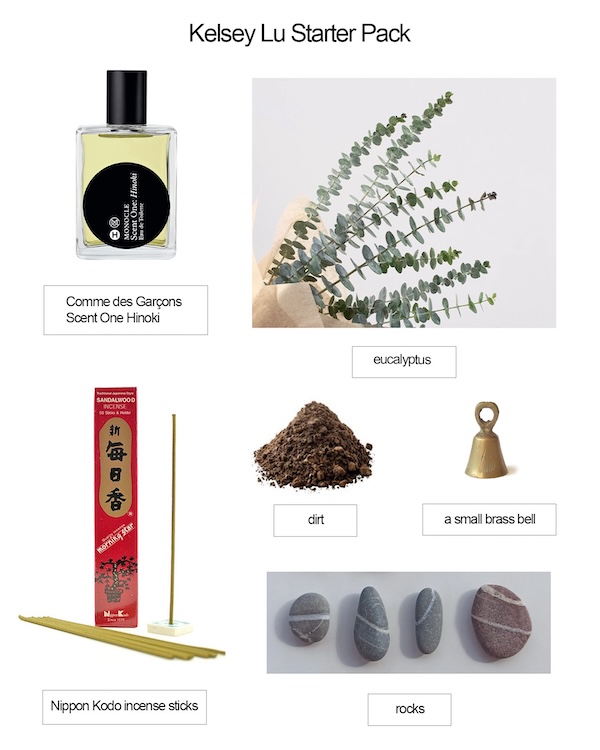
Kelsey Lu starter pack:
This content originally appeared on The Creative Independent and was authored by Yang Shi.