

Illustration by Simone Noronha for ProPublica
It was late May, the French Open was on and DraftKings was pushing me into the action.
A promotion pinged on my phone. “BET & GET,” it boomed, offering to boost my profits if I threw down on tennis, punctuating the point with a cartoon stack of cash. I was already in the middle of a two-hour betting spree, ripping 64 wagers on the clay courts of Paris from my office chair in New York City.
A $75 bet that Claire Liu would win the fifth point of her first set tiebreak against Maria Sakkari? Wrong. How about an easy $300 on Francisco Comesana to win the first game of the second set against Luciano Darderi? Negativo.
I’ll be the first to admit that my backhand needs some work. But this wasn’t about sports. It was about scratching an itch.
For the past six weeks, I’d been gambling like a man out of control, testing the guardrails of one of America’s most popular — and controversial — products: online sports betting. I’d morphed from a prudent, just-for-fun $40 bettor into a “degen” (sports betting slang for a degenerate gambler) who casually yeets $1,500 on a game. I’d feverishly jumped from sport to sport, following playoff basketball bets with live Czech table tennis. And I’d gone hog wild at the online casino, doubling down at the blackjack table. Most of the time, I’d lost — then chased those losses with more bets. Now, I was in the grips of yet another binge.
And as I approached $4,500 in losses in 24 hours, transferring money from my bank directly into my DraftKings account, the company seemed to clock the problem, sending me an in-app notification.
“Take a loss? Now take a beat,” it read. This felt right after the tear I’d been on. To date I’d blown about $12,500 in total on DraftKings. That’s the equivalent of six months of mortgage payments in as many weeks.
I followed the prompt to the site’s “responsible gaming” center, where I opted to limit myself to just two hours per day on the app and barred myself from depositing more than $100 in a 24-hour period. That pause is an essential part of DraftKings’ seemingly paradoxical business model — to make as much money as possible from the nation’s growing ranks of sports bettors without encouraging gambling addiction. The company says these limits are a cornerstone of that strategy.
Yet 30 minutes later, the company pushed me in the other direction. My phone buzzed with the first of four promotional alerts that day. Betting opportunities, they said, were waiting.
What Does Your Data Reveal About Sports Betting Apps?
If you’ve bet on sports with FanDuel or DraftKings, you can help ProPublica understand how these apps work. Use our browser extension to download your betting history, then upload the files to us.
This wink-and-a-nod dynamic is now at the center of a fierce public policy debate over online gambling, addiction and consumer protection.
Since 2018, when the Supreme Court allowed states to legalize sports betting, Americans have put more than $600 billion into play. Sports betting is now legal in 39 states and Washington, D.C. Add in prediction markets like Kalshi and Polymarket, and more people are betting on sports than ever before.
That explosive growth has come with consequences: About a quarter of active sportsbook account holders surveyed by the Siena Research Institute this year said that they’d lost enough on a bet that they’d have trouble meeting their financial obligations. As a result, regulators and lawmakers from Colorado to Massachusetts are starting to question whether things have gone too far — and some are now proposing stricter consumer protections.
Amid the mounting scrutiny, major operators like DraftKings have pushed back, arguing that their responsible gaming system provides adequate safeguards to protect their customers from spiraling out of control. “I think as a business, as an industry, we’re doing a good job of educating people, of raising awareness, of making tools and resources available, of monitoring accounts,” Lori Kalani, the company’s chief responsible gaming officer, told me. If a customer waves too many red flags, she said, the company will proactively close the account. But when I asked how often this actually happens, DraftKings wouldn’t say.
So I decided to find out for myself: If I bet like a compulsive gambler, would DraftKings stop me — even if it cost the company money?
I opened an account under my own name and linked it to my debit card. ProPublica bankrolled me. When the app asked me what I did for a living, I disclosed that I was a reporter. I assembled a panel of addiction specialists, recovering gambling addicts and professional sports bettors who pointed me to the telltale wagering habits of someone who’s out of control. And then I got to work.
Over the next 10 weeks, I’d mimic those patterns and come to find out just how much DraftKings would encourage my recklessness — and just how little pushback I’d get as I spiraled downward.
I used the NBA playoffs as my launching pad, and, like much of New York, I was all in on the Knicks. After a week of moderate betting, I waved my first red flag during Game 3 of the Knicks vs. Atlanta Hawks first-round series.

I slept fitfully after my night of loss chasing and awoke at dawn to catch a train to Boston, where I attended a symposium on online gambling put on by the Public Health Advocacy Institute at the Northeastern University School of Law.
There, Matthew Gaskell, a British psychologist and expert on gambling addiction, said that the bettors that companies are most interested in are, well, losers like me. Indeed, a modest set of very active losers account for a substantial amount of sportsbooks’ revenue, he said. (A 2024 study out of Connecticut found that 1.8% of problem gamblers in the state accounted for 51% of sports betting revenue.) And the companies have created sophisticated technology products designed to squeeze maximum engagement out of them, just as social media companies like Meta did years earlier with users of Facebook and Instagram, added Darragh McGee, a researcher at the University of Bath.
In fact, as The New York Times reported, DraftKings employs machine learning and data scientists to identify losing customers and entice them with promotions to keep them going — even if those are exactly the kinds of customers at risk of becoming addicts. DraftKings told the newspaper its promotions are geared toward users who spend a lot of time on the app and that the company “rejects any implication that its marketing practices are unfair or improperly targets customers.”
To keep users loyal, the major operators offer VIP programs, not unlike what airlines or rental car companies do. As a bettor climbs the tiers, the perks get bigger and better, from free bets and swag to primo seats at games, fancy dinners and even concert tickets. A FanDuel VIP in Pennsylvania received a personalized video message from MLB slugger Bryce Harper.
I wanted to be a VIP. I wanted cool perks.
To help get that status, I’d tapped the skills of Isaac Rose-Berman, a precocious 26-year-old professional sports bettor and policy expert at the American Institute for Boys and Men, a think tank that focuses on policy issues impacting dudes. He had a hunch that by chasing losses and displaying other signs of problem gambling I’d eventually get an invite. We just didn’t know when it would come — or how much it would cost.
It happened sooner than either of us thought.
At 5:01 p.m. the day after I lost nearly $1,800 on basketball in one night, during the closing remarks of the gambling addiction symposium, an email popped into my inbox. “Welcome to the DraftKings VIP Showcase,” the subject line read. I couldn’t believe it. My night of loss chasing was being rewarded.
The VIP showcase is basically a three-week tryout. Every week I’d get a new promotion as the company sussed me out to make sure that I was worthy of the title. It wanted to know whether I was actually a big spender, aka a whale, or a wolf in sheep’s clothing — a pro bettor, like Rose-Berman, who, armed with math, can beat the house more often than most by exploiting mispriced odds. Bettors like these, known in the business as sharps, calculate savvy wagers that have as much to do with sports knowledge as with probability. The apps do not like losing money to them and so limit how much they can bet.
For long-term losers like me, though, those limits don’t apply. I’m not a sharp. I’m a square.
And when I read the fine print of the VIP loyalty program, I was floored to see the incentive structure laid out so plainly: The more I spent on long-odds wagers, the quicker I’d accumulate the credits I needed to advance from tier to tier — from bronze, to silver, to gold, to diamond, to Onyx — and thus get closer to the cool perks I so desired. The upshot? Full send every time, baby!
Before I could get started though, I encountered my first in-app responsible gaming prompt since I began betting.

In just over a week, I’d gambled away roughly what a minimum-wage worker in New York City earns in a month by chasing my losses and repeatedly tapping my bank account. But the notice wasn’t served to me because of how I’d been betting. It was sent because when New York lawmakers legalized mobile sports betting in 2023, they required the apps to notify users when they hit $2,500 in total deposits.
The law also requires sportsbooks like DraftKings to submit a “problem-gaming plan” to the state regulator but leaves the specifics of it up to the companies. The plan must include, among other things, procedures “for identifying users with suspected or known problem-gaming behavior” and for “providing information to users concerning problem-gaming identification and resources.” But the exact details are unclear because such plans are not publicly available. (A DraftKings spokesperson wouldn’t provide a copy, and my request for it under the state’s open records law with the gaming commission is under review.)
The app’s response to my $2,500 in deposits was tepid. With a click I could either set limits on my betting or avoid doing so altogether. Eager to gamble, I clicked “I Understand” and moved on. That was it, warning resolved. I got on the horn with my panel of experts to map out the next phase of my experiment. It was time to up the ante.
One of my advisers, Joshua Grubbs, who studies gambling disorders at the University of New Mexico, said he’d expect to see someone on my trajectory pick up the frequency of his betting, have longer sessions on the app, jump from sport to sport in search of fast action and start experimenting with more exotic betting products, like parlays and prop bets.
OK, I said. Let’s rip some parlays.
Parlays link multiple events into a single wager, drastically decreasing the likelihood of all parts happening while simultaneously increasing the potential payout. They’re enticing, aspirational bets. And, Grubbs was quick to remind me, they’re known by another name: a sucker’s bet.
DraftKings heavily promotes parlays, offering “profit boosts” that juice their potential payouts.
The companies say these bets make watching a game more fun and exciting. They’re a reason to tune in, and hang on, if you’re not otherwise interested in whatever’s on TV.
Do enough parlays, though, and you become seduced by what’s known as the “near miss” effect — a psychological phenomenon in which your brain basically tricks you into thinking you’ve got skill after almost winning.
Mathematically, however, you’re actually four times more likely to get three out of four legs of a parlay, for example, than all four. Yet every time I got close, I wondered if maybe I just needed to tweak my formula, even as my rational brain recognized that I couldn’t hit a parlay to save my life.
Prop bets play on a different dynamic in your brain. They are wagers on a player’s stats or a specific event within a game that’s divorced from the overall outcome. Among the most controversial forms is the microbet, which offers very fast action — who will win the next point in a tennis match, will the next pitch be a strike. Another one of my consultants, Natasha Schull, an anthropologist at New York University and the author of “Addiction by Design: Machine Gambling in Las Vegas,” said microbetting is as close as you can get in sports betting to playing slots, widely considered to be one of the most addictive forms of gambling.
So I followed Grubbs’ and Schull’s advice to escalate my risk-taking as I bet from my living room couch.

Betting on the couch was fun enough, but I was itching to feel what it was like to have money riding on a game being played right in front of me. So in early May, when my neighbor and I went to see the Yankees play, I decided to give betting IRL a try.
It’s hard to overstate how heavy-handed the sports betting messaging in Yankee Stadium is. When I went to get a hot dog, there were ads from DraftKings’ chief rival, FanDuel, on the monitors that displayed the menus.
I settled into my seat, cracked a cold one and logged into DraftKings. It was time for more microbets. When Yankees shortstop José Caballero was up in the fifth inning, I bet $50 that he’d either get a hit or take a ball on his third pitch. I was right! Easiest $95 I’d ever made.
So I kept going — with less success.
I lost $50 on the next pitch to Caballero, then I went 0-5 at $20 a pop trying to guess what Baltimore Orioles center fielder Leody Taveras would do from the box during his third plate appearance. I’d managed to squander my payday in just a couple of minutes.
Schull told me that since there’s so little lag time between placing your wager and getting your result, you can quickly get into a flow of submitting and repeating bets — exactly the kind of trance she observed in gambling addicts pulling slot machine levers. The result, obviously, is that it’s very easy to lose a lot very quickly.
I’d soon find out that DraftKings knows this, too, though its take on microbetting was far less full of doomerism.
Three days after the Yankees game, on May 7, following yet even more parlay losses, the company served me a “responsible gaming” pop-up video — the first I’d been served in the app since the New York-mandated one on April 25.
“Took a loss? Now take a beat,” it read, directing me on how to visit the “My Stat Sheet” page on the app, where I could set a budget or impose limits on my ability to spend. I clicked “Maybe Later,” and the interruption was over.
But DraftKings’ apparent concern for my well-being was belied by a promotion the company sent me just hours later: A 20% profit BOOST on bets of up to $250 for an unlimited number of live microbets on baseball plate appearances. This was exactly the kind of bet that had led me to lose so quickly at the ballpark. Now the company was encouraging me to run it back at even bigger dollar amounts for as many times as I wanted until the promotion expired later that day. “Bet, settle, repeat!” read the push notification that popped up on my phone. I could practically hear the crank of a slot machine lever.


When I described this bet-pause-promote progression to Kalani, DraftKings’ responsible gaming chief, she told me she’d “take that back” to her team for review but added, “I just don’t think we should be drawing broad conclusions from, you know, your single account, what you did.”
A few days later, exactly two weeks after my first big night of loss chasing during the Knicks game, I was formally accepted into the VIP program and assigned my very own, personal concierge. It had taken only three weeks and $5,800 in deposits on the app. My rep said he’d be “keeping an eye out for opportunities and perks tailored specifically” to my account, plus “reminders about Responsible Gaming.”
I could text him directly. I could reach out for special treatment. Rose-Berman explained to me that this meant I could ask for “bonus bets,” free one-time bets using house money, or, more commonly, “deposit matches,” extra house money called DK Dollars, that fattened up my account when I made a transfer from my bank. He said that sportsbooks are happy to provide these freebies to losers like me because they’ve assessed, rightly, that we’re likely to end up gambling it right back — and that the special treatment will keep us loyal. I’d be earning crowns that I could convert to DK Dollars as I climbed the tiers of the loyalty program, which I could use to bet more or buy merch. I couldn’t help but hope that I’d also get the really cool stuff. A personalized video from a major leaguer? Tickets to a game? Swag?
My rapid ascent to VIP at DraftKings made me wonder how its major competitor, FanDuel, would handle a problem gambler like me. So I repeated the behavior there, placing the same kinds of bets at the same odds over the course of a week on their app.
One night I blew $529 on playoff basketball bets and then chased my losses with a $750 wager on professional hockey, backing the Minnesota Wild in a high-scoring matchup against the Colorado Avalanche. When the Avs won and my money was gone, I found the only remaining live action I could: a cricket match between Indonesia and Malaysia.
Like most Americans, I have no idea what cricket is. But whatever. It was near midnight and this was work, so I deposited $500 and tried to put it all on Malaysia. That bet would’ve netted me $11,000 had Malaysia won, but FanDuel wouldn’t accept it and required me to lower my wager amount. When I later asked the company about this, FanDuel wouldn’t say whether it did so because it didn’t want to lose the money or out of a commitment to responsible gaming. In any event, I put $200 on Malaysia instead and, of course, lost.
The app also put some speed bumps in my way over the course of that night, prompting me with “Reality Check” reminders six times that showed me the amount of time I’d been on the app and the amount I’d wagered thus far.

And unlike on DraftKings, my weeklong betting behavior on FanDuel didn’t result in a VIP invite. When I reached out to FanDuel for comment, the company touted its responsible gaming tools. A company spokesperson added in a statement that FanDuel’s program is “designed to identify potential risk early and empower customers with real-time information about their play.” For some customers, the statement said, “trained specialists” will intervene “or apply protective measures, including limits or exclusion,” though the company didn’t say how often that happens and what it takes, exactly, to trigger those measures. The New York Times reported that FanDuel is one of several operators that have signed up with third-party firms that help gauge customers’ risk for problem gambling to curb it. DraftKings is not among them but said it has its own tools.
Over on DraftKings, things were heating up. A month into my experiment I’d already lost $4,671 — enough scratch to buy a used car (with a lot of miles) — and my bet size was growing, too. I was getting used to risking large sums. I looked back on how nervous I’d been to place $200 bets when I first started and couldn’t believe that I’d been so naive.
I’d been wagering so much, in fact, that the quick-tap deposit buttons in the app had increased to $500, $750 and $950, making it even easier to mindlessly transfer large sums from my bank into my DraftKings account.

Computer scientists have a term for this choice of user design: They call it a “dark pattern.” Critics say this is a key way that apps essentially trick you into subscribing to or purchasing things you don’t want or need with just one click.
And boy, was I getting fed opportunities to click. I’d selected the open settings for notifications on DraftKings, and as a result I was just getting pummeled with push alerts to my phone. Sometimes there’d be six in a day, offering BOOSTS. In the app, they’ve even got their own tagline: “BOOSTS DON’T STOP.”

I was hoping for tickets to a game or swag or anything super cool, but so far my VIP rep had hooked me up with only a 12-month ESPN subscription. That and lots of promotions to bet, at all hours. On Saturday, May 16, as I was getting the kids home from my son’s baseball game, DraftKings pushed me an “Exclusive Offer” to double my winnings on any bet up to $250. I pieced together a parlay on the subway, placing the bet as my service cut in and out.
The Yankees were playing the Mets that night, and Rose-Berman had encouraged me to shoot the moon — to climb the tiers of VIP status — so I strung together a five-leg parlay for the full eligible amount. My payout, highlighted in purple at the bottom of my slip, would be $6,250 if it hit.
The Yankees lost, and I hit only one leg of my parlay. As I nursed my wounds I began to wonder: Would I have spent that $250 but for the promotion?
I promise you I wasn’t trying to lose. Sure, I was firing unlikely bets, but I wanted them to win. If you could lose intentionally then you could win intentionally, and gambling wouldn’t exist. Over time most gamblers lose, and like them my performance was trending southward consistently — and fast.
But then, heading into Memorial Day weekend, I got on a hot streak. In statistics, this is called variance, but colloquially we refer to it as luck. Over five days, I notched real wins betting serious cash. After winning $3,869 on parlays from a Yankees game and the thrilling double overtime Spurs win in Game 1 of the Western Conference finals against the Oklahoma City Thunder, I almost forgot that, net, I was still down $8,836. And you know what? I felt like Superman.
To my betting brain, I was flying high. I was hot. I contacted one of my advisers, Rob Minnick, himself a recovering gambling addict who hosts a YouTube channel about problem gambling, and asked what he did after big wins.
He told me to withdraw the deposit I’d made immediately before my hot streak and then bet the winnings left in my DraftKings account with gusto because, hey, it’s just house money.
“I always say on my channel, like all wins are just future losses because when you don’t stop, it eventually gets given back,” he said.
Today, nearly a quarter of all Americans, and half of men ages 18 to 49, say they have an active sportsbook account, according to the Siena Research Institute. And with the advent of prediction markets, millions more are believed to be betting on sports.
But companies like DraftKings and FanDuel don’t just offer sports action: You can also gamble on casino games like blackjack and roulette in the handful of states where that’s legal. The companies call it iGaming, and they want it to be legal everywhere that sports betting is.
“I do think it’s a when, not if, that a lot of these states are going to legalize iGaming,” DraftKings CEO Jason Robins said at a June investor conference. “Customers want it. The tax revenue potential is real. And so we’re seeing a lot of momentum develop in different states.”
New York doesn’t permit that kind of gambling, but New Jersey is one of the roughly half dozen states that does. Since I was headed down the shore for Memorial Day weekend and my DraftKings account was flush from playoff basketball betting, it proved to be the perfect opportunity to try out iGaming.
I logged into my account from the beach on May 22 and was hit with a reminder of the app’s responsible gaming suite of tools, including the option to set a budget. I bypassed the prompt with the swipe of a finger, and there, on the main page, was a shortcut straight to the card table.

I explored the expansive casino offerings: I played roulette and tried out blackjack. The cards were dealt on a table that looked straight out of Vegas but for your phone. I didn’t have to think about how much to wager because DraftKings had already done that for me: With the click of a button I could bet as much as $1,000 per hand. And I was struck by how DraftKings cross-promoted iGaming to the sports bettor.
That included “baseball blackjack” and “basketball blackjack” — a regular deck of cards but instead of a felt card table background, there was a baseball diamond or basketball court.
I didn’t think much of that until after I bet on the Knicks and Cavs in Game 3 of the Eastern Conference finals the next day. At the bottom of the receipt of my bet slip, I noticed for the first time a “Suggested For You” section. Mine advertised baseball blackjack and basketball blackjack. The app was drawing me back to the table.


Not that I needed that hard of a nudge to start playing cards again.
Rose-Berman and I had discussed a strategy for the weekend: To escalate my compulsive betting late into the night, I transitioned from my usual sports fare to even faster, more exotic sports action (read: Czech table tennis) and then, ultimately, to the casino, following the path DraftKings was all but paving for me.
As I devolved in Jersey, Draft Kings promoted me to silver-tier status.

I’d played about 500 rounds of blackjack in a couple of days — accounting for just over half of my total betting activity during 10 weeks on DraftKings. By the end of the holiday weekend, I’d blown close to $3,000 on casino gambling. Before I left the Garden State, I asked my VIP rep whether there was any way to get just the casino stuff off my phone.
Days later he responded, informing me that, no, unfortunately, that wasn’t possible. But he did ask me whether I needed “help with setting in app limits.” I declined the offer.
DraftKings’ Kalani told me I wasn’t the first user to voice this complaint and said the company was working on allowing customers who’d rather just bet on sports to toggle off the casino on their phone.
I came away from my betting mania with an overarching takeaway: that the “responsible gaming” prompts that were served to me were no match for the product design pushing me to do more gambling.
While I was fighting off sleep to play cards, DraftKings occasionally threw me some responsible gaming speed bumps. Just before midnight, for example, a “time reminder” popped up on the blackjack table, telling me I’d been on the app for three hours and 45 minutes.
The pop-ups were barely disruptive: They covered a small part of the screen and could be swept away in a second. The design of the blackjack game, by contrast, facilitated betting big and chasing losses. That’s because DraftKings has made a “Double” button one of the options you’re served after your hand is dealt — literally enabling doubling down in a millisecond with the push of a thumb.


Minnick, who, in addition to hosting a YouTube channel on problem gambling, has co-founded a nonprofit industry watchdog that Rose-Berman advises, told me this dynamic pretty much summed up how he has come to understand the industry’s “responsible gaming” approach.
“It’s like an entire system that’s just built to appear to be doing something good while giving them basically like a free pass to do everything bad by saying, ‘Hey, we told you, you know, you have a responsibility, it’s your fault,’” Minnick said.
In a statement, DraftKings disputed that characterization, saying that all 5,000-plus of its employees are trained on responsible gaming every year and that it’s “not a side initiative. It is embedded across our business and essential to DraftKings’ long-term sustainability.”
But either way, Minnick and others said the framework for protecting consumers shouldn’t be entrusted to a publicly traded company that’s driven to grow revenue. “It’s unfair for us to expect or require a private business to do something that goes against its own mission of generating profit, right?” Minnick said. “Well, if you choose the industry standard, it’s going to be the least effective means.”
By late May, according to my expert panel, I was enthusiastically waving all the red flags of a compulsive gambler. Loss chasing? Check. Regular depositing? Yup. Exotic betting products? Lots of ’em. Long hours on the app and bets of increasing size and frequency? Yes and yes.
Yet the only pushback I got from DraftKings came in the form of responsible gaming prompts that required me to opt in to the app’s tools. The company told me it sent a total of 32 such notices over my 10 weeks of gambling, including emails that every DraftKings customer gets. By my count, I got in-app notifications about my betting on 14 of the 71 days I gambled.
Kalani, who served as DraftKings’ outside lawyer before becoming its responsible gaming chief, says her 51-person team manually reviews user accounts suspected of problem gambling. But I’d never heard from a single one, and I wondered if it was because I wasn’t compulsive enough.
So to erase any conceivable doubts about my status as a problem gambler, I went full “degen,” as sports bettors say when they’re on a particularly wild tear.
This is the moment that I bet feverishly on the French Open. I was fueled with $1,100 I’d won from my second bet ever, on April 16, a $200 wager on the Knicks to win the Eastern Conference finals. Now, six weeks later, I was compulsively betting on tennis, a sport I’d never bet on before. Once I blew my stack, I went straight to the responsible gaming center to set limits on how much I could deposit and how many hours I could be on the app.
The company says it doesn’t want there to be a stigma attached to using responsible gaming tools, but instead wants to encourage its users to budget, impose limits and avoid going off the deep end. DraftKings says millions of customers have visited its responsible gaming center, but the little data available publicly suggests only a small percentage opt into these tools.
As of April, just over 8% of active DraftKings users in Massachusetts were using them, a company official told state regulators this summer. This number was trending up, which was a good thing, the official said.
But when I used the tools, it didn’t take long to see their limitations. Just a half an hour after opting in, I received the first of four push alerts.
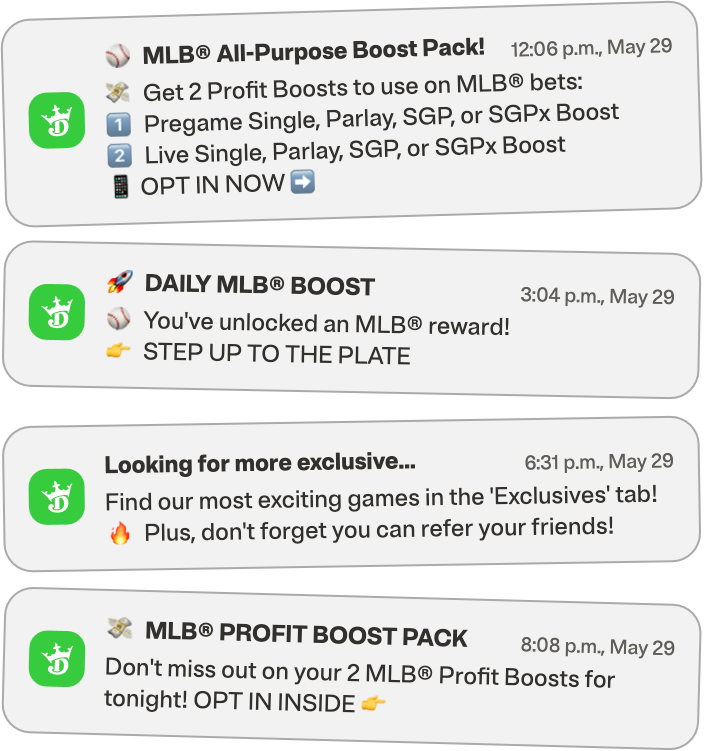
When I asked Kalani if the push notifications undermined my efforts to control myself, she dismissed the issue.
“People use our tools all the time, and they also appreciate being offered the same things other customers are also offered,” she said. “I think they are two very different things.” Besides, she said, those kinds of marketing materials aren’t sent to customers who opt into more severe restrictions, like a “cool-off” period.
I knew she was right about that from firsthand experience because I’d opted into a three-day cool-off after blowing another couple of grand on tennis to really communicate to DraftKings that I was struggling.
When you’re cooling off, you literally can’t log in. I’d picked a torturous time to enroll — the NBA Finals were underway as I was headed to a reunion trip with the college bros. I couldn’t have scripted a more stereotypical scenario for betting. The Knicks were playing the Spurs in Game 1, but I couldn’t get in on the action!
When I emerged from betting purgatory, it did seem like DraftKings had taken its foot off the gas. I wasn’t getting push alerts. Some of the bonus perks the app regularly fed me weren’t available. Even the dark patterns deposit buttons had returned to the default amounts of $10, $20 and $50.
So on June 8, ahead of Game 3 in the Knicks-Spurs series, I texted my VIP host to see what the deal was — and to see how firm the guardrails were. I asked whether I could get some extra DK Dollars in exchange for making a big deposit. I wondered if, given the circumstances, he’d invoke responsible gaming. He responded a day later and initially demurred.
But on the advice of a recovering gambling addict I’d been speaking to, I tried another tactic: asking for a bonus bet — just to remind my rep that I was eager for action.

Not one week after coming off my three-day cool-off, my VIP rep juiced my biggest deposit to date with an extra $1,250 in free DK Dollars.
Kalani told me she didn’t see a problem with this, either. It had been me, after all, and not my host, who first made contact following the cool-off. “At that point, again, you’re a VIP customer, and you’re asking for something that we would give to any customer,” she said.
Overall, “the system worked the way it was supposed to” in my case, Kalani said. The range of behaviors and indicators that DraftKings scans for that trigger closing or manually reviewing an account didn’t ping for me, she said.
While I often played late into the night, I wasn’t playing in the wee-est hours, between 1:30 a.m. and 5:30 a.m., she said.
I found this response revealing, though perhaps not in the way she’d intended it to be. I’d deposited $21,600 into my account in less than eight weeks, exhibiting just about every sign of compulsive gambling there is, according to my expert consultants. By DraftKings’ metrics, I didn’t even register for a manual review. Kalani had told me that the company was motivated to retain customers who were betting “within their means and can sustain their own entertainment.”
So I asked Kalani straight up: Does DraftKings ever cut somebody off purely based on their betting history and not because they’ve disclosed that they’ve got a problem? “Yes, we do that all the time,” she told me. She repeated the same answer when I asked her how often. I pressed again, and a spokesperson interjected, telling me he could take the question as a follow-up. I checked in later, but the company told me that “we do not share the specific number of closures.”
Sportsbooks know how to identify and restrict gamblers’ behavior. In fact, they already do so when it comes to sharp bettors like Rose-Berman. Gaming regulators in Massachusetts who crunched the numbers on this last September found that, on average, just 0.64% of gamblers in the commonwealth were limited as of December 2024 and that, within that group, winning bettors were more likely to have their bet maximums lowered than losers.
Sportsbooks could do the same to losers who are digging deeper and deeper holes. In fact, the Times reported, data scientists at DraftKings had developed a tool to identify customers who were headed in this direction, but the company didn’t adopt it. Kalani told the Times that DraftKings’ existing system for identifying problem gamblers was a “better methodology.”
As it stands, the current system relies on users to opt into setting responsible gaming tools like budgets or time limits. That model restricts the tools’ utility to those who have the wherewithal to police themselves, said Brianne Doura-Schawohl, a gambling reform advocate who lobbies statehouses to impose stronger consumer and public health protections on behalf of the Campaign for Fairer Gambling.
To stem the flow of casual money losing and potential addiction, advocates say, the design should be the exact opposite, requiring users to opt out of setting limits, especially since research shows that gambling can impair decision-making.
The argument about responsible gaming tools, while legitimate, misses an even larger public policy question, Doura-Schawohl added. States that have legalized sports betting derive billions of dollars in revenue from it — even as research shows that gambling disorder diagnoses are skyrocketing in those places. That makes it harder for lawmakers to impose stiffer regulations on specific offerings such as VIP programs or prop bets, like microbets, that are huge sources of revenue for companies and thus state coffers, she said. Other countries have already taken aggressive steps to curb some of the industry’s more problematic products, from marketing practices to advertisements. But in the U.S., the industry has actively opposed proposed reforms in Washington as well as statehouses across the country, and it even seeded a political action committee with $41 million to influence elections this year.
“We want regulations like deposit limits, the reconsideration of microbets. Let’s talk about the inundation of advertising that we’re all sick of,” Doura-Schawohl said. “How do the products themselves impact harm? I think VIP is a big problem with that.”
Midway through June, the unimaginable happened: The Knicks won the NBA championship for the first time in more than half a century.
It’s hard to add anything of substance to the canon of what’s already been written about the historic turn. But what I can say is that from a betting perspective, this was very good for me. My first bet, for $100, was on the Knicks to take home the chip. And ahead of Game 5, I had laid down my biggest bet ever: $10,000 on the Knicks — five times my biggest bet to date. As the city erupted in celebration, my account was as flush as ever, with $25,350. I’d erased all of my previous losses and netted a couple grand in profit.
And as it turns out, I was far from alone.
In fact, so many New York fans went big that the unlikely win resulted in sportsbook operators reporting a $48.5 million loss for the week ending after the Knicks secured the championship, the first time that’s happened since state lawmakers legalized online sports betting.
This confusing series of events presented a wrinkle in my experiment: What does the problem gambler who has been a consistent loser do when, by the grace of God, he comes out ahead?
Minnick, Grubbs and Rose-Berman all had the same answer: He keeps on going. “Congrats on becoming a huge world cup fan,” Minnick texted me.
It was good timing. The 48-team tournament was a major betting event, with billions wagered on the regulated apps alone. DraftKings was eager to get me into the action.
For the first time in the 12 days since my cool-off, with my account newly fat with house money, the company turned back on the push notifications notifying me of BOOSTS and betting opportunities. Between 1 p.m. and 8 p.m. on June 16, for example, I got five alerts pushing me to bet. “Defending champs Argentina start their quest for back-to-back glory,” read one. “Can they score 3+ goals vs Algeria (+180)?…” So I threw myself into World Cup betting with enthusiasm. And guess what? I was winning. A lot.

I was up $16,000 on top of my initial investment — astronomical heights. I frankly started to wonder: What if I was really good at this? What if I kept on winning?
My experts knew better. Winning, and winning big, can actually be dangerous for a problem gambler because it instills in that person a false confidence, a validation of their betting behavior. What I experienced was also a representative snapshot of how it really plays out on a problem gambler’s account.
“Most people’s gambling stories aren’t straight down,” Rose-Berman told me. “The whole point is that so much of the asymmetric downside is caused by the initial upside.”
Do You Know More About DraftKings, FanDuel and Sports Betting?
We’re still reporting. If you are a former or current employee of a sportsbook or prediction market, or know more about the online gambling industry, please contact us.
Jake Pearson
I had to keep going. I was putting more money than ever into play, placing between $3,000 and $7,000 a day on games, going for lucrative, unlikely parlays.
Think about that. That’s well above monthly rent for most people.
But I was hit in the app with responsible gaming prompts on only one of the 10 days that I spent so lavishly on the World Cup, receiving time reminder pop-ups notifying me of how long I’d been on the app, and how much I’d wagered, on June 17.
In fact, DraftKings was egging me on. Because of my VIP status, I’d been able to bet up to $250 to qualify for a profit BOOST. But as I kept spending more and more, DraftKings lifted the qualifying bet amount from $250 to $500 and even $1,000.
I’d recently hit the gold tier of VIP, but I still hadn’t gotten any cool perks as a result of my status. So I texted my host to see if I could get tickets to a World Cup match in New Jersey. No such luck, he said.
That should have been an omen. My fortune was turning.

In all, I’d lost $10,702 and decided enough was enough. I’d eventually withdraw the remainder and return it to ProPublica.
But before closing out my experiment, I wanted to see just how far DraftKings would let me go. So I asked my VIP rep if I could get a match on a (hypothetical!) $25,000 deposit.
If I deposited more, my rep said, he could “look into the account and see what is available to add in.”
The post I Deliberately Bet Like a Problem Gambler. DraftKings Made Me a VIP. appeared first on ProPublica.
This content originally appeared on ProPublica and was authored by Jake Pearson.