
Delhi’s new draft electoral roll has 97,53,577 names. In February 2025, 94,94,607 people voted in the Delhi assembly elections. Eighteen months later, the roll of eligible voters has just 2,58,970, or 2.7%, more names than the number of people who turned out to vote last year.
Now, in 24 of Delhi’s 70 assembly constituencies, the gap has disappeared altogether: The draft roll contains fewer names than the number of people who actually voted in those seats in 2025.
The numbers raise a fundamental question about the Special Intensive Revision (SIR): Has the exercise removed large numbers of people who were genuine, eligible voters and actually cast their ballots in 2025? Or did the electoral rolls used for that election contain a large number of names that should never have been there — including people who had died, shifted or were duplicated? The Election Commission of India (ECI) needs to account for the discrepancy.
An Alt News analysis of constituency-wise data procured and compiled by Mandate Analytics from ECI’s own records shows that the draft roll published on August 31, 2026, under the SIR has fewer names than the number of people who voted in the 2025 election in 24 constituencies.
Delhi SIR in Numbers
The SIR, which began in Bihar in June 2025, has resulted in more than 13 crore names being excluded from draft electoral rolls across 30 states and union territories, according to The Indian Express. In Delhi, the draft roll has shrunk by 58,73,159 names, or 37.6%, compared with the 2025 electoral roll.
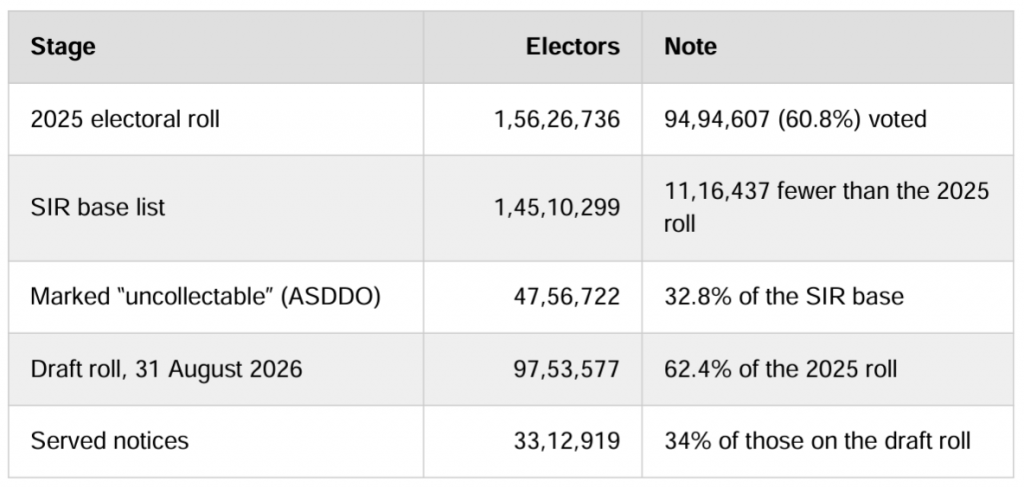
The SIR began with a base list of 1.45 crore names — 11.16 lakh fewer than the electoral roll used for the 2025 election. Every elector on the base list was to receive an enumeration form from a booth level officer (BLO) and return the completed form. Forms that were not returned were marked “uncollectable” and assigned one of the ASDDO categories: absent, shifted, dead, duplicate or other. These electors were then excluded from the draft roll. Across Delhi, 47,56,722 forms, which is nearly a third of the base list, were marked uncollectable.
The exclusions were unevenly distributed. In South East Delhi, an average of 43.5% of the base-list names in each constituency were marked uncollectable, compared with 24.3% in Outer North Delhi.
The 24 Constituencies Which Throw up a Puzzle
In February 2025, Sangam Vihar had 2,05,647 names on its electoral roll, and 1,25,723 people voted. BJP’s Chandan Kumar Choudhary won the seat by 344 votes — the narrowest margin in the city. The SIR draft roll now lists 1,14,412 electors in Sangam Vihar: 91,235 fewer than the 2025 roll and 11,311 fewer than the number of people who actually voted.
The disparity extends across 24 constituencies. A total of 28,89,268 people voted in these seats in 2025, while the SIR draft roll now has just 27,66,145 names. This means that, even under the impossible assumption that every person on the current draft roll voted in 2025, at least 1,23,123 people who actually voted last year are no longer on the draft rolls of these constituencies.
That is a floor, not an estimate of the actual number. The real number of 2025 voters missing from the draft rolls can only be higher.
These 24 constituencies had 49,14,127 electors in 2025, of whom 58.8% voted. The SIR draft roll now contains 27,66,145 names — just 56.3% of the 2025 electorate, below the 58.8% turnout. In Tughlakabad, 56.1% of electors voted in 2025, while the draft roll contains just 49% of the 2025 electorate. In New Delhi, 56.7% voted; the draft roll contains 48.1%.
Across these constituencies, the electoral roll has fallen by 21,47,982 names, or 43.7%, since 2025. Of these, 4,10,759 names were already absent from the SIR base list, while 17,37,223 forms were marked uncollectable during the revision. Tughlakabad has the highest uncollectable rate in Delhi, at 47.8% of its base list.
All seven constituencies in South East Delhi — Jangpura, Kasturba Nagar, Sangam Vihar, Kalkaji, Tughlakabad, Badarpur and Okhla — are among the 24 constituencies where the draft roll is smaller than the number of people who voted in 2025.
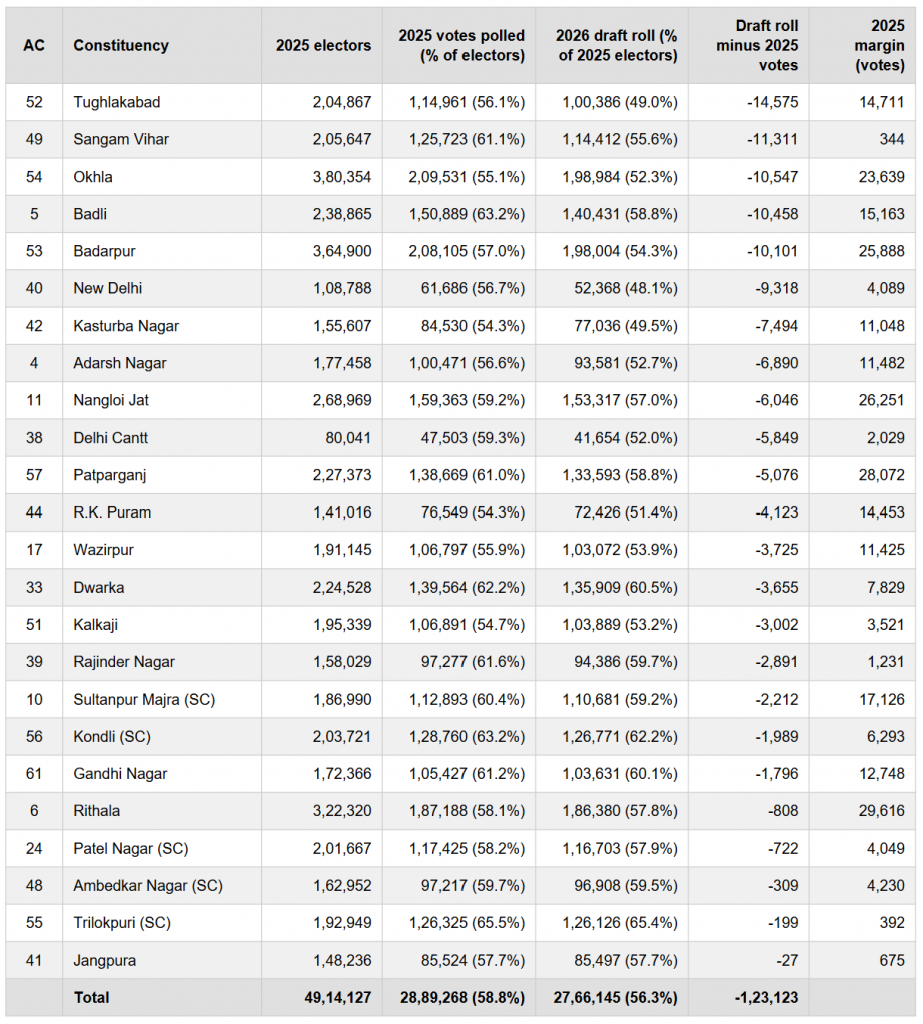
In four seats the gap between the draft roll and 2025 turnout is larger than the margin that decided the seat. These are: Sangam Vihar, New Delhi, Delhi Cantt and Rajinder Nagar. In New Delhi, Arvind Kejriwal lost by 4,089 votes. The seat had 1,08,788 electors in 2025; the draft roll has 52,368, which is 9,318 short of the number of people who voted.
The Cuts are not Over
It is also worth remembering that the draft roll is not the final roll; it is likely to shrink further.
After the uncollectable forms were set aside, a second round of exclusions began. Electors whose names appeared on the draft roll are now being served notices requiring them to produce documents. Those unable to establish their eligibility risk being excluded from the final roll. In these 24 constituencies, 9,78,541 electors — about 35% of those on the draft roll — have been served notices. Across Delhi, the figure is 33.13 lakh.
The impact could extend well beyond these 24 constituencies. If just one in 10 of the electors served notices is ultimately excluded, 39 of Delhi’s 70 constituencies would have fewer names on the final roll than the number of people who voted there in 2025.
The Question the EC has to Answer
In other words, in February 2025, the ECI’s roll for these 24 constituencies had 49.14 lakh names, and 28.89 lakh people voted. Its own revision now leaves just 27.66 lakh names on the draft roll — fewer than the number of people who actually voted in those constituencies 18 months ago. And the roll is still shrinking.
The numbers demand an explanation. Either the SIR has excluded large numbers of genuine, living residents who voted in the 2025 election, or the rolls on which the ECI conducted that election contained lakhs of names that should not have been there. Either way, the discrepancy is one the Commission needs to account for.
It is also, in substance, the same Election Commission. The Delhi election was conducted under chief election commissioner (CEC) Rajiv Kumar, with Gyanesh Kumar and Sukhbir Singh Sandhu as election commissioners. Gyanesh Kumar took over as CEC on February 19, 2025, just days after the results. He has since overseen the SIR exercise.
Questions from Inside the Commission
These numbers come at a time when the SIR is itself facing scrutiny within the Election Commission.
An investigation by The Indian Express, published on September 23, reported that two of the three members of the Commission, Sukhbir Singh Sandhu and Vivek Joshi, objected on record at least 14 times over 10 months to decisions and orders issued during the nationwide rollout of the SIR. In several instances, they recorded that decisions had been taken without their knowledge. The report does not examine Delhi, but one of the concerns it raises is directly relevant to the revision here.
Who decided? The ECI has repeatedly responded to allegations of electoral-roll manipulation by pointing out that rolls in each constituency are prepared and maintained under the authority of the Electoral Registration Officer (ERO), a statutory official. But according to The Indian Express, both Commissioners raised concerns that this safeguard was being weakened. Joshi flagged the increasing centralisation of the electoral-roll database, while Sandhu recorded that state election officials had said they did not have full access to ERONet, the software used to maintain the rolls.
That raises a question for Delhi: when 17.37 lakh names were marked uncollectable across 24 constituencies, and all seven constituencies in South East Delhi were among those with the highest rates, who made those determinations? Were they made by the constituency-level EROs, as the statutory framework envisages, or were decisions being taken or directed elsewhere? The ECI has not publicly explained this.
Alt News has sent questions to the Election Commission of India seeking an explanation. This report will be updated if and when a response is received.
The constituency-level data used in this report was procured and compiled by Mandate Analytics from records published by the Election Commission of India and the chief electoral officer (CEO), Delhi. Alt News independently verified the figures against the original ECI and CEO Delhi documents. The constituency-wise figures for electors issued notices are as compiled by Mandate Analytics.
SIR-related data for Delhi and other states is available at macinsights.in.
This content originally appeared on Alt News and was authored by Ankit Jain.