
The United States has no right to wage war on Iran, or to have a say who governs the country. The opinion pages of the New York Times and Washington Post, however, are offering facile humanitarian arguments for the US to escalate its attacks on Iran. These are based on the nonsensical assumption that the US wants to help brighten Iranians’ futures.
In two editorials addressing the possibility of the US undertaking a bombing and shooting war on Iran, the Washington Post expressed no opposition to such policies and endorsed economic warfare as well.
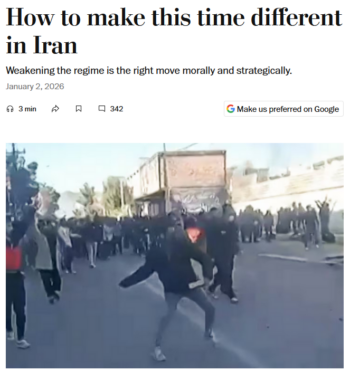
The Washington Post (1/2/26) declared that “Western financial controls are actually working quite well” against Iran—citing Iran’s marketing “ballistic missiles, drones and warships” as evidence of the success of this policy.
Crediting Trump with “the wisdom of distinguishing between an authoritarian regime and the people who suffer under its rule,” the first Post editorial (1/2/26) approvingly quoted Trump’s Truth Social promise (1/2/26) to Iranian protesters that the US “will come to their rescue…. We are locked and loaded and ready to go.”
For the Post, the problem was not that Trump was threatening to bomb a sovereign state, but that “airstrikes are, at best, a temporary solution”:
If the administration wants this time to be different, it will need to oversee a patient, sustained campaign of maximum pressure against the government…. The optimal strategy is to economically squeeze the regime as hard as possible at this moment of maximum vulnerability. More stringent enforcement of existing oil sanctions would go a long way…. Western financial controls are actually working quite well.
Thus, the paper offers advice on how to integrate bombing Iran into a broader effort to overthrow the country’s government in a hybrid war. Central to that project are the sanctions with which the Post is so thoroughly impressed. Such measures have “squeeze[d] the regime” by, for example, decimating “the government’s primary source of revenue, oil exports, limiting the state’s ability to provide for millions of impoverished Iranians through social safety nets” (CNN, 10/19/25).
That the US continues to apply the sanctions, knowing that they have these effects, demonstrates that it has no interest in, as the Post put it, “free[ing]” Iranians “from bondage.”
‘Always more room for sanctions’
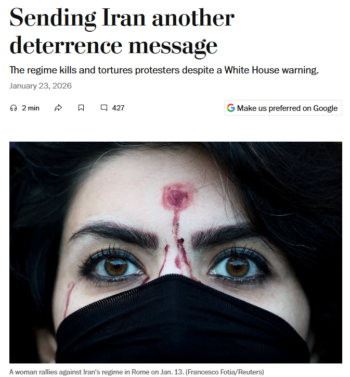
The Washington Post (1/23/26) urged Donald Trump to respond with violence to Iranian gibes, saying, “The president cannot maintain effective deterrence by turning the other cheek.”
The second Washington Post editorial (1/23/26) expressed disappointment that, despite “mass killings” and the “most repressive crackdown in decades,” “Trump has ratcheted back his earlier rhetoric.” It emphasized that “the regime is now mocking Trump for backing down.” The paper offered advice for the president:
Airstrikes alone won’t bring down the regime—or make it behave like a normal country. But Israel and the US have shown in recent years that bombing can cause significant tactical setbacks. And there is always more room for sanctions pressure….
The president cannot maintain effective deterrence by turning the other cheek [in response to Iranians who have taunted him]. How he responds is just as important as how quickly he does it.
The implication is that, to deter Iran’s government from killing Iranians, the US needs to kill Iranians. After all, bombing campaigns come with “mass killings” of their own: The US/Israeli aggression against Iran last June killed more than 1,000 Iranians, most of them civilians.
Meanwhile, those sanctions the paper wants to use to deter the Iranian government from “harm[ing] its own people” do quite a bit of damage in their own right, often causing “low-income citizens’ food consumption” to “deteriorate due to sanctions”—a rather novel approach to harm reduction.
Bombing other countries, depriving them of food—is this what it means to “behave like a normal country”?
‘Too depraved’ for reform
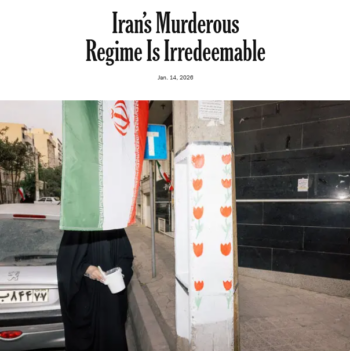
The New York Times (1/14/26) wrote that “Iran’s government has impoverished its own people,” because its “warmongering…led other countries to exclude it from global trade”—making the devastation inflicted by sanctions Iran’s fault rather than the US’s.
Over its own pro–regime change piece, the New York Times editorial board headline (1/14/26) declared: “Iran’s Murderous Regime Is Irredeemable.”
“The Khamenei regime is too depraved to be reformed,” the editors wrote, spending the majority of the piece building its case to that effect before turning to solutions. For the Times, these start “with a unified expression of solidarity with the protesters,” and quickly move to punitive measures against the Iranian government:
The world can also extend the sanctions it has imposed on Iran. The Trump administration this week announced new tariffs on any countries that do business with Iran, and other democracies should impose their own economic penalties.
For the authors, “deprav[ity]” needs to be resisted by Washington and its partners, who have demonstrated their moral superiority with their presumably depravity-free sanctions. These have, as Germany’s DW (11/23/25) reported, “caused medical shortages that hit [Iran’s] most vulnerable citizens hardest,” preventing the country from being able “to purchase special medicines—like those required by cancer patients.”
The Times also supported US military violence against Iran—if with somewhat more restraint than the Post, asking Trump to “move much more judiciously than he typically does.” The Times wants him to seek “approval from Congress before any military operation,” and make “clear its limitations and goals.” The paper warned Trump not to attack “without adequate preparation and resources”:
Above all, he should avoid the lack of strategic discipline and illegal actions that have defined the Venezuela campaign. He should ask which policies have the best chance of undermining the regime’s violent repression and creating the conditions for a democratic transition.
One glaring problem with suggesting that a US “military operation” should be based on “policies [that] have the best chance of…creating the conditions for a democratic transition” is that very recent precedents show that US wars don’t bring about democracy, and are not intended to do so; instead, such wars bring about social collapse.
Consider, for example, US interventions in Libya and Syria. In both cases, the US backed decidedly nondemocratic forces (Jacobin, 9/2/13; Harper’s, 1/16) and, as one might expect, neither war resulted in democracy. In Libya’s case, the outcome has been slavery and state collapse (In These Times, 8/18/20). In Syria, the new, unelected government is implicated in sectarian mass murder (FAIR.org, 6/2/25).
If DHS killed Pretti, why not bomb Iran?
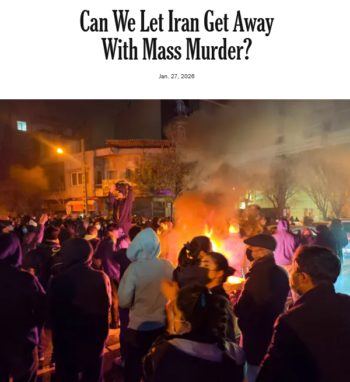
Bret Stephens (New York Times, 1/27/26) warned of the risk of “missing the opportunity to cripple an enemy when it is vulnerable.”
There are no grounds for believing that the US would chart a different course if it bombs Iran again. But that hasn’t stopped other Times contributors from suggesting that the US should conduct a war in Iran—for the good of Iranians, of course.
Times columnist Bret Stephens (1/27/26) worried about the “risk” posed by “the example of a US president who urged protesters to go in the streets and said help was on the way, only to betray them through inaction.”
Invoking the DHS’s killing of Minneapolis resident Alex Pretti, Stephens urged “thoughtful Americans” to encourage the same administration that killed him to exercise “the military option” in Iran:
But if Pretti’s death is a tragedy, what do we say or do in the face of the murder of thousands of Iranians? Are they, as Stalin might have said, just another statistic?
Stephens is citing people’s outrage against the US government killing a protester as a reason they should support the US government inflicting more violence against Iran. The logical corollary to that would be that if you’re opposed to Iran suppressing anti-government forces, you should therefore be in favor of Tehran launching armed attacks to defend protesters in the US.
Masih Alinejad, a US-government-funded Iranian-American journalist, wrote in the Times (1/27/26) that Trump
encouraged Iranians to intensify their mass protests, writing, “HELP IS ON ITS WAY.” That help never came, and many protesters now feel betrayed. Still, the USS Abraham Lincoln aircraft carrier strike group has recently arrived in the Middle East. Mr. Trump has not said what he plans to do now that it is there, but it does give him the option of striking a blow against government repression.
Policy of pain
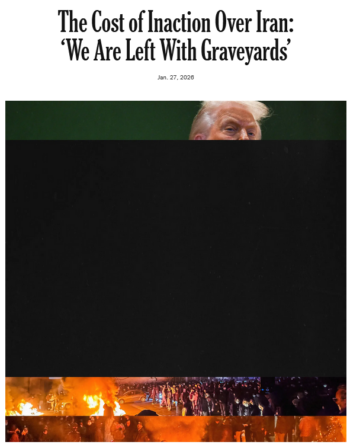
(New York Times, 1/27/26) pointed to protesters waving the Shah of Iran’s flag as evidence that bombing her country might turn out better than bombing Libya did.
Both Stephens and Alinejad present their calls for the US to assault Iran in moral terms, suggesting that the US should demonstrate loyalty to Iranian protestors by “help[ing]” them through an armed attack on the country in which they live. Their premise is that the US is interested in enabling the Iranian population to flourish, an assertion contradicted by more than 70 years of Washington’s policy of inflicting pain on Iranians in an effort to dominate them.
That US policy has included overthrowing Iran’s democratically elected government in 1953 (NPR, 2/7/19), propping up the Shah’s brutal dictatorship for the next 26 years (BBC, 6/3/16; AP, 2/6/19), sponsoring Saddam Hussein’s invasion of the country and use of chemical weapons against it (Foreign Policy, 8/26/13), partnering with Israel in a years-long campaign of murdering Iranian scientists (Responsible Statecraft, 12/21/20), and currently maintaining—along with its allies—a sanctions regime that is associated with a substantial drop in Iranian life expectancy (Al Jazeera, 1/13/26).
If Stephens or Alinejad had evidence that the US is so radically re-orienting its conduct in the international arena, one imagines that they would want to share with their readers the proof that the Trump administration’s magnanimity is so profound that it overrides the UN Charter, and justifies America carrying out a war to “help” a country it has terrorized for decades.
This content originally appeared on FAIR and was authored by Gregory Shupak.

Gregory Shupak | Radio Free (2026-02-10T20:53:49+00:00) Leading Papers Call for Destroying Iran to Save It. Retrieved from https://www.radiofree.org/2026/02/10/leading-papers-call-for-destroying-iran-to-save-it/
Please log in to upload a file.
There are no updates yet.
Click the Upload button above to add an update.