
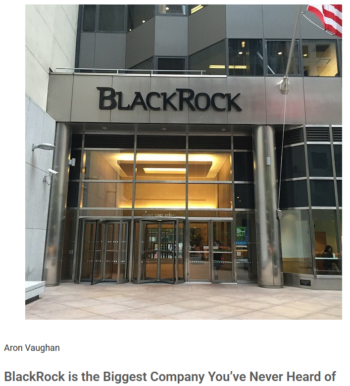
Innovation & Tech Today (7/8/22): “Together, BlackRock and Vanguard own 18% of Fox, 16% of CBS, 13% of Comcast—which owns NBC, MSNBC, CNBC and the Sky media group—12% of CNN, and 12% of Disney.”
Recently, FAIR (2/3/26) took a look at the owners of the biggest online media outlets. It focused on the controlling owners of those outlets, which are mostly publicly traded corporations. But a lot of the money—about $2 trillion dollars—invested in the top 50 online media outlets in the US is not the controlling owners’. Rather, it is possessed by minority institutional investors that manage assets for others.
Take BlackRock, Inc., for instance. Innovation & Tech Today (7/8/22) called it “the biggest company you’ve probably never heard of.” The multinational’s influence comes from the $13.5 trillion it manages on behalf of retirement funds, governments, other corporations and individual investors. That figure is enough to purchase every share of Amazon five times over.
BlackRock is just one of the Big Three US asset management firms. The other two, the Vanguard Group and State Street Corporation, are similarly big financial players. Vanguard manages $12 trillion and State Street manages about $5.5 trillion. Collectively, the Big Three “steward” almost 7% of all of the wealth in the entire world: stocks, bonds, cash, everything, everywhere. And while they are not a cartel, they hold the same interests, by dint of owning a small slice of almost everything.
‘Steely grip and cleareyed vision’
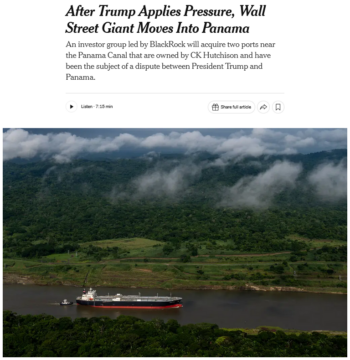
New York Times (3/4/25): “For BlackRock, it’s the latest sign of its desire to expand beyond what it is historically been known for—managing trillions of dollars for everyday investors in stock and bond funds.”
The sheer amount of capital the Big Three can throw around gives them weight. When President Donald Trump went off on an extended tirade about Chinese control of the Panama Canal, BlackRock was there with a solution: “An investor group led by BlackRock will acquire two ports near the Panama Canal,” the New York Times (3/4/25) reported. And when the US economy went into a financial tailspin in 2007–08, BlackRock’s CEO Larry Fink was the person that central bankers and presidents had on speed dial. They’re invested in private prisons and residential real estate and Kellogg’s cereals, to name just a few.
They’re also invested in the media. The Big Three’s holdings in the companies that control the top 50 media outlets by online reach are almost $1.2 trillion out of the $2 trillion mentioned above. They collectively hold almost a quarter of the New York Times’ shares, the same in CNN’s parent company Warner Brothers Discovery, and nearly 30% of News Corp’s, one of the Murdoch family’s main vehicles for right-wing news. That’s typical of their shares in most corporate news outlets: They manage 24% of the shares of People.com’s parent company, 21% of Microsoft, and 18% of Alphabet, the owners of Google.
The Big Three may not own a controlling stake in the New York Times or News Corp‘s Wall Street Journal, but they do have billions of dollars in managed assets riding on the profitability of the outlets.
Predictably, the corporate media they own such a hefty slice of don’t pay a lot of attention to these massive players in the global economy. For example, CNN has hardly any news at all about the Big Three, and what very little it does have is exclusively business-focused.
In a business article on BlackRock’s future, the Times (5/18/24) led with a description of the CEO’s “steely grip, a thick skin and…clear-eyed vision.” The company itself was described as a “caretaker…of investor money” and “a provider of sophisticated trading technology.” It would seem the only substantive problems with one company having so much sway over trillions of dollars are succession at the top, and that it’s “ever harder to find new assets to manage.”
The Times article did not disclose the significant stake that BlackRock has in the newspaper’s parent company, typical of how media report on The Big Three on the rare occasions when they do.
‘Considerable influence on corporate outcomes’
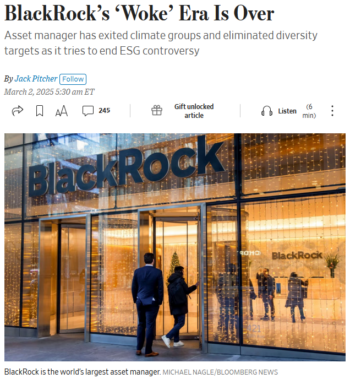
Wall Street Journal (3/2/25): BlackRock, “which was eager to discuss how it could lead on environmental and social issues just a few years ago, has largely abandoned such rhetoric after a series of congressional inquiries and red-state lawsuits.”
These three companies have a lot of power (Business & Politics, 4/25/17), stemming from the advice they give the investors whose assets they manage, and on whose behalf they often act as proxies. By having a seat at the table, the Big Three have a role in helping to select leaders, thereby indirectly setting corporate policy.
Moreover, they heavily influence votes. A Boston University Law Review paper (12/13/22) found that “the Big Three collectively hold more than 20% of the shares of S&P 500 companies and almost 25% of the votes cast at the annual meetings of those companies.” The authors said, “Due to their voting power, the Big Three have considerable influence on corporate outcomes through both what they do and what they fail to do.”
At first glance, this might not seem like the worst thing. In recent years, the Big Three had touted their support for “environmental, social and governance” (ESG) resolutions at various companies, as a means of demonstrating that they take their responsibility to society seriously. These covered topics like closing the gender and racial pay gaps, gender transition benefits and climate change.
For example, under pressure from its clients, BlackRock joined Climate Action 100+, an investor initiative to push for better steps from greenhouse gas–emitting companies. “We believe that companies that better manage their exposure to climate risk and capitalize on opportunities will generate better long term financial outcomes,” the company still says on its website.
The framing here is important, though. At best, BlackRock will only do as much on climate with the $13.5 trillion it has been entrusted with as is in the interests of the actual owners of the capital. The asset managers have a “fiduciary” duty to the investors who actually own the funds at the Big Three’s disposal. This means that they are sworn to act in the best long-term interests of the actual owners of the big chunk of the world’s capital that is at their disposal.
The result is that even as BlackRock was touting its environmentalism, it held one of the largest fossil fuel portfolios in the world. And once it came under pressure for its support for ESGs, it stopped supporting them (Wall Street Journal, 3/2/25), and withdrew $6.6 trillion in assets from being covered by the program. As it now says on its website, “In the US alone, we have invested $225 billion on behalf of our clients in American energy companies, including pipelines and power generation facilities.”
The interests of capital writ large
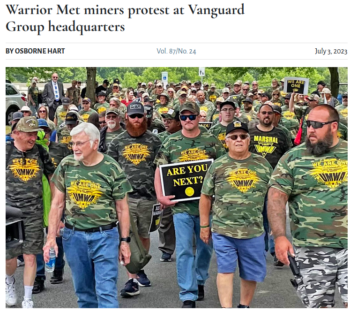
Militant (7/3/23): “Vanguard has the largest holdings in Warrior Met…one of the most profitable U.S. coal companies…. The new owners told miners they had to accept deep cuts in wages, benefits and working conditions or the mine would be closed.”
As Zephyr Teachout writes in her anti-monopoly book Break ‘Em Up:
It is absurd to expect that a common owner of multiple firms in the industry similarly encourages each one of them to steal market share from the other firms in the investor’s portfolio…. Even if [a big investor] promises to remain a quiet (“passive”) investor, basic economic theory and existing empirical results indicate that [their] involvement in the industry is likely to help lessen competition between airlines and further improve their profitability.
Putting the interests of capital writ large above all else is the Big Three’s job. Just ask the miners from Warrior Met, who were told by Vanguard and other owners that they needed to accept deep cuts to pay and benefits, or their mine would be shut down (Militant, 7/3/23). Or Palestinians maimed by weapons the UN Human Rights Office of the High Commissioner says were financed by the Big Three. Or the employees of the roofing contractors that BlackRock and other private equity investors put out of business (New York Times, 11/13/25).
Publicly traded media corporations have always faced structural pressure to act in ways that maximize shareholder value. And while an individual reporter or editor might be inured to this pressure to an extent, the institution as a whole has to respond to it.
The results are corporate media practices that FAIR chronicles on a daily basis: cuts in the name of profits (Disney, Warner Brothers and Paramount have all had layoffs and/or restructuring in recent years), opinions that hew to a narrow spectrum of what’s considered respectable, and a politics that’s insufficient to meet the moment we’re living in.
It’s not that the Big Three control the corporate media through some narrow conspiracy; rather, their holdings illustrate the power that capital has to shape the way we get our news.
Society has broader and different interests than the owners of capital do, and that applies with regard to the media, too. Having a robust news media oriented towards people—even if it doesn’t turn a profit—would benefit us all. But that’s exactly the kind of thing the Big Three—the biggest profitmakers of our society—are not going to get behind.
This content originally appeared on FAIR and was authored by Saurav Sarkar.

Saurav Sarkar | Radio Free (2026-03-06T00:23:29+00:00) Three Massive Funds Control a Chunk of Most Media: Maybe that’s why you might not have heard of them. Retrieved from https://www.radiofree.org/2026/03/06/three-massive-funds-control-a-chunk-of-most-media-maybe-thats-why-you-might-not-have-heard-of-them/
Please log in to upload a file.
There are no updates yet.
Click the Upload button above to add an update.