
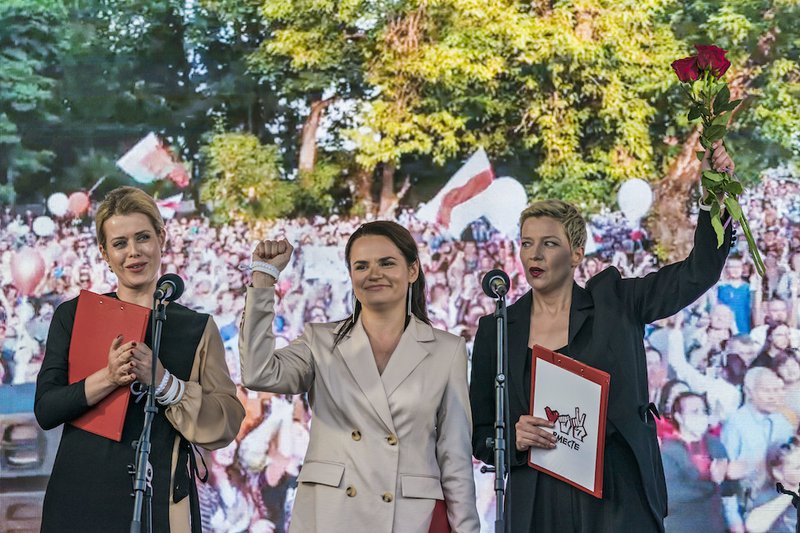
In the end, the Belarusian Central Election Commission was forced to register several alternative candidates – Sviatlana Tsikhanouskaya, wife of the blogger Siarhei Tsikhanouski, Andrey Dmitriyev – leader of the “constructive opposition”, Hanna Kanopatskaya, and social democrat businessman Siarhei Cherachen.
Most likely, the authorities’ logic was that Sviatlana Tsikhanouskaya, an English-language teacher unversed in politics, would be a convenient opponent for the current president. But she became the main rival to Lukashenka early on, and was supported by the Tsepkala and Babaryka teams. Veranika Tsepkala and Maria Kolesnikova, representative of the Babaryka team, accompanied Tsikhanouskaya around the country – the diplomat’s wife and public official giving weight to Tsikhanouskaya’s sincerity.
Many different social groups have united around Tsikhanouskaya – small business owners and workers, young people and pensioners, intelligentsia and big business. The large number of migrant workers – who haven’t made it to Poland or Russia due to quarantine – have also created additional tension for the regime.
It’s worth noting that the Tsikhanouskaya team decided to use an economic programme previously developed by liberal economists for the Belarusian opposition’s “united candidate”. It proposes a far-reaching privatisation of state assets, introducing new employment laws and other anti-social measures. But in the euphoria of struggle against the authoritarian regime, ordinary voters neither see, nor think about this.
In their direct addresses to voters, the “united opposition” does not discuss the prospect of neoliberal reforms. And speaking before 14,000 people in Gomel, Maria Kolesnikova promised the opposite – to “restore workers’ their respect” and introduce workers’ control at Belarusian enterprises.
Bloody Sunday
After voting came to an end on the evening of 9 August, Belarusian police used rubber bullets, flash grenades and water cannons against peaceful protesters, and they led to serious injuries. The police detained both active protesters and passers-by. In the days after 9 August, up to 7,000 people were detained in the country.
According to many testimonies, detainees were subject to beatings during arrest, and then in detention centres afterwards. Official statistics suggest that more than 200 people ended up in hospital, and some of them are still in serious condition. In the city of Pinsk, a man received a firearm wound to the head and is still in a critical condition. At least three people died. And 80 people are still unaccounted for.
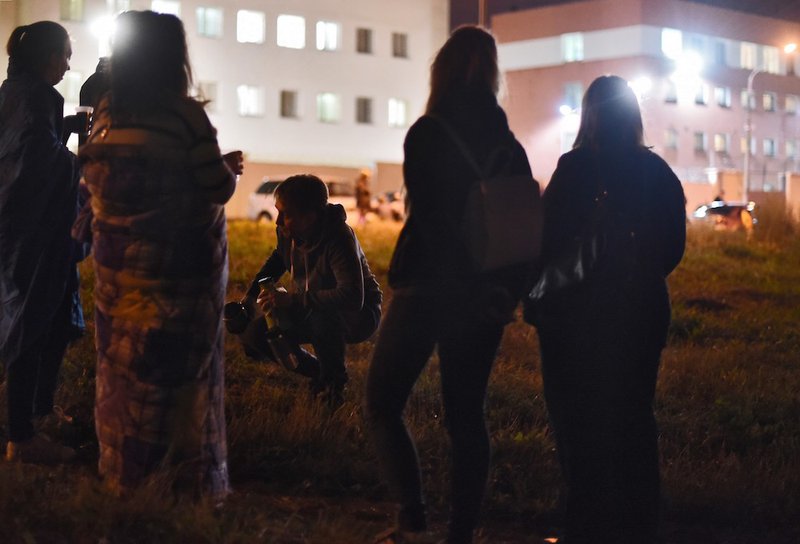 (c) Kommersant Photo Agency/SIPA USA/PA Images. All rights reserved
But even this unprecedented violence did not stop protesters, provoking instead an explosion of civic anger. Women were the first to come out against police terror, and in the week following the election they stood in white on streets and squares of towns across the country, demanding that the violence end. The authorities, it seems, chose not to use police force against them.
On 13 and 14 August, the protest movement shifted to the factories. The first to come out on strike were the Minsk Automobile Plant, GrodnoAzot and the Belarusian Metal Factory in Zhlobin. Then meetings started being held at other factories, largely around demands to stop violence, release those still in detention, and hold free elections. It was precisely these actions by the working class that forced the Belarusian authorities to stop mass arrests of protesters. And after four days of brutal repressions, the authorities ended the widespread persecution of protesters. Interior Minister Yury Karayev apologised for the actions of his subordinates, and arrestees started being released, including before their sentences were finished.
[embedded content]
Workers come out to protest at BelAZ, 13 August.
On Sunday 16 August, mass rallies, unprecedented in their size, were held in Minsk and the other big towns of Belarus. In the capital, between 120,000 and 200,000 people were in attendance. The police did not interfere, and the rallies were held with an atmosphere of a public holiday. In a number of towns, representatives of the administration and law enforcement had to justify the actions of their subordinates in public.
The next day, on 17 August, the strike continued and began to spread. Miners in Salihorsk declared a strike and held a rally in the centre of town. Large enterprises such as Belaruskalii, the Naftan petrochemical complex, Minsk Wheel Tractor Plant, Minsk Tractor Factory, Minsk Automobile Plant, Belarusian Metal Plant and BelAZ automobile plant and the Polotsk glass fibre factory came out on strike or held solidarity actions. The strike committee in Grodno had applications from initiative groups from 22 enterprises in the city, including the local airfield. Journalists from state television also joined the strike, having previously participated in the information war against the Belarusian opposition. Several thousand workers from Minsk Automobile Plant marched to the state television centre.
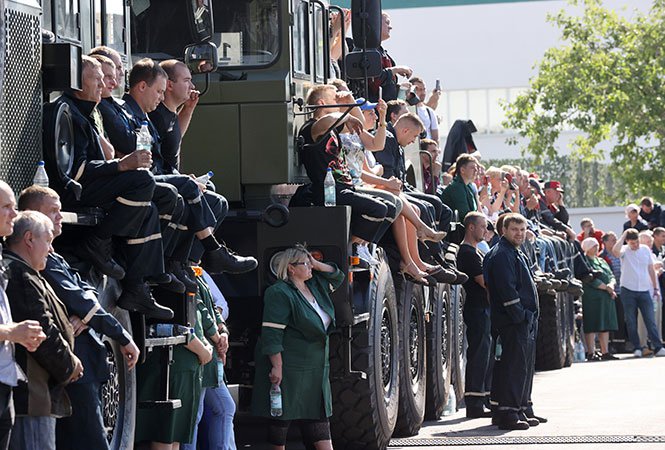 Minsk Wheel Tractor Plant | Source: President.gov.by
In response, Lukashenka visited the Minsk Wheel Tractor Plant, arriving by helicopter. But he was forced to end his speech, which mixed pleas with threats, after workers shouted him down with cries of “Leave!”. Several people were detained in the aftermath. That same day, on the initiative of Tsikhanouskaya, a new opposition Coordination Council on transferring power was set up, and similar councils were formed around the country – and Lukashenka made some vague promises to change the Belarusian constitution via referendum and then hold elections.
Locked in political struggle
But do protesters have enough real power to carry out these demands? Despite the rise of the protest movement, it’s not so clear cut. In the majority of cases, enterprises have not gone out on strike. Instead, at state enterprises workers are mostly holding public meetings, resolutions and marches. At many plants, management still has the situation under control – for example, at Gomel’s largest factory, the Gomselmash agricultural equipment manufacturer, workers are simply being locked in their workshops.
[embedded content]
Gomselmash, 18 August 2020.
The mobilisation of workers to protest has often happened spontaneously, and independent trade unions have long held a “wait and see” position, joining the struggle slightly late. Their influence, it should be said, is extremely limited due to resistance by management. The people who initiated the mobilisations are mostly young workers at the big Minsk factories. In this regard, workers who are older, or who work in the provinces, are more conservative and inert.
Liberal ideologues and commentators are also forcing a purely political agenda onto workers. The Belarusian Independent Trade Union has already announced the creation of a National Strike Committee. Yet it often seems that people who speak for this committee have no relationship to the labour movement. If strike committees do put forward socio-economic demands – for example, an end to the fixed-term contract system or cancelling the pension age rise – then opposition media do not report it. Business, meanwhile, has announced a campaign of material support for striking workers.
Moreover, a new Marxist Telegram channel (“StrikeBY”, “ZabastovkaBY”) has been set up, which proposes more clear class demands for Belarusian workers. Aside from the demand to recognise the presidential elections as false, this channel proposes to ban privatisation, an end to the fixed-term contract system, the pension reform and the “social parasite” tax, and establish workers’ control at state enterprises. But the influence of this group among workers is limited.
A few weeks before the elections, a conference of left-wing parties and trade unions was held in Minsk – the Just World left-wing party, the Belarusian Green Party, the Belarusian Social Democratic Party (Assembly), Marxist group Common Cause, the Belarusian Congress of Democratic Trade Unions, the Independent Union of Metal Workers and several other organisations. The conference agreed to put forward a joint demand to the alternative candidates to include socio-economic demands in their agenda. Unfortunately, due to disagreement between Just World and the Green Party (of which I am the deputy chair), the conference was unable to agree the final text: the Green Party passed a separate social resolution; the social democrats chose to support Tsikhanouskaya’s liberal programme.
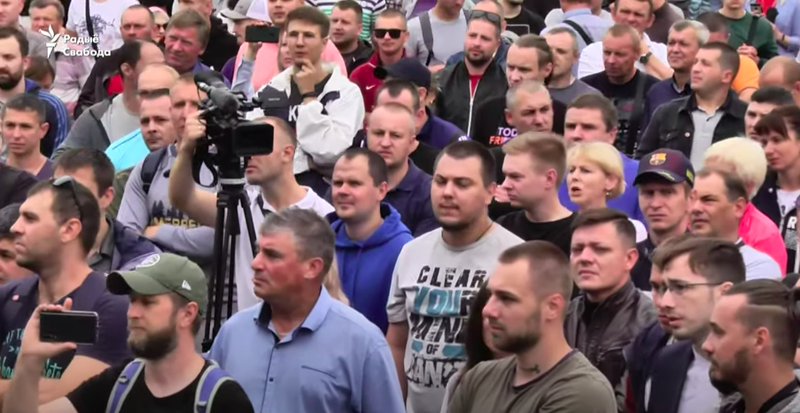 Workers at Belaruskalkalii, 18 August | Source: Radio Svaboda / YouTube
The Coordination Council, now targeted in a criminal investigation, has hardly any delegates from Belarus’ state enterprises, and is mostly made up of representatives from the liberal intelligentsia, including Nobel laureate Svetlana Alexievich, creative professions, business and centre-right opposition parties. Of course, neoliberal reforms remain a priority for them, though they don’t wish to advertise this too strongly in front of most protesters.
The regime has also started actively mobilising their supporters, and one of the central themes of official propaganda has been privatisation. In Belarus’ largely state-owned industry, people are afraid of being left without a job, and the authorities are playing on that fear. The Coordination Council has already publicly distanced itself from the “anti-Russian” section of its programme. But no one in the Coordination Council is in a hurry to distance themselves from neoliberal reforms. And this significantly reduces protest potential in the country.
Moreover, there are several voices on the National Strike Committee that suggest that workers have not come out “for money”, while some in the liberal camp have put forward similar ideas. Despite its apparent idealism, these messages ignore the social component of worker unrest – and serves the true interests of the country’s liberal bourgeoisie. Similar messages were put forward during Ukraine’s Maidan.
In his previous speeches, former banker Viktar Babaryka and other candidates have tried to give a populist slant to the prospect of mass privatisation. In their opinion, workers who lose their jobs as a result of privatisation will be able to retrain and requalify via state-supported programmes, joining the ranks of small and medium-sized business. The outcome of this proposal for many is clear.
The problem of business in Belarus is not that the state “suffocates” businesspeople. In fact, the government has long limited audits for business. Small business owners, much like the economy as a whole, suffer from high levels of competition, including from transnational corporations, people’s low purchasing power, and global economic crises. The promise to make Belarus’ economy “blossom” by turning millions of workers into individual entrepreneurs is a reactionary utopia. But as political advertising, it finds support among entrepreneurs and young people.
The variety of social forces involved in Belarus’ protests guarantees a broad front, but it also makes this coalition internally fragile. Today, the authorities and their opponents are locked in a political grapple. On the one hand, Aliaksandr Lukashenka, the state bureaucracy and sectors of big business connected to it. The more inert parts of society are also on their side. And then you have a broad spectrum of social groups, from liberal entrepreneurs, workers and service personnel, as well as even some public officials. They have a common aim: democratise the country. But it’s hard to forget that the true interests of the “progressive bourgeoisie” and workers are not the same.
The outcome of the standoff in Belarus is far from being decided. But in any case, the country will never be the same. The authoritarian model of power has entered the most serious crisis in its existence.
Print
Yury Glushakov | Radio Free (2020-08-21T00:00:00+00:00) “Belarus will never be the same”. Retrieved from https://www.radiofree.org/2020/08/21/belarus-will-never-be-the-same/
Please log in to upload a file.
There are no updates yet.
Click the Upload button above to add an update.