
Janine Jackson interviewed Institute for Policy Studies’ Sarah Anderson about “successful” corporations paying poverty wages for the April 17, 2026, episode of CounterSpin. This is a lightly edited transcript.
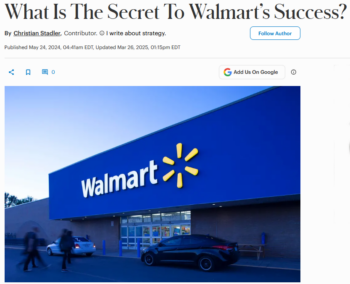
Forbes (5/24/24)
Janine Jackson: In 2024, Forbes asked, “What Is the Secret to Walmart’s Success?” The answer:
Walmart’s strategy is boring but reliable. The foundation is provided by the scale of the business, creating the fuel necessary to maintain cost leadership.
In 2025, the Economist explained to readers “How Walmart Became a Tech Giant—and Took Over the World.” The answer, well, founder Sam Walton, a “trucker-capped, pickup-driving penny-pincher,” had a simple idea: “Keep costs low, pass savings on to customers, win market share, harness scale to further lower costs, and listen as the cash registers sing.”
Early this year, Inc. Magazine gave us “One Bold Decision Helped Make Walmart a Trillion-Dollar Company.” That story says:
Most experts see the company’s tremendous growth as a triumph of technology, including AI, and that’s certainly true. Walmart has used its heft, highly efficient warehouse network and the ubiquity of its stores as a competitive advantage.
But oho, the shocker, the big reveal, is that former CEO, Doug McMillon, “visited Walmart stores and asked the people working there what they needed. He listened to their answers and he started paying them more.”
Well, I hope you’re sitting down for this: “To begin with, every associate, as Walmart calls employees, would earn at least $9 an hour and soon move up to $10 an hour.” McMillon took home $27.4 million in 2024.
Inequality.org (3/4/26)
That the same media that herald companies like Walmart for supposedly building a better mousetrap, and getting their rightful riches, also complain about government spending on public assistance programs like SNAP encapsulates a certain media mythology that needs puncturing.
And that’s just what a new report does. “America’s 20 Largest Low-Wage Employers and the Affordability Crisis” is out from the Institute for Policy Studies, and we’re joined now by its author.
Sarah Anderson directs the Global Economy Project at the Institute for Policy Studies, and co-edits the IPS website Inequality.org. She joins us now by phone; welcome back to CounterSpin, Sarah Anderson.
Sarah Anderson: Really great to be here. Thank you.
JJ: Media talk about companies as not just successful, but as evidence that profit-driven capitalism—and the deregulation that enables it—really is the best thing for everyone, because, look, they’re providing a product or a service; they’re creating jobs. So, really, any criticism is wrong, and maybe just jealousy.
Your new report is not about a small, ancillary thing that companies could improve on. It really drives a stake through the heart of this mythology. So tell us, what did you look at, and what did you find?
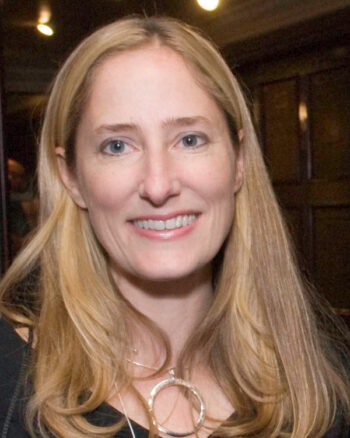
Sarah Anderson: “The rest of us are affected, because it’s our taxpayer money that is going into those public assistance programs that these companies are using to make this model workable.”
SA: Yeah, well, just continuing with the Walmart example, you mentioned that the CEO made $27.4 million in 2024. So, yeah, if we criticize that, then sometimes people will say, “Oh, you’re just envious. You want to make that amount of money, and it doesn’t have anything to do with you, so why should you complain?”
Well, it does have to do with all of the rest of us, because, for one thing, Walmart and many other large US corporations are really based on a business model that extracts wealth from low-wage workers and funnels it up to guys like Doug McMillon. And they are paying their low-level workers so little that many of them have no choice but to rely on public assistance.
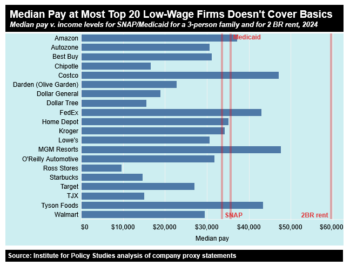
And so that’s what our report looks at, is the 20 largest US corporations with the lowest median worker pay, and we found that the vast majority of them have median pay that’s so low that a worker at that level would qualify for Medicaid for a family of three. Most of them would qualify for SNAP food aid benefits.
And what that means is that not only are workers getting the shaft from this business model, that it’s all about keeping wages at poverty levels at the base to overpay their CEOs, but the rest of us are affected, because it’s our taxpayer money that is going into those public assistance programs that these companies are using to make this model workable.
And I think that this is a big part of the current affordability crisis that so many people are talking about, as they struggle with the rising costs for things like housing and groceries. And there’s a lot of focus on how can we bring these costs down, but we’ve also got to look at why do people have so little money in their pockets in the first place, and that’s because of wage suppression by companies like Walmart.
JJ: I just want to say, if we can say “poverty-wage business model,” like 10 times; I want that to enter the lexicon.
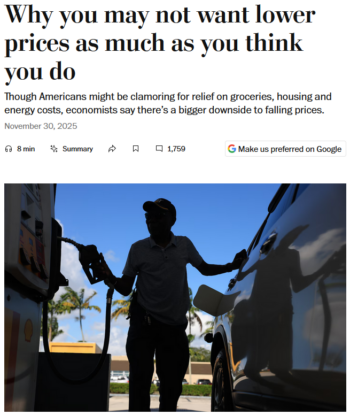
Washington Post (11/30/25)
But I feel like some media feel like they found a hack. The Washington Post had a thing a few months back, “Why You May Not Want Lower Prices as Much as You Think You Do.”
And I get it. They’re saying prices are one factor, and we have to look at other factors. But if you just report it that way, “Oh, you’re so dim, you want prices to go down. You don’t understand how the economy works.” It’s like giving the ball score, “Yankees four.”
There are other elements of course at work here, and this is in a context, as the report lays out. It’s in a context of cuts to benefits, union participation, stock buybacks. There’s a lot going on here that is part of the affordability crisis, yeah?
SA: Absolutely. And the companies are saying, “Oh, with rising costs for so many things, we have to pass those costs on to customers, or we have to cut jobs. There’s no other way to find money to cover these things”—when, if you look at what they really are spending money on, these 20 companies altogether have been on a massive stock buyback spending spree. Altogether, let’s see, I think it was over $200 billion over the past 20 years.
Some companies are just completely outrageous examples, like Home Depot spent $38 billion on stock buybacks over the past six years, and every dollar that’s spent on stock buybacks—first of all, I should explain what they are. This is when companies go out and repurchase their own stock on the open market, and when they do that, it artificially inflates the value of their shares, because they’re reducing the available supply.
IPS (3/4/26)
And what that also does is it inflates the value of their CEO paychecks, because CEOs get most of their compensation in some form of stock-based pay. And every dollar that’s spent on those buybacks is a dollar that’s not spent on worker wages.
And so at Home Depot, if they’d taken all the money that they spent on buybacks over the past six years, and instead gave it to their workers, they could have given every one of their 419,000 US employees a $15,000 bonus every year for those six years.
At Lowe’s, Home Depot’s competitor in the home improvement field, the figures are even more insane. I think that they could have doubled the level of median pay at that company if they had spent money on worker wages instead of stock buybacks.
So it’s not that these companies don’t have the resources to be paying something other than poverty wages; it’s that they’re choosing to use their resources to enrich those at the top.
JJ: It’s so important to indicate that these are choices. When you read economic reporting, it’s often like, “They had to pass the cost on to customers.” Like they had to. No, these are choices. These are priorities that are being made. We could talk about them that way.
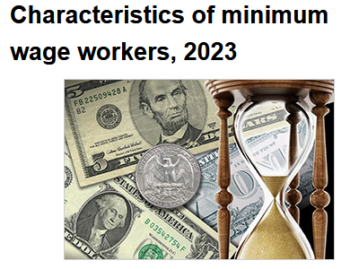
SA: Absolutely. They also say, “Well, of course pay is low at these companies, because the workers are mostly part-time.” Again, that is a choice, to have a business model that’s based on an overwhelmingly part-time workforce, which comes with all kinds of costs. It tends to contribute to higher levels of turnover, and people not feeling as invested in their workplace.
And so there’s all kinds of business arguments as to why it might make more sense for them to have more full-time employees with benefits, but it’s a choice. They want more part-time workers so they don’t have to pay benefits, so they can keep their labor costs down. So it is a choice. It’s not just something like the weather, that just happens out of their control.
BLS Reports (5/24)
JJ: Right. And it’s a storyline. It’s such an old storyline: “We don’t need to pay fast food workers a livable wage because they’re teenagers, and they’re just getting pick-up money to go to the movies.” And it’s so outdated and unrealistic. And I have such frustration with the unending power of these narratives.
SA: Exactly. There’s such a large share of these low-wage workers are parents, many of them single parents, who are really struggling to make ends meet. We’ve talked about our country’s largest private-sector employer, Walmart, but if you look at Amazon, too—we were able to get data from a handful of state governments that report how many employees big companies have on public-assistance programs.
The state of Nevada actually is the only one that reveals this information for Medicaid, and Amazon had 8,900 employees in Nevada on Medicaid, and that was 48% of their whole workforce. So imagine that, they’re the second-largest private-sector employer, with a gazillionaire founder in Jeff Bezos. They’re generating enormous wealth for people at the top, and yet 48% of their employees in this one state are on Medicaid.
JJ: OK. I’m going to need to talk to you more about this, I suspect, but for now, I just would ask you, what could happen today, tomorrow, policy-wise, legislatively? What could happen that could start to address this situation?
The Nation (3/11/26)
SA: Yeah, there’s a lot that could be done. First of all, raising the federal minimum wage, which has been stuck at $7.25 an hour for 16 years now. We could strengthen our labor laws, so that workers like the ones at Amazon and Starbucks that have voted to unionize about four years ago now, but still don’t have a first contract because our protections for union rights are so weak, and these companies have just used every trick in the book to undermine the desires of their employees to be members of unions to bargain collectively for better pay.
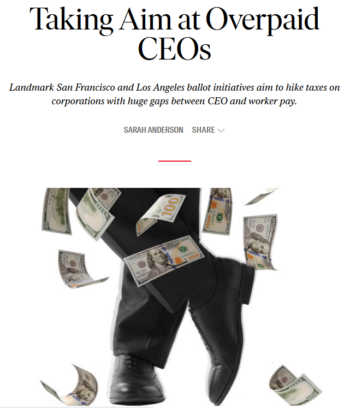
And then I’m very excited about efforts to also use the tax code to address this issue of overpaying CEOs and underpaying workers. And this year, there are ballot initiatives moving ahead in both Los Angeles and San Francisco that would raise local taxes on businesses based on the size of the gap between their CEO and their worker pay, as an incentive for them to either narrow those gaps by lifting up worker pay or bringing down CEO pay, or, if companies refuse to do that, and want to stick with the status quo of having really large pay gaps, then they would pay more taxes into public services and infrastructure that is so needed by so many states and cities because of the federal cutbacks in funding.
JJ: All right, then. OK. We’ll end there for now, but I suspect I’ll be talking with you again soon.
Sarah Anderson directs the Global Economy Project at the Institute for Policy Studies, and co-edits the IPS website Inequality.org. The report we’re talking about is “America’s 20 Largest Low-Wage Employers and the Affordability Crisis,” and I encourage you to check it out.
Sarah Anderson, thank you so much for joining us this week on CounterSpin.
SA: My pleasure. Thank you.
This content originally appeared on FAIR and was authored by Janine Jackson.

Janine Jackson | Radio Free (2026-04-20T22:04:44+00:00) ‘It’s All About Keeping Wages at Poverty Levels to Overpay Their CEOs’: CounterSpin interview with Sarah Anderson on poverty wages. Retrieved from https://www.radiofree.org/2026/04/20/its-all-about-keeping-wages-at-poverty-levels-to-overpay-their-ceos-counterspin-interview-with-sarah-anderson-on-poverty-wages/
Please log in to upload a file.
There are no updates yet.
Click the Upload button above to add an update.