
Janine Jackson interviewed Fight for the Future’s Lia Holland about the Internet Archive’s Wayback Machine for the April 17, 2026, episode of CounterSpin. This is a lightly edited transcript.
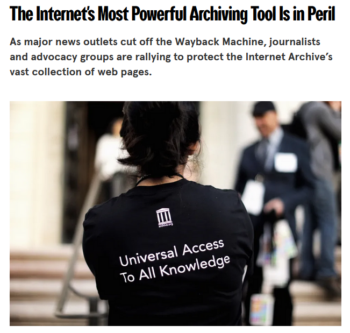
Wired (4/13/26)
Janine Jackson: A recent report by Wired‘s Kate Knibbs leads with the contradiction: USA Today published a story recently on how ICE is misinforming about its detainment policies, a case that the paper built on data from the Internet Archive’s Wayback Machine, a nonprofit digital library that preserves webpages.
At the same time, USA Today bars the Wayback Machine from archiving its work. Along with outlets like the New York Times, the paper is trying to block the Internet Archive project from doing their job of preserving reporting.
So what’s going on here? Here to catch us up is Lia Holland, a social artist, writer and activist, and campaigns and communications director at the group Fight for the Future. They join us now by phone from Oregon. Welcome to CounterSpin, Lia Holland.
Lia Holland: Thank you so much. It’s great to be here.
JJ: Please fill out our understanding a little more of what the Wayback Machine is and does. It seems like, particularly in these times, a critical information resource.
LH: Absolutely. And that’s why my organization is so engaged with this issue. The Wayback Machine, for 30 years this year, has been the best and most reliable archive for preserving our digital lives, culture, recording and history. They archive nearly 5 million links on Wikipedia to news articles, and are a trusted resource for journalists all around the globe to investigate everything from corruption, to report on culture, to really do their jobs. And, unfortunately, that is under threat now.
JJ: Let’s talk about what’s happening now. What is the crisis, if you will, and why is it of particular concern? You’ve tipped it, but why is it of particular concern for what I have seen called “accountability journalism,” but I think is just journalism?
Pluralistic (2/9/23)
LH: Yeah. Most journalists do work to hold the powerful to account. And I think that that is a part of the factor in what’s happening in this moment.
So since February, the Wayback Machine has not been able to archive the New York Times. And there are other major publications like this that have told them to stop preserving all of their journalism. And this is happening for reasons that I can only speculate on, but it seems that many of these major media outlets are very interested in packaging up their content to sell for AI training, and they’re concerned that sharing it with the Internet Archive somehow weakens their product, or weakens their stance on whether or not AI training is a copyright violation in various lawsuits.
I’m not quite sure why they’re doing it, but the reality is that blocking the Wayback Machine, and saying, “No, there can be no independent, unimpeachable record of the news anymore,” is not going to stop AI from doing whatever it’s going to do. What that does is destroy a resource that every working journalist that I speak to has relied on in order to do their job.
JJ: Right. We can be forgiven for pausing, if you will, on the notion that the same outlets that are pushing AI in our face at every turn are also saying, “Oh, we’re concerned about the Wayback Machine because it might be training AI, and we really don’t want that. ” That just doesn’t pass a sniff test. It sounds more like they want to be in charge of the way that AI is used, in terms of their historical records.
LH: Yes, and also want to be in charge of what the public record is. Frequently, the Wayback Machine is used for accountability at publications like the New York Times. They will change the content of articles, or take things down, just like any corporation that is archived on the Wayback Machine. And I would say there are many powerful people who would rather there never be a record of what they said or did.
JJ: Absolutely. It’s the longitudinal aspect of it that is the value. And in this Wired piece, a labor organizer talks about how they used old job listings to check against what their company was offering at that time, and what they’re offering now. That’s not something that you can get if you don’t have access to archived or older material, right?
LH: Absolutely. And another thing that I think is important to point out is that the Internet Archive works directly with journalists and with news organizations. Their goal is to preserve respectfully, and to not negatively impact the bottom line at these companies.
People sometimes conflate the Internet Archive and the Wayback Machine with archive.is, or these other paywall-jumping tools that people use. And it’s unfortunate, because that’s not what the Internet Archive is doing, or what the Wayback Machine is known for, or what it’s regularly used for. And so I think that that misconception also is really harmful when it comes to the public, and also these decision-makers choosing whether or not they want the archives to continue to do what it’s been doing for 30 years.
JJ: Spell that out just a little bit more. What does it mean to work with journalists, rather than not do that? What does that look like?
LH: I got to peek behind the curtain a little bit as a part of this campaign. It was very cool.
So at any given time, there are employees at this nonprofit that are working directly with journalists who are investigating very important stories, people at every globally renowned media outlet digging through the archives of what is stored in the Wayback Machine, with assists from employees. And there are countless articles, over the course of a year, that reference what that journalist has found in the Wayback Machine. I think that there’s several to a dozen a day, at times, where the Wayback Machine was used as a source.

Lia Holland: “DOGE set a goal of eliminating 20% of government websites, whereas everything that’s been deleted now is living in the Wayback Machine.”
JJ: And this is government data, not just journalism, but all kinds of information, yeah?
LH: Yeah. The Trump administration, I believe, or DOGE, set a goal of eliminating 20% of government websites, whereas everything that’s been deleted now is living in the Wayback Machine. And I think that’s also really important for corporate accountability reporting, where what they said in a press release that’s been removed, and things like that union organizer you mentioned, what was promised and what was actually delivered.
JJ: It seems, I mean, it’s existential. Even beyond journalism, this is about collective memory. This is what we’re allowed to know that happened. I feel like we’re so many iterations beyond Orwell at this point, but clearly an entity that’s invested in erasing our memory, we should be fighting against that.
So I would just say, finally, is there a way for folks to plug into this, even if it’s just to say that they value the work that the Wayback Machine does?
LH: Yeah, absolutely. The biggest thing that I’m doing in this moment, in collaboration with the Internet Archive and journalists, is I’m collecting signatures from anyone who is a journalist or has worked as a journalist at SaveTheArchive.com/Journalists. Any journalist, student journalist, radio journalist, if you’re a podcaster, it doesn’t matter what medium you work in, this resource is important to you. Go sign that letter that’s been signed by well over a hundred journalists, including Rachel Maddow, Cory Doctorow, big names.
And if you are not a journalist, and you are a subscriber to any major news outlet, or even your local newspaper, send them a note, let them know how much you value the Wayback Machine, and that you really hope that their work continues to be preserved in it. I think that expressing our disagreement with the idea that we cannot be the keepers of our own history, and that we can’t have access to the record of our digital lives, is the crucial thing to do right now.
JJ: We’ve been speaking with Lia Holland. You can find Fight for the Future at FightForTheFuture.org. Lia’s site is LiaHolland.com. Lia Holland, thank you so much for joining us this week on CounterSpin.
LH: It’s been a pleasure. Thank you.
This content originally appeared on FAIR and was authored by Janine Jackson.

Janine Jackson | Radio Free (2026-04-22T15:34:51+00:00) ‘The Wayback Machine Has Been the Best Archive for Preserving Our Digital Lives’: CounterSpin interview with Lia Holland on the Internet Archive. Retrieved from https://www.radiofree.org/2026/04/22/the-wayback-machine-has-been-the-best-archive-for-preserving-our-digital-lives-counterspin-interview-with-lia-holland-on-the-internet-archive/
Please log in to upload a file.
There are no updates yet.
Click the Upload button above to add an update.