
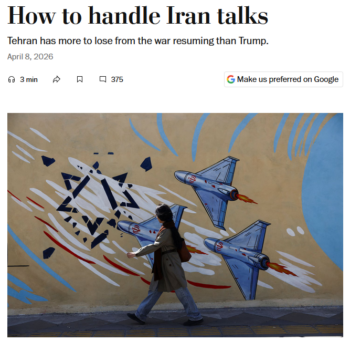
The Washington Post (4/8/26) asserts that “the Islamic Republic stands to lose more from the war resuming than Washington does”—though Trump’s plummeting approval ratings might suggest otherwise.
In the wake of the temporary US/Iran ceasefire, hawkish commentary in leading American newspapers advanced the premise that the US can dictate terms to Iran in negotiations, with a faith in the power of Washington’s military might that was hard to justify by the previous course of the war.
A Washington Post editorial (4/8/26) contended:
Despite the massive damage inflicted upon the country by the US in recent weeks, the regime acts like it holds the cards. Its leaders are demanding the US pull all troops out of the Middle East and accept Iran’s right to pursue nuclear weapons. The question is why Trump would bend over backward to keep obviously unserious talks on track.
Whether the Post likes it or not, Iran has a decent hand to play. For instance, Iranian drones cost just $20,000 to produce, and the US uses missiles that cost $4 million each to try and destroy them (Bloomberg, 3/2/26). Less than three weeks into the war, the US was already estimated to have spent more than $18 billion attacking Iran (Guardian, 3/19/26). The longer Iran can hold out, the more it financially bleeds the US.
The majority of Americans already consistently oppose the war (NBC News, 4/1/26) and, as costs spiral, domestic opposition to the US’s assault is likely to grow. In this context, the paper may need to revise its definition of seriousness to include accepting that Iran has the power to resist US bullying and bluster.
‘More work to degrade’
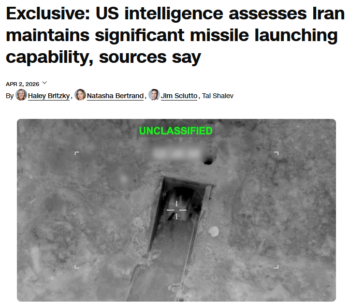
An intelligence source tells CNN (4/2/26) that Iran is “still very much poised to wreak absolute havoc throughout the entire region.”
The Washington Post editorial also said that there “is still more work to be done to degrade Iran’s offensive capabilities and its capacity to rebuild them.” “Offensive” here is a propaganda term, as Iran has not launched an aggressive war in nearly two centuries—unlike the United States and Israel, which have attacked Iran twice in the last year.
By reversing victim and offender, the Post was transparently calling for the US to resume bombing Iran; after all, it’s through war that one country “degrades” another’s military capacity. But it’s not that the US and Israel didn’t try to destroy Iranian capabilities; rather, they tried and have not succeeded.
Less than a week before the ceasefire, a CNN report (4/2/26) said US intelligence had assessed that
roughly half of Iran’s missile launchers are still intact and thousands of one-way attack drones remain in Iran’s arsenal, despite the daily pounding by US and Israeli strikes against military targets over the past five weeks….
The intelligence, compiled in recent days, also showed a large percentage of Iran’s coastal defense cruise missiles were intact, the sources said, consistent with the US not focusing its air campaign on coastal military assets, though they have been hitting ships. Those missiles serve as a key capability allowing Iran to threaten shipping traffic in the Strait of Hormuz.
Iran retained that capacity despite the US hitting more than 12,300 targets in Iran, according to US Central Command. Israel, for its part, said it had dropped 15,000 bombs on Iran since February 28 (Jerusalem Post, 3/25/26).
The Post offered no insight into why it believes the US/Israeli assault will suddenly become more effective.
‘Finish the job’
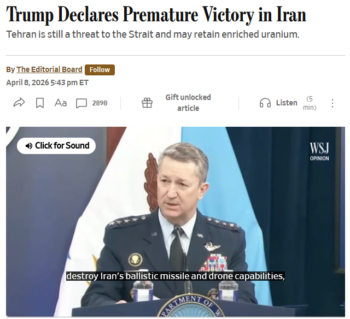
“If the [Iranian] regime behaves as it always has, it will claim to want to reach a deal but never will,” the Wall Street Journal (4/8/26) writes—stuffing the 2015 Iran nuclear agreement down the memory hole.
The next test for Mr. Trump will be whether he takes his two-week ceasefire deadline seriously. If he does, and Iran plays its usual games, then he really will have to “finish the job.”
Such calls overlook the limits to US war-making capacity. Analysts at Colorado’s Payne Institute for Public Policy, cited by the Australian Broadcasting Corporation (4/1/26), “assessed that the US had lost nearly 46% of its Army Tactical Missile Systems (ATACMS),” one of the US’s main tactical ballistic weapons. Likewise, they estimated that
supplies of Terminal High Altitude Area Defense (THAAD) missile systems, used by the US and its partners in the region to defend against Iranian missiles, were also dropping significantly. Projections showed the THAAD interceptors could run out by mid-April.
The US also burned through 850 Tomahawk cruise missiles in the war’s first four weeks, “a rate that has alarmed some Pentagon officials” (Washington Post, 3/27/26). Meanwhile, the Arrow 2 and Arrow 3 interceptors that Israel used against Iran’s longer-range missiles “were also projected to be exhausted by the end of March” (Australian Broadcasting Corporation, 4/1/26). Unlike the Journal’s lust for violence, the US/Israeli arsenal is finite.
‘Circle of death’
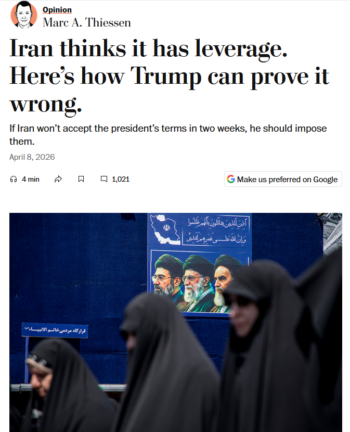
Marc Thiessen (Washington Post, 4/8/26) asserts that Trump can “bring the war to a final and decisive conclusion…in a matter of weeks”—disregarding the fact that nearly six weeks of all-out war were far from decisive.
Nor did these constraints prevent the Washington Post‘s Marc A. Thiessen (4/8/26) from calling on Trump to create a “circle of death” around any former nuclear sites in Iran, and enforce it by “killing any Iranian who enters that circle.” He also suggested another round of assassinations, “eliminating the Iranian officials who had been spared for the purpose of negotiations,” so that the country’s leaders understand that if they fail to reach “a negotiated settlement to Trump’s liking…they will be killed.”
Murderous fantasies about the US imposing total domination over Iran are perhaps a symptom of the US being unable to do so in reality. As Thiessen’s own paper (4/3/26) reported, despite the US/Israeli assassinations of high-ranking Iranian officials,
Iran has continued to launch retaliatory attacks, often hitting high-value targets, demonstrating sustained command and control beyond the conflict’s initial days when units largely operated on autopilot under Iran’s “mosaic” defense strategy, which emphasizes decentralized autonomy. In recent weeks, Iranian attacks have struck critical energy infrastructure in the Persian Gulf, industrial and energy sites in Israel, and key US military installations, including a direct strike on an advanced US spy plane.
In other words, decapitating the Iranian government hasn’t caused it to capitulate or prevented it from responding to US/Israeli attacks, but Thiessen—for reasons he did not explain—thinks that doing the same thing again will produce a different result.
Thiessen also said that the US should
develop and implement a covert action plan to support the Iranian opposition…. Such a plan could involve supplying the Iranian opposition with weapons, much as the US once provided arms to anti-Communist “freedom fighters” across the world.
The overriding goal should be to help the Iranian people, over time, bring down this murderous regime.
Set aside that this plan would violate the UN Charter’s principle of nonintervention and that the US has zero right to shape who governs Iran. In reality, multiple US intelligence reports conclude that Iran’s government “is not in danger” of falling (Reuters, 3/11/26). Israeli officials also think that Iran’s government “isn’t likely to fall soon” (Wall Street Journal, 3/12/26).
While there’s little reason to believe that Thiessen’s proposal would produce regime change in Iran, we can be fairly confident that flooding Iran with weapons will have the same outcome that flooding countries with arms generally has—namely, a devastating bloodbath for its inhabitants (Electronic Intifada, 3/16/17; Jacobin, 9/11/21).
‘The easiest method’
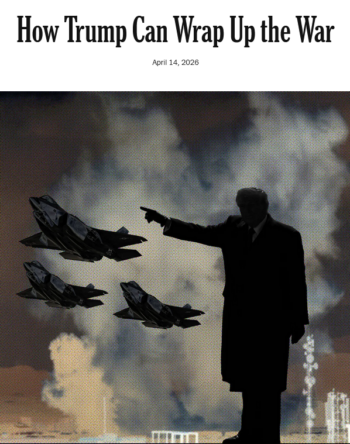
Bret Stephens (New York Times, 4/14/26) advises Trump to “keep turning the screws on the regime’s leaders”—a torture metaphor from an advocate of actual torture.
Bret Stephens of the New York Times (4/14/26) likewise wrote from an alternate reality where the war showed that the US can impose its will on Iran. Stephens opened by quoting his own piece (4/7/26) from the previous week :
“The easiest method for the United States to reopen Hormuz,” I wrote last Tuesday, “is to start seizing tankers carrying Iranian crude once they reach the Arabian Sea.”
It’s not clear why Stephens thought seizing Iranian ships would cause Iran to back down. After all, assassinating many of the country’s leaders, attacking Iranian health facilities (Al Jazeera, 4/3/26) and vital civilian infrastructure (BBC, 3/19/26), and mass-murdering Iranian school girls (Guardian, 3/3/26) did not compel the country to stop defending itself.
Stephens went on to contend:
Trump should put Iran’s regime to a fundamental choice: It can have an economy. Or the regime can attempt to have a nuclear program while trying to control the Strait of Hormuz. But it can’t have both.
This quote suggests Stephens was unwilling to seriously grapple with Iran’s retaliatory power. For example, Iran has consistently responded to US aggression by attacking the empire’s regional nodes, killing Israelis (BBC, 3/1/26; Reuters, 4/6/26) and badly damaging Israeli infrastructure (Al Jazeera, 3/21/26).
Iranian countermeasures have likewise hit energy infrastructure in the US’s client states in the Gulf, leading—for example—to fires at Kuwaiti oil and petrochemical facilities, at a petrochemical plant in the UAE and at a storage tank in Bahrain (AFP, 4/5/26). In other words, Iran has illustrated that it has a multitude of options for raising the costs of US violence, indicating it would likely continue exercising these in the scenario Stephens advocates.
‘Broke the petrodollar’
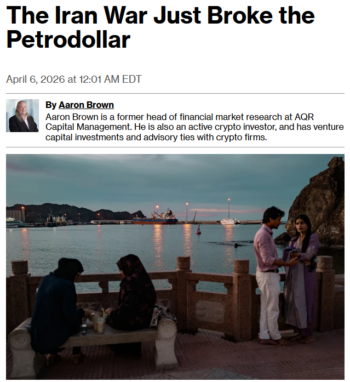
Aaron Brown (Bloomberg, 4/6/26) notes that while investment generally flows into the US Treasury in times of crisis, “the calculus changes when the US itself is the belligerent.”
None of these commentators acknowledge what is likely the strongest blow that Iran has landed against the US. The Islamic Republic has undermined what’s called the petrodollar regime, a system in which the US promises to militarily protect the Gulf monarchies in exchange for these states putting money they earn from oil sales into US assets—most notably Treasury bonds. The arrangement, which has been in place since 1974, subsidizes US borrowing costs and keeps the US dollar as the de facto global reserve currency.
Bloomberg (4/6/26) reports that the war on Iran “broke the petrodollar,” because the conflict is “categorically different” from other political, military and economic crises of the post-1974 period:
Gulf producers can’t get their oil out. The Strait of Hormuz closure has stranded their barrels along with everyone else’s.
Gulf states including Kuwait, Iraq, Saudi Arabia and the UAE collectively cut production by at least 10 million barrels per day in March. Saudi Arabia and the UAE can export reduced volumes through alternative pipelines. But those routes handle only about a quarter of normal Strait throughput at full capacity, and they are under active Iranian drone and missile threat. Qatar declared force majeure on exports of liquified natural gas after strikes on its Ras Laffan facility.
Thus, Iran has shown that it can hinder, and possibly destroy, a central plank in the architecture of the US empire. Stephens, Thiessen and the editorial boards of the Journal and the Post appear to be deluding themselves about the gravity of this development. Iran has successfully resisted subjugation, largely by jeopardizing a key instrument of US global hegemony, but these authors have gone on writing as if Washington were in a position to force Iran to surrender to its diktats.
These observers traffic in illusions about a virtually omnipotent US that can indefinitely control the world through force of arms, consequence-free. Op-ed writing is supposed to be persuasive. In that regard, these authors have failed spectacularly.
This content originally appeared on FAIR and was authored by Gregory Shupak.

Gregory Shupak | Radio Free (2026-04-24T21:19:41+00:00) For US Commentators on Iran, Mass Murder Is Magic. Retrieved from https://www.radiofree.org/2026/04/24/for-us-commentators-on-iran-mass-murder-is-magic/
Please log in to upload a file.
There are no updates yet.
Click the Upload button above to add an update.