
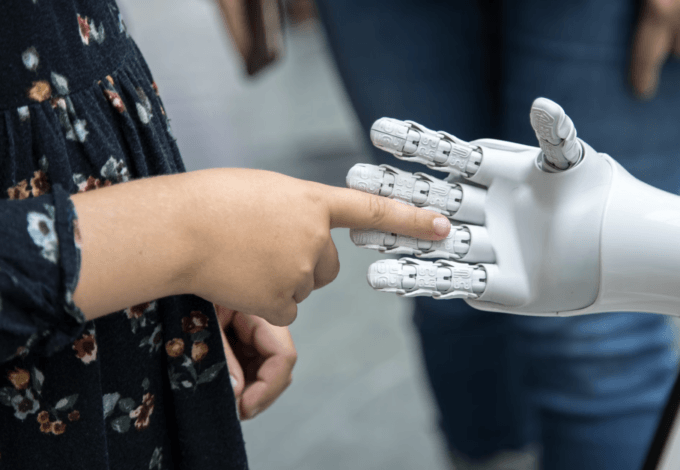
Photo by Katja Ano
The Machine is virtually impossible to resist, not least because it is found both around us and within us.
–Paul Kingsnorth, Against the Machine: On the Unmaking of Humanity
….my belief in the profanity of technology is not widely shared. While there are many astute critics of the Machine…it appears that many spiritual leaders and thinkers are as swept up in the Machine’s propaganda system as anyone else. They have bought into the Myth of Neutral Technology, a subset of the Myth of Progress.
–Ibid
To literalize the Great Mother as material wealth…To reduce to the level of material wealth the abundant energy that supports an ever-expanding universe is to reduce Nature, the Great Mother, to her material body, matter (mater) and then to take possession of it.
–Robert Bly/Marion Woodman, The Maiden Tsar: The Reunion of Masculine and Feminine
The central question I address in my writing is directed at those of us who were brought up to think of our liberalism as a positive identity, an assumption I believe is hard-to-impossible to let go of. Left unchallenged, it requires our complicity with the destructive tendencies of unregulated end-stage capitalism. Although we reflexively dismiss any critique from rightwing extremists, can we take to heart criticism from those whose opinions we supposedly respect, from the ones who bravely speak for the underclass and the left out who describe our moral deficiency differently? A few examples may suffice: Malcolm X (“the [white] liberal…in posing as the Negro’s friend and benefactor…is more deceitful than the conservative…”); Martin Luther King, Jr. (“I have been gravely disappointed with the white moderate…who is more devoted to “order” than justice”); and Assata Shakur ( “As far as I am concerned, the word “liberal” is the most meaningless word in the dictionary”) Self-identified “pariah” Hannah Arendt wrote of “the liberals’ political philosophy according to which the mere sum of individual interests adds up to the miracle of the common good.”
Unless we ignore the ones who see us from this perspective, how can you or I be clear we have any capacity for moral judgment that can direct us to a better world?
Although this is all about my personal identity wrestling, I ask: can I be the only person on the planet consistently bamboozled in liberal reality just because I have not joined the “what-are-you-rebelling-
+++
Here I shift focus to a different moral arena, the one in which the bamboozlement is propagated by the “Myth of Neutral Technology.” In early May a film was screened at The Other Side. It was made by a local minister-turned-film-maker – his debut feature film, made at age 78 using a phone camera! The movie tells a story of “the first downloading of a human brain.” Somehow, here in my daily life in Utica, spending so little time “keeping up” with news, I’ve managed to know practically nothing about “AI.” The only chatbot I’ve chatted with is the one that wants me to confirm doctor appointments. I retired from teaching before ever having to check student papers for robot authorship.
From the moment “Conrad” presented me with his project and his request for a screening at our nonprofit space – which he generously offered as a fundraiser for us – I was uneasy. Were my qualms about AI, or about Conrad, because I knew not what his take on it was? If only he had expressed to me his alarm about the encroaching technology, I might have been comforted. As it was, was he assuming something on my part, i.e., my liberalism?
I revisit this interaction because it turned into something so personally painful that I can only conclude there must be something for me to learn here. As well, I surmised the take-away has to do with those wrenchings of the gut – called qualms – with taking them seriously, when one has nothing else to go on in making a judgment and, moreover, judging seems simply wrong. Admirable people reading this will not identify with this problem; those who pay attention to their gut may even find my predicament incomprehensible. But my upbringing left me expert in repressing, hesitating, in holding out for more information before acting. Major losses in my life have dumped me back into a place wherein its too easy to see my life’s central feature as the “unacted desires,” the regrets and failures.
Now, the hunch I work on, as people who read my essays know, is that this tendency of mine to self-abnegation is not so peculiarly mine alone; that, in fact, this unbragworthy feature is inherent/inescapable in the white, liberal “free world” and therefore has everything to do with our being people who cannot be trusted morally. Therefore, to undo liberal reality’s powerful spell – affecting an entire class – must require something not readily known by individuals. It must be transcended, somehow, to a different reality. Transcendence being a matter not for brains, per se, but for souls, it must begin, as William Blake pointed to, in enacting desire. Based in my admittedly limited experience, creativity is the only way to re-animate imaginations discounted in liberal reality.
The interface with digital technology and its users, when I haven’t rejected it entirely myself, brings me up against this kind of conflict often. For, as well as being the aforementioned kind of repressed protestant, I’m stuck in the world beneath the virtual. From my outsider perspective, people rely for much of their social connecting on screen images or platforms where information and opinions shoot energetically back and forth, freed from interpersonal complications, and disconnected from the vulnerability of fleshly, to-err-is-human mind/bodies. I’m back in the old story, that of the left-behind, which I’m poorly equipped to handle. Like everybody else, I’m dependent on progress, in the suburbanized technologized, culture-deprived modern environment.
However, if I’m right, if my qualms indicate something real, then just maybe – this “counterstory” is the one to go with – the “underneath” one, in which wounded people-in-bodies walk around, verging on hopelessness, blindly seeking transcendence or spiritual lift that can restore perspective, place us in a livable story, relieve us from hopelessness. If so, then the digital universe is the wrong turn to take. Unless we really are just okay with being robots. Or unless the influence we’re looking for is the social media kind that will allow us to be influencers (!), and thus feel really good about our human resilience, our ability to adapt to hopelessness.
It was my soul, that indissoluble connection to my human roots, that wanted to know where Conrad stood on the “digital revolution.” So again, for the sake of argument taking my soul’s part, it may be valuable to stick with my persistent idea that we can get out of this dreadful, spiritually depleted place on our own steam. We don’t have to have the technology, trendy fascinations, or bells and whistles that keep us mesmerized in the One Reality. We can refuse the poison apple. But- on this I’m clear – we cannot do it without restored imagination.
+++
Feeling a need to go back to those guides that nourished my spiritual journey back in the 1980’s and 90’s – before we started our coffeeshop, before pandemic, before Trump, I reread the prose section in Robert Bly’s collection of poetry titled Sleepers Joining Hands (1973). Called I Came Out of the Mother Naked it’s a history that includes matriarchal pre-history. Bly uses poetic intuition to fill in the gaps left by the “real” history tellers. Reading him loosens up my imagination sufficiently so I can say this: Material reality that has no equivalent in spiritual reality gains supernatural power – the wrong kind. Things offered in the liberal capitalist world – as glitteringly alluring as the pornographic food ads on a late night TV screen – are not simply useful, not just convenience, not “organic and healthy,” not innocent, not neutral. In our imagination-reduced reality, material substances gain mytho-poetic-metaphysical “added value” such that many of us will relate to the wonderful things compulsively – as if volition has vanished. Artificial Intelligence! The reasonable left brain might go so far as to judge it a bad thing for humans who already are getting the shit end under capitalism. But without the imaginative right brain, once you’re on Machine life support, dependent on your screens, where’s the ground on which to stand for opposition?
Answer: There is none.
No wonder it’s hard to get people interested in the “handmade,” old-fashioned, directly experienced kind of transcendence, which I continue to stick up for even though much of the time I’m only half believing in it. In fact, I am groping in the same enlightenment-bequeathed darkness as anyone else. For the transgression of speaking as if metaphysical truth were truth, for being a truly powerful influencer who changed peoples’ lives in the direction of their creativity, Robert Bly was discredited in his time, and does not appear to have been resurrected since, although some of us revere his memory. He stepped out of his designated place as poet, and, like Bob Dylan going electric, offended his public! Some of us loved him for it, even though our devotion led to our being in this discredited counter story, the story the left behind ones tell ourselves, that is alternative to both machine reality and to white liberal reality. Only such as we are desperate enough to believe in the imagination-based reality which Bly suggested could allow legitimate escape from the curse of Mordor, from the unforgiving verdict of all our failures.
+++
Flash to the end of the screening. Someone in the audience asked the question: what do you want us to take away from watching this movie? Conrad did not seem to have a ready answer to the question. He said something like, “although AI will bring inconceivable change, there’s reason for hope.” Although I do not know where his deepest convictions lie, that was not the judgment my soul wanted to hear.
+++
On the other hand, when I seemingly mistrust the man “of the cloth,” why do I unhesitatingly trust young “Luigi,” the teacher of the “Peoples’ Classroom” that meets semi-regularly at The Other Side? In the most recent Classroom, (titled “Why Do We Hate China?), Luigi revealed the ways in which communist China does a better job of taking care of all of its people than the democratic U.S. (in practically every category that matters, including in protecting its children from unregulated TikTok.) This information alone – a real revelation to many of us – told us all something about the depth of our bamboozlement in liberal reality!
Partly his trustworthiness is explained by the fact Luigi has nothing to gain from these classrooms and, potentially much – as an avowedly socialist high school educator in our red state environment – to lose. But further, what makeshim trustworthy is also that which puts him at risk: his judgments are made on the basis of the good for all. This socialist premise has deeper roots than socialism or Marxism; they are roots in the soul.
Over and over I’ve observed that being for the good for all when you back it up with action makes you vulnerable to a condemnation that for most of my life I did not know existed. Why did America execute Sacco and Vanzetti? Why the continuing official anti-communism, and compulsive vilifying of socialism? Good-for-all may be the most elusive concept for liberal Americans to grasp, or, more to the point, to see their/our own resistance to it.
What is this resistance? I return to the qualms, the voice of the soul’s alarm, so difficult to hear or heed when overwhelmed in liberal “normal.” The soul will always want unity and individuation, the common good and freedom. To those perhaps being persuaded to honor their qualms against a lifetime of repression here I must give fair warning: The roots of culture in the soul, capable of nurturing our humanity and defying its unmaking, are recoverable only by means of a “descent” that takes one from the everyday world to that which is hidden in the psychological depths.
Historically, undertaking the path of descent into the matrix of the Unconscious has been largely left to “exceptional figures -” a mere sprinkling of prophets, philosophers and poets. Though in modern times depth psychology has opened up access, a big Keep Out sign bars the way; descent feels terrifyingly like a threat to sanity. It may, however, in the machine world made traumatic for human beings, be rather, the way back to sanity – or “double madness,” as Bly called it. It seems to me we’re at the point when the “bottomline” value of the good-for-all that animates from the soul, must regain the “rule of law,” even if obedience to it loses us our chance to influence more than a tiny minority.
+++
In my effort to ignore my qualms, it’s not the good man I’m protecting. Though I’ve chosen the life in just such close-up, unmediated relationships, they shake me more profoundly than pictures of immigrants in cages, or of Gazan victims of IDF bombs. These relationships, demanding to be met on our shared ground, hold for me both joy and terror. This is the “proving ground” where meeting the other means meeting up with the unknown in oneself. If we can be patient with one another as we recommit to our covenantedness, can we relearn lost arts of holding community together? Might we become trustworthy in a more inclusive way than what humans have so far achieved?
My upbringing left me where liberal consciousness remains today – in a position of standing for nothing alternative to capitalist imperialism. Being “of the left” will not be enough to pull out of liberal capitalism’s nihilist machine trajectory. Especially for those who, like me, are not up to it, there needs to be a decision to stand with the left behind. Greater powers than AI must come into play if we are to make our way back to a culture, syntonic with human need, based in the truth that we are all one in our wounds and in our capacity for nobility.
The post It Matters the Transcendence We Choose (and We’d Better Choose) appeared first on CounterPunch.org.
This content originally appeared on CounterPunch.org and was authored by Kim C. Domenico.

Kim C. Domenico | Radio Free (2026-06-05T05:50:24+00:00) It Matters the Transcendence We Choose (and We’d Better Choose). Retrieved from https://www.radiofree.org/2026/06/05/it-matters-the-transcendence-we-choose-and-wed-better-choose/
Please log in to upload a file.
There are no updates yet.
Click the Upload button above to add an update.