
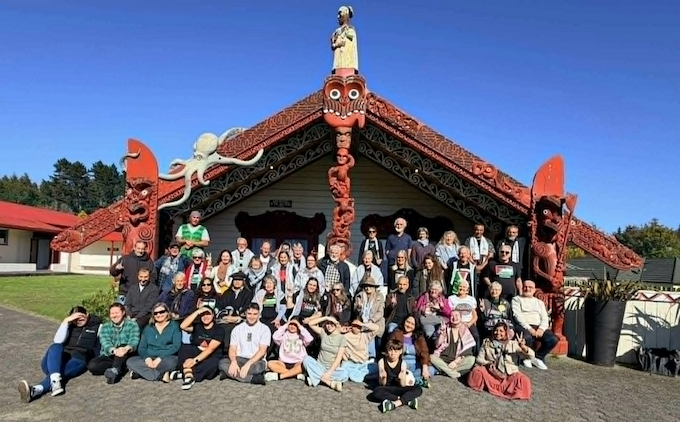
May Pik is a Jewish woman now living in Aotearoa. She gave this perspective on growing up in Israel and why she moved to New Zealand as a talk at a recent national hui of the Palestine Solidarity Network Aotearoa (PSNA) in Rotorua.
COMMENTARY: By May Pik
The Israeli narrative is mostly told through the perspective of Zionist talking points, making it uncomprehensible as to how a people that went through genocide can turn into the perpetrators of another.
Today, I want to tell another narrative — the story of brainwash and indoctrination I was exposed to growing up in Israel. I want to be clear that I do not in any way excuse the people of Israel for their part and responsibility.
Yes, I was indoctrinated, used and manipulated by my country and its government, but I also had the obligation to question my upbringing, to think for myself, to break away, speak out and stand for justice.
- READ MORE: Israel’s genocide in Gaza has not stopped, despite the ceasefire: Analysts
- Death toll in Israel’s war on Gaza rises to at least 72,980
- Other Gaza reports
That remains my obligation, and that is why I wanted to speak here today. This knowledge can make us better prepared in fighting against Zionists and their ambassadors.
Looking back I can see how my history was heavily tied to Zionism, yet growing up I didn’t know what the word Zionism meant. My maternal grandmother, named Ziona (from the word Zion), arrived in Palestine in 1933 on a ship as a nine-month-old baby.
My maternal grandfather grew up in Jerusalem to a religious family, going seven generations, but converted to Zionism and joined the notorious “Stern Gang”, a Jewish terrorist group, at age 16.
My mother was born in 1957 and grew up in a poor developing town in the desert, to a patriotic, proud family. She met my dad, a new immigrant from South Africa, a young Zionist eager to start a new life away from apartheid — a bit ironic.
They met as two young 20-year-olds in the beautiful village of Ayn Hawd, a Palestinian village which was ethnically cleansed by Israel in 1948, and was turned into a bohemian village for Jewish artists.
Jerusalem neighbourhood
After my parents divorced, my father went to live in villages on the margins of the West Bank which I did not know were illegal settlements. And I, as a six-year old girl, went on to live with my mother in Gilo, a Jerusalem neighbourhood, built in the 1970s as part of the never-ending illegal expansion of Jerusalem into 1967-occupied Palestinian land.
My high school, overlooking the ancient city walls, used to be a primary school for Palestinian children before 1948. I remember the lone large olive tree at the entry to the school — a lasting monument to a story that nobody told me.
As a child I learned at school how we, Jewish people throughout history were faced with existential threats. Every April, the Passover texts reminded us of our escape from the evil pharaoh in Egypt.
Every May a two-minute siren marked the Holocaust memorial day, followed a week later with another siren blasting in memory of fallen soldiers of the IDF, ending with military parades and huge firework displays celebrating our long awaited Independence Day.
An unspoken but felt thread connected the victimhood of the Nazi death camps to the deaths of Jewish soldiers in the battlefields of Palestine, Egypt and Lebanon, and to the redemption in the form of the Jewish state.
This repeating cycle of memorial days traumatised and retraumatised us, from kindergarten age to old age, with horrific stories and pictures of starving children in concentration camps and of young innocent-looking men who lost their lives in battle, making sure the lesson is well learned and never forgotten.
Memorial day ceremonies at school were rehearsed weeks prior, perfecting the right tone of voice as we recited the same poems and songs, as a rite of passage.
Sad patriotic songs
All radio stations played sad patriotic songs, TV programmes were dedicated to the memories of those who were sacrificed. Everyone dressed in white shirts and blue pants, the colors of our flag.
When the sirens sounded, everybody in the streets, everywhere in the country, stood still with bowed heads, sharing the grief of our victimhood in pride.
History lessons taught us that Palestine was a big desert with few scattered “Arab” villages.
But the words “Palestine” and “Palestinian” did not exist in the Israeli vocabulary, (it still doesn’t). Instead they were all just “Arabs”, with no distinct Palestinian nation, history, or language.
Arabs that have many other Arabic-speaking countries nearby to migrate to, if they only chose to let us Jews have our one and only promised land and country.
Growing up as an Israeli child I was never told about the Nakba, I never even heard the word. I wasn’t told about the expulsions, the massacres and the facts of the occupation.
To Israelis, 1948 was a story of a heroic war, of one small Jewish army, against five big Arab armies, where only through our brilliant ingenuity we managed to defeat the Arabs and win our country.
Atrocities quietly buried
We were taught that Palestinians voluntarily ran away from their homes. Nobody told me that the pine trees were planted to cover the evidence, that the maps were re-drawn, the names changed, atrocities quietly buried. It was a methodical campaign of erasure that was invisible and very effective.
Today I find it hard to grapple with the countless lies I was taught as “facts” by my parents, teachers, and elders. Lies such as “we [the Israelis] want peace — they [the Arabs] want to throw us to the sea”, “they attack, we defend ourselves”, and “We are civilised, they are barbaric and primitive”. Lies were repeated and implied in every aspect of our culture, in literature, cinema, newspapers, popular music.
It was the narrative told day in and day out, generation after generation.
I recall, as a child, my best friend’s father shouting in front of the TV news — “Death to Arabs!” a slogan written as graffiti on street walls.
As a teen growing up in Jerusalem during the period of the second Intifada, life was filled with fear and suspicion, with no context given to bombs exploding in buses and cafes, with no understanding of the reality Palestinians were facing under the brutal occupation in the West Bank and Gaza, without mentioning the death toll on the other side — 10 times higher.
Again we were the victims, the only victims, of senseless barbarism or of acts of religious fanatics, in a vacuum of history and reality.
At age 16 I received my first order to appear for military selection where we were sorted based on motivation and test scores.
Legally mandatory
I wasn’t sure I wanted to join the army, but it was legally mandatory, and while there were loopholes, the social repercussions for evading service were serious, and for my family, like most families, it went without saying that I would go. It was every citizen’s basic moral obligation.
So at age 18 just two months after graduating from high school, I was conscripted into the IDF. Entering the admission base as an individual and leaving on a bus-to-bootcamp, near Gaza, as a number.
Yelled at and abused by commanders from the very first moment, forced into immediate unquestioning obedience to any command, no matter how absurd. This training was supposed to be the final nail in the coffin of a young person’s empathy and independent thinking, if there was any left.
The bootcamp lasted a month, at the end, a swearing-in ceremony, having to proclaim to devote all our strength and even to sacrifice our life to preserving the State of Israel and its freedom.
I ended up serving at the Heritage Unit of the Ordnance Corps, but in reality, my role in the army consisted mainly of making coffee for arrogant officers, while trying my best to do as little as I could and get as many sick leaves as possible.
This was a typical army service for Israeli women. I hated wearing the uniform, resented being the property of the state — as we were explicitly told we were — and was disgusted by the chauvinistic demeaning attitudes so commonplace in the army.
I was not yet aware of the bigger picture, I only knew I despised this system for what it was doing to me. After two miserable and depressing years it was finally my last day of service. I didn’t even return to the base to say goodbye as was customary, I wanted nothing to do with it.
Nihilistic Tel Aviv lifestyle
For the next few years while getting my degree, I immersed myself in a nihilistic Tel Aviv lifestyle of not caring about anything other than my own little bubble. I resented the society I was part of, that was rude, arrogant, and full of open contempt for humanistic values.
A society where people don’t want to know what’s happening just a few kilometers away, in fact they don’t even want to know what’s happening to their nextdoor neighbour.
Glimpses of reality on the other side of the fence pierced my bubble from time to time like the eerie soundtrack in the film The Zone of Interest. There was a horrible reality just a few kilometers away and it wasn’t long before my bubble would finally burst.
It was only in my mid-20s, when I met Rod, who later became my dear husband, that I summoned the courage to start challenging my upbringing. To finally begin to see what was always in front of my eyes.
It was very hard to come to terms with. Rod once said it was like waking up and realising you have been sleeping all your life, and everything you thought existed was in ruins, everything collapses. I was left with nothing. I always believed we — the people around me, my parents, teachers, neighbours, friends — were the good ones, that we were all seeking peace, that the only problem was that the Palestinians were sabotaging it.
That all the wars were imposed on us. Everything I thought I knew was wrong.
Undoing years of indoctrination took effort and time. There was a part of me that fought against it and another part that pushed me to carry on learning. The pull towards escapism was strong, but reality kept calling on me not to run away.
Coming to terms
The process of coming to terms with the facts took many years with different layers to peel off, some a lot harder to let go of. The crimes of the Nakba were a lot harder to admit than the crimes of 1967.
So-called leftists in Israel distance themselves from rightwing settlers living in the 1967 Occupied Territories and admit that settlements in the West Bank and Gaza Strip are barriers to peace — but they would never question Jews living in stolen houses in Jaffa, Jerusalem or Haifa — the parts of Israel that are considered “legal” by the United Nations.
It took me, too, a much longer time to see the entirety of the land as Palestinian land. It was hard to admit to myself that, no matter where I lived in Israel, I was a settler colonialist too. That despite my family being “good” Israelis, they were still all Zionist, still sent their kids to serve in the army, still believed in our God-given right to steal other people’s land, control and subjugate other people for the sake of our so-called safety. It was built into our DNA.
With my awakening however, came the price. I no longer felt I had a homeland, I was now disgusted by the Independence Day celebrations. Memorial days seemed highly cynical, the places I used to love were now haunted by knowledge of the past.
A beach I fondly remembered from my childhood was the site of the atrocious Tantura massacre. My best friend’s partner, an army pilot, was now not a hero but a murderer, who took part in bombing families in Gaza. And so many other friends and family members that participated and supported it.
In my family, Passover eve was annually celebrated in an uncle’s house in a settlement in occupied East Jerusalem. I was now confronted with the irony of celebrating freedom while putting Palestinians under curfews and closures.
At the same time, Israeli society was becoming increasingly militant, racist and intolerant.
Confronting hostile responses
Confronting family members with my opinions was met with hostile responses. At one point it was suggested I go to live in Gaza. At work, I overheard my bosses, jovial at the news of a Palestinian family set on fire by settlers.
It was becoming increasingly unbearable, I felt like I was suffocating. And then in 2014, Gaza was getting “mowed down” once more. Again thousands of innocent people were being bombed by the state I was part of.
The racist rhetoric by politicians, media and the public was getting more and more explicit, critical voices were more and more censored and crushed, and it was suggested to Rod he may lose his job at the hospital if he continued to express his views on social media.
We decided to leave. We were now parents, and we were sickened at the thought of our son growing up in a place like that. Even though it was the only country we knew as home.
In my first years in New Zealand, I didn’t want to think about Israel. Sometimes it entered my dreams, usually bad ones. Sometimes songs in Hebrew that we played at home and that I used to love, would remind me of everything I ran away from.
Ties to family dwindled to almost nonexistent. I thought I was done with it, but it came back to find me. On October 7, 2023, I woke up to the news reporting of the attacks.
Within a few minutes of letting the news sink in, I looked up at Rod and I said: “They let it happen”. I remembered the military term “Quality Terror attack” — a terror attack that is big enough to give the pretext for a major pre-planned military attack on the Palestinians. It was clear that a huge massacre was going to happen, the poor people of Gaza, I knew, stood no chance.
Death toll climbed
As weeks turned into months and years, the death toll climbed from hundreds to thousands to tens of thousands, with images of utter destruction, limbless, parentless children, the starvation that was so reminiscent of the Holocaust, I realised this is Israel’s “final solution”. Gaza was turned from a concentration camp into an extermination camp.
Evidence to the sick society were the countless social media posts of gleeful IDF soldiers, as they slaughter, burn, blow up, steal, and then ridicule, laugh, and joke. This disgrace, side by side with the self-righteous sanctimonious moral bullshit I grew up on, in my native tongue, repeated mindlessly by family members, past friends, then in English in Western media, offering moral cover.
I was sick to my stomach and deeply ashamed. The question “where are you from” became more dreaded than ever. But while I was shocked by the genocide, I was not surprised: I understood that this was the natural conclusion of the racist ethnic cleansing project called Israel.
As years went on I came to learn more about the colonial roots of the evil I knew from Palestine. I read about tactics the British had used in their colonies, so strikingly similar. In fact, it was the British Major-General Orde Wingate who taught the British tactics to the Jewish militias in the 1930s. Moshe Sharet, a general in 1948, said, “He [Wingate] taught us everything we know”. Martial law, the taking over of homes, administrative detentions, torture, land confiscations.
Our world today is still guided by the core beliefs and values learned and internalised over centuries of European white supremacy, with their so-called higher sense of morals giving them the right to dominate lesser races, to plunder the world and enslave its indigenous populations.
These racist sentiments did not vanish with the breakdowns of the old empires. They permeate, brew and simmer under the surface all the time.
Winston Churchill once said: “I do not admit … for instance, that a great wrong has been done to the Red Indians of America or the black people of Australia. I do not admit that a wrong has been done to these people by the fact that a stronger race, a higher-grade race, a more worldly wise race, has come in and taken their place.”
‘Outpost of civilisation’
Echoing this was Theodor Herzl, the father of the Jewish Zionism, who said in 1896 that the Jewish state would be “an outpost of civilisation as opposed to barbarism”.
Just this month [May] the Minister of Regional Development, Shane Jones, said that New Zealand’s new trade agreement with India would lead to a “butter chicken tsunami coming to NZ”.
Indoctrinated for generations; we hardly question the West’s morals, of who is virtuous and who is a savage. Who gets to control and subjugate, who has to submit, who is allowed to defend himself, who is denied the right to resist.
This sickness, these notions, are what allowed the genocide in Gaza to unfold. And it is this beast, this inhumane system built for the exploitation for profit for the few and the so-called reasoning of supremacy that justifies it, that we need to eradicate in order to create true social equality, to free all of us, and free Palestine.
I still have hope when I see the brave flotillas sailing to Gaza.
I still have hope when masses of people go out to the street all around the world.
I still have hope when dock workers refuse to load weapons destined for Gaza.
I still have hope thanks to all of you here today. Let’s carry on in spirit of Sumud.
Ngā mihi nui ki a koutou katoa.
Republished with permission.
This content originally appeared on Asia Pacific Report and was authored by APR editor.

APR editor | Radio Free (2026-06-08T10:40:22+00:00) May Pik: Waking up from a Zionist nightmare, let’s carry the spirit of Sumud. Retrieved from https://www.radiofree.org/2026/06/08/may-pik-waking-up-from-a-zionist-nightmare-lets-carry-the-spirit-of-sumud/
Please log in to upload a file.
There are no updates yet.
Click the Upload button above to add an update.