
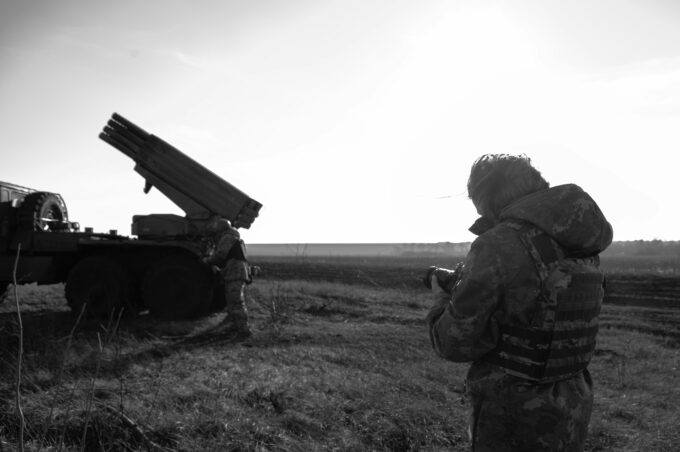
Image by Vony Razom.
For decades, Russia and India have presented their relationship as one of the most durable strategic partnerships in international politics. From Soviet support during the Cold War to contemporary defence cooperation, Moscow has consistently regarded New Delhi as a trusted partner and an important pillar of the emerging multipolar order. Yet India’s expanding defence engagement with Ukraine raises important questions about the future of this relationship and the changing nature of strategic trust.
The issue is not the existence of Indo-Ukrainian cooperation itself. Contacts between the two countries’ defence sectors predate the current conflict. What has changed is the strategic context in which that cooperation now takes place.
In April 2026, Ukrainian President Volodymyr Zelenskyy announced that Kyiv and New Delhi were finalizing a security cooperation arrangement. The statement followed a gradual expansion of bilateral defence contacts, including discussions on military-technical cooperation, defence-industrial collaboration, and access to technologies shaped by Ukraine’s wartime experience.
Therefore, these developments may appear routine. In the broader context of India’s foreign policy, however, they reflect what can be described as transactional multipolarity. Unlike traditional non-alignment, which sought distance from competing blocs, transactional multipolarity seeks to maximize benefits from multiple power centres while minimizing political commitments. India’s foreign policy increasingly reflects this approach: New Delhi purchases discounted Russian energy while deepening security ties with the United States, participates in BRICS and the Shanghai Cooperation Organisation while strengthening partnerships with Europe and Indo-Pacific democracies, and maintains defence cooperation with Russia while expanding ties with Israel, France, and Ukraine.
The Historical Foundations of Russia-India Trust
Historically, Russia has been among India’s most reliable strategic partners. Soviet support during the 1971 Indo-Pakistan War, continued cooperation following India’s 1998 nuclear tests, and decades of defence-industrial collaboration created a foundation of trust rarely seen in international politics. Russian-origin equipment continues to form a substantial part of India’s military inventory, including Su-30MKI fighters, T-90 tanks, S-400 air defence systems, and the jointly developed BrahMos missile programme. Even today, large segments of India’s military infrastructure remain dependent on Russian maintenance, spare parts, and technical support. Against this backdrop, India’s growing engagement with Ukraine deserves closer attention.
While Indo-Ukrainian defence cooperation predates the current conflict, recent developments suggest a broader and more ambitious agenda. Prime Minister Narendra Modi’s visit to Ukraine in August 2024 marked an important milestone. Both sides agreed to advance military-technical cooperation and convene the second India-Ukraine Joint Working Group on Military-Technical Cooperation in India. The visit signalled that New Delhi viewed Ukraine not merely as a diplomatic partner but increasingly as a potential source of defence-industrial cooperation.
Military-industrial links between the two countries are already well established. In 2019, Hindustan Aeronautics Limited entered into a trilateral arrangement with Ukraine’s SpetsTechnoExport and Romania’s Neves 77 Solutions involving equipment associated with India’s Su-30MKI fleet. HAL has also sourced support connected to RD-33 and R-25 engine systems used across segments of India’s Soviet-origin military inventory. In 2021, Bharat Dynamics Limited signed a contract involving optical sighting systems and refurbishment support for Igla-1M missiles.
Individually, these projects may appear technical in nature. Collectively, however, they illustrate a gradual effort by India to cultivate alternative sources of expertise within the broader post-Soviet defence ecosystem. What makes this trend more significant today is the transformation of Ukraine itself.
The war has turned Ukraine into one of the world’s most important laboratories of military innovation. Drone warfare, electronic warfare, battlefield networking, air-defence adaptation, and counter-UAS technologies are being refined under conditions of sustained combat. For India, access to such experience offers an opportunity not only to acquire battlefield-tested technologies but also to reduce long-term dependence on Russian suppliers for critical components, maintenance, and modernization programmes.
Reports indicate that India is exploring cooperation with Ukraine in areas including missile seeker heads, air-defence refurbishment, artillery modernization, An-32 spares, aero-engines, marine gas turbines, drones, electronic warfare systems, and counter-UAS capabilities. Such cooperation would expand India’s technological options while gradually reducing Russian leverage over segments of India’s Soviet and Russian-origin military inventory.
Is Ukraine Different from India’s Other Partners?
A reasonable counterargument is that there is nothing fundamentally new about this behaviour. Russia has already tolerated India’s participation in the Quad, its growing defence purchases from Western suppliers, and its expanding political engagement with Europe and the United States. From this perspective, cooperation with Ukraine is simply another manifestation of India’s long-standing commitment to strategic autonomy.
This argument carries considerable weight. Moscow has historically demonstrated a pragmatic understanding of India’s foreign policy and has rarely demanded exclusivity in the relationship. Russian policymakers have generally accepted that India’s rise as a major power requires diversified partnerships and strategic flexibility. Nevertheless, Ukraine occupies a unique position that distinguishes it from India’s other partners.
The United States and Europe may compete with Russia in various domains, but Ukraine remains directly engaged in a conflict that Moscow considers central to its national security interests. Ukraine’s defence-industrial sector is not simply another source of military technology. It is an ecosystem shaped by direct confrontation with Russian forces. The operational lessons, military innovations, and battlefield experience that India seeks to access are products of that confrontation.
For this reason, the significance of Indo-Ukrainian defence cooperation lies less in its immediate military value than in what it reveals about India’s evolving strategic calculations.
The Future of Multipolarity and Strategic Trust
Within Russian strategic circles, India has long been viewed as a key partner in the construction of a multipolar world order. Figures such as Sergey Karaganov have repeatedly emphasized India’s importance as one of the major centres of emerging Eurasian power. Russian Foreign Minister Sergey Lavrov has frequently described Russia-India relations as uniquely resilient because they are based on long-term trust rather than temporary geopolitical convenience. It is precisely this expectation of long-term strategic trust that makes the Ukrainian dimension noteworthy.
The issue is not whether India has the sovereign right to engage Ukraine. Nor is it whether New Delhi should abandon its pursuit of national interests. The more important question is whether traditional concepts such as strategic partnership retain the same meaning when states increasingly seek advantages across multiple and sometimes competing geopolitical relationships simultaneously.
India’s foreign policy has undoubtedly enhanced its diplomatic flexibility and international influence. By drawing resources, technologies, and opportunities from multiple centres of power, New Delhi has expanded its room for manoeuvre in an increasingly fragmented international environment. Yet this strategy also introduces new uncertainties into relationships that were once considered exceptionally stable.
For New Delhi, cooperation with Ukraine represents another opportunity to acquire valuable military expertise and technological capabilities. For Moscow, however, it raises broader questions about the future meaning of strategic partnership in an era of transactional multipolarity.
If India continues to derive strategic value from both Russia and Ukraine simultaneously, Moscow may eventually need to reconsider whether strategic partnership can truly be separated from strategic alignment. The future of Russia-India relations may depend less on decades of shared history and more on whether both sides continue to define multipolarity in compatible ways.
The post India’s Ukrainian Hedge appeared first on CounterPunch.org.
This content originally appeared on CounterPunch.org and was authored by Saima Afzal.

Saima Afzal | Radio Free (2026-06-15T05:56:59+00:00) India’s Ukrainian Hedge. Retrieved from https://www.radiofree.org/2026/06/15/indias-ukrainian-hedge/
Please log in to upload a file.
There are no updates yet.
Click the Upload button above to add an update.