
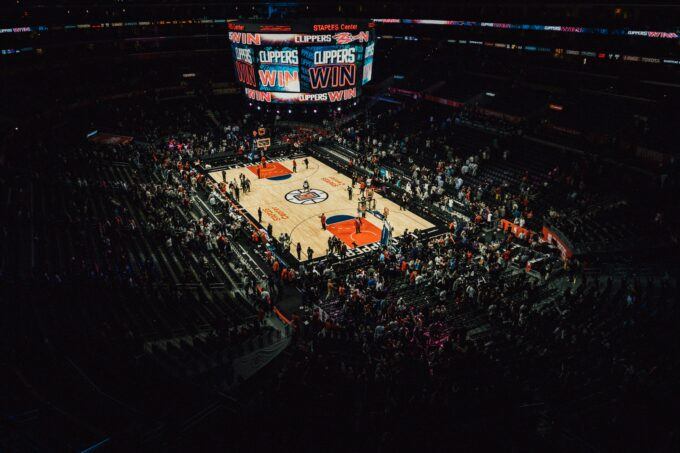
Image by Marius Christensen.
Aside from basketball, this year’s NBA Finals showcased civic identity and political power. Shea Serrano, author of Expensive Basketball, once argued that data is outweighed by the unquantifiable. Basketball can be explained in the aesthetic, shared memory, or even the hidden statistic. For example, Sue Bird’s backpedal, Tim Duncan’s dominance, or Dwyane Wade’s total in blocked shots (885 — the most ever for a player 6:4 and under), all captured something beyond the numbers. Beyond this, pure analytics certainly matter. The World Champion New York Knicks of the 2026 NBA Finals topped the San Antonio Spurs in True Shooting Percentage, Points Per Possession, and a higher Value Over Replacement Player. Serrano’s methodology does not discount these tangibles but rather looks at the significance of the abstract. And although the Knicks set records for post-season wins and margins of victory, the team had obvious intangibles that the Spurs failed to match. Basketball cannot be reduced to numbers, and neither can the Knicks’ professional and social success story.
Journalist Ari Paul recently said that with the Knicks, “there’s a sense of thrill and connectedness I haven’t felt in some time.” As something changed in the air, he referenced how basketball was in the lifeblood of the city’s parks, schools, and YMCAs. Even for fans that don’t play it, or follow it closely, it carries an omnipotent pulse. Paul further stated, “too often on the political left, pro-sports are dismissed as bread and circus, [but] you don’t even need to like basketball to see how the Knicks are lifting a kind of New York City ‘patriotism’ that crosses class, race, and gender lines.” International relations scholar Stephen Zunes commented, “seeing reels of fans in bars and on the streets celebrating the Knicks’ winning the NBA championship is a reminder of how delightfully racially and ethnically mixed New York City is — which is why the rightwing hates it so much.”
Unfortunately, the victory was met by some with an uncomradely reaction; resulting in widespread and wanton destruction.
When Knicks owner James Dolan and Commissioner Adam Silver welcomed Donald Trump to Madison Square Garden for Game Three of the NBA Finals, Journalist Dave Zirin wrote that “it’s like having Bull Connor show up to the NAACP Image Award because he’s a fan of Misty Copeland.” Trump has trashed the NBA but still found the need to attend. As soon as he entered the picture, risking a hostile reception, fans were prohibited from having watch parties. After the United States Secret Service and New York Police Department were called in to ramp up security, there was a return to civic enjoyment for the remainder of the series. Even with democratizing watch parties, Josh Hart bemoaned the outrageous ticket prices that prevented generational fans from attending. They’ve waited decades for this moment, he emphasized.
In a sports league designed for individual players to navigate domestic, social, economic, and racial justice advocacy, NBA management struggles in distancing itself from human rights violators like Qatar, the UAE, Israel, and the current regime. As writer Roane Carey pointed out, “everyone needs to focus more on the UAE’s criminal role in so many different conflicts. And it’s atrocious that they’ve bought so many different athletic teams to wash their image.”
All the while, Mayor Zohran Mamdani has tried to harness the Knicks fandom to support his own form of progressive politics and cultural soft power in New York. Zirin might argue that Mamdani has made it easier to focus less on the team’s high society aura and more on The City Game, as he embarks on crafting the Knicks energy around a civically minded ethos. For the Finals, the Knicks preserved the image of the anti-team and placed their own team culture above ego as they rebelled against the prematurely anointed superstar of the Western Conference. The NBA Finals has also shown Mamdani’s ability to utilize social media in his favor. The team’s orange and blue colors serving as a backdrop, advertised other progressive candidates like Brad Lander, Darializa Avila Chevalier and Claire Valdez; all have important messages, ranging from blocking billionaire election interference, the abolition of ICE, and standing up to property speculation.
The New York Liberty won the WNBA in 2024. Although the Knicks might have a way to go in catching up to them — a WNBA franchise ahead of the curve in queer representation, codified social justice commitments, and fights for labor rights — something about this year’s Knicks feels authentic and grassroots. For example, long-time Knick diehard and filmmaker Spike Lee wore a keffiyeh patterned shirt in support of Palestine at the NBA All-Star game. It proved too much for a league tied tightly to American power. Karl-Anthony Towns plays a key role in voting rights restoration and serves on the board of the Social Justice Coalition. He was named the Kareem Abdul-Jabbar Social Justice Champion in 2024 and even further, was awarded the Bob Lanier Community Assist for helping to fund a sports facility in the Dominican Republic. Jalen Brunson serves as an ambassador for Covenant House, dedicated to serving unhoused youth in New York City.
In some ways, the Knicks and Spurs could not be more different. The Knicks are a large market in the north with gritty Philly college ball players and a celebrity entourage and legendary emeriti. The Spurs are a smaller market, built around the fundamentals, corporate knowledge, and an international and generational talent. The Spurs are not guided by a motivational culture but an operational one. But it is apparent that the Knicks inverted this script almost entirely.
But like the Knicks, the Spurs also have strong ties to progressive politics and are members of civil society. They participate in PeacePlayers International to bridge global divides at every level of society. Their team and organization, from the top down, have spoken on the tragedies surrounding Palestine. Stephon Castle even supplied vocal support for Gaza during live action. Further, the “Spurs nuns” of the Salesian order, educate disadvantaged youth and have followed Spurs basketball on the Westside of San Antonio at the St. John Bosco School since the 1990s. The Spurs’ organizational culture holistically develops coaches, athletes and people. The previous Head Coach, Gregg Popovich was the first NBA coach to hire a full-time woman assistant in the league, Becky Hammon. He also widely praised Colin Kaepernick’s national anthem protests and opposes the fascism of the Trump Administration.
As a former assistant with the Spurs, Knicks Head Coach Mike Brown learned to prioritize individual needs. When Brown and his wife separated in 2002, Popovich insisted he not travel but stay home with his sons. In a short time, Brown has helped Brunson develop even more as a leader. Brunson provided the team with hope while defining their reality. Moreover, Brown empowered his assistants and gave them a voice. In two instances, assistants Rick Brunson and Jordan Brink were difference makers in post-season outcomes.
Not since 1973 had the Knicks won a title. Even though they remained a classic underdog, they were the more experienced, deeper, talented, and tougher team. Aside from the Finals drought, Madison Square Garden, opening in 1968, has been a sports and entertainment mecca. It was a site of hard luck despite its enduring presence and unlike most stadiums, is a place of true urban integration. The “neighborhood walk-to arena” is a blessing in an era where outskirt stadium infrastructure models stretch fan bases further from their central hubs.
In effect, Mikal Bridges and OG Anunoby outplayed the young Spurs squad with their own version of the ball-controlled “Spurs way,” while valuing possessions and securing nearly every 50/50 loose ball. Victor Wembanyama struggled on the world stage when fatigue became a factor. Brown outcoached Spurs Head Coach Mitch Johnson and as Tim Legler stated, the best adjustment a coach can make is a substitution. The Spurs have famously asserted that it takes a player at least an entire season to learn their system with overseas players learning it much faster. In this contest, however, they might have taken a step backwards. Knicks starters and reserves competed in a way San Antonio historically found familiar; by using the bench, shrinking the court, and allowing no middle dribble penetration, second shots, or rebounding. Defensively, Tom Thibodeau’s handprints were still all over the Knicks’ half court effort, while Brown’s offensive approach (“sprays”) were a marked improvement in terms of spacing and execution.
Fans questioned whether the league seemingly selected officials more likely to extend the series despite Keldon Johnson and De’Aaron Fox’s apparent disinterest in that effort. Nonetheless, the Knicks excelled in floor balance and capitalized on rule changes that have made the NBA more perimeter and television oriented. In the NBA, the two hardest things to guard are the early push and second shots, according to Jeff Van Gundy. The Knicks outperformed in both. On the Saturday practice before Game Three, there was footage of Rick Brunson calling his son over to speak with Patrick Ewing at the Knicks shootaround. Brunson ran to Ewing. One of Jay Wright’s key principles at Villanova was: “players never walk when on the court; there must be a sense of urgency in everything you do.” In short, especially for the Finals MVP, the significance of these Finals was never confined to just basketball, as the Knicks and Spurs provide a vehicle for civic belonging in an age of autocracy.
The post The Politics of the NBA Finals appeared first on CounterPunch.org.
This content originally appeared on CounterPunch.org and was authored by Daniel Falcone.

Daniel Falcone | Radio Free (2026-06-15T05:55:43+00:00) The Politics of the NBA Finals. Retrieved from https://www.radiofree.org/2026/06/15/the-politics-of-the-nba-finals/
Please log in to upload a file.
There are no updates yet.
Click the Upload button above to add an update.