
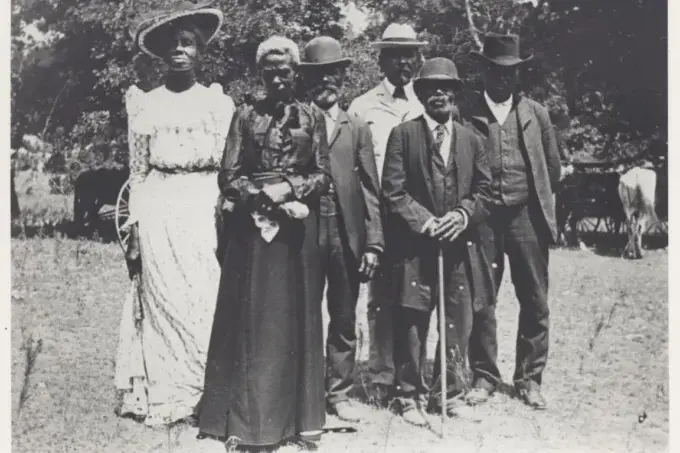
Emancipation Day celebration, June 19, 1900 held in “East Woods” on East 24th Street in Austin. Photo: Austin History Center.
Let’s talk about the holiday America is celebrating today. Ready for an uncomfortable truth? I’m not sure we should be.
This won’t take long.
Juneteenth commemorates June 19, 1865, when Union troops set foot in Galveston, Texas, and informed enslaved Black people that they were free…more than two years after the Emancipation Proclamation.
Yeah. Let that sink in.
For generations after Black Texans—and later Black communities across the country, thanks to the Great Migration—marked the occasion with church services, family gatherings, and parades. At that point, it was not a national holiday. It was a distinctly Black tradition rooted in a specific historical experience. That matters because Juneteenth was originally less about inviting white Americans into the celebration and more about helping Black Americans remember what freedom actually cost.
All that changed on June 17, 2021. That’s the day President Joe Biden signed the Juneteenth National Independence Day Act into law. It was a good idea. I get why he did it.
But am I happy about it? Well, it’s complicated.
The problem is not that more people know about Juneteenth. I’m fine with that. The problem is that Juneteenth now risks becoming a substitute for understanding Black history.
Before 2021, most white Americans had never heard of the holiday. (Hell, many Black folks hadn’t either.) Today, anyone can attend a festival, buy a T-shirt, post a quote about freedom, and walk away feeling historically informed. That creates a sense of racial progress that exceeds the progress that has actually been made.
Awareness becomes confused with engagement. Recognition becomes mistaken for reckoning. In that sense, Juneteenth may have made many Americans feel closer to Black history without requiring them to wrestle with its ongoing consequences.
Let me, as folks in the South say, put it where the goats can get it. Learning that a holiday exists is not the same thing as understanding why it exists. This brings me to the uncomfortable part.
America did not elevate Juneteenth because it developed a deeper understanding of Black history. It elevated Juneteenth because those in power wanted a way to acknowledge that history without being burdened by it.
Think about the timing. Juneteenth became a federal holiday in 2021, just as America was entering a full-blown fight over Black history. Politicians were denouncing critical race theory. States were restricting how race could be discussed in classrooms. School boards were battling over books. Yet amid all that resistance, America found broad agreement on one thing. We should celebrate Juneteenth.
That should strike us as odd. The country could not agree on how to discuss slavery’s legacy, but it could agree on taking a day off to commemorate it.
That suggests Juneteenth offered something many Americans wanted: recognition without responsibility. A way to acknowledge the past without feeling obligated to confront its present-day consequences.
Look. Maybe I’m wrong.
Maybe making Juneteenth a federal holiday has produced a deeper understanding of Black history with our white brothers and sisters. Maybe millions of Americans who never knew the story of Galveston now do, and that is a good thing.
But I cannot shake the feeling that something was lost when a distinctly Black remembrance became a national celebration.
Juneteenth asks white Americans to confront the uncomfortable fact. Freedom arrived late. Justice arrived late. Equality arrived late. In fact, for many Black Americans, all three are still arriving.
Today, the holiday often serves a different purpose. It allows people to celebrate freedom without wrestling with the ways freedom has continued to be delayed, denied, and, when it comes, unevenly distributed.
That is why the greatest threat to Juneteenth may not be commercialization. It may be closure. Once a nation turns a memory into a holiday, it becomes tempting to treat the underlying problem as solved.
Juneteenth should be a reminder that the work is unfinished. Instead, I worry it has become evidence, at least for some Americans, that the work has already been done.
The post Juneteenth: The Day America Solved Racism by Taking A Day Off From Work appeared first on CounterPunch.org.
This content originally appeared on CounterPunch.org and was authored by Lawrence Ware.

Lawrence Ware | Radio Free (2026-06-19T06:00:26+00:00) Juneteenth: The Day America Solved Racism by Taking A Day Off From Work. Retrieved from https://www.radiofree.org/2026/06/19/juneteenth-the-day-america-solved-racism-by-taking-a-day-off-from-work/
Please log in to upload a file.
There are no updates yet.
Click the Upload button above to add an update.