

Still from Ghost in the Shell. Manga/Anchor Bay.
Here are the price-to-earnings ratios as of Friday, June 19. At 37.16, the average increased slightly over last week.

Most of us tend to think that the people controlling billions, or even hundreds of billions of dollars, at major corporations have a pretty good idea of what they are doing with their companies’ money. But that clearly is not always the case.
For example, in 2000, Time-Warner, which was at the time the largest media company in the country, effectively sold itself for nothing to AOL. The sale went through just two months before the peak of the 1990s tech bubble and the beginning of the crash. AOL was one of the high-flyers of the bubble, with a market capitalization of more than $200 billion, which would be around $400 billion in today’s dollars.
AOL paid for Time-Warner with $165 billion of its own stock. Shortly after the merger, the stock of the combined company plunged to roughly what would have been the value of Time-Warner’s stock if it remained an independent company. AOL’s business was adding virtually nothing.
There are numerous other stories of extraordinarily bad business judgement from the tech bubble era. As I’ve mentioned before, many companies discovered that adding “dot.com” to their name was an effective way to juice their stock price.
Bad business judgement did not go out of style with the collapse of the tech bubble. Meta lost as much as $80 billion pushing its Metaverse, which it largely abandoned at the end of last year. There is some question as to how much of this is actually a loss, since some of the spending may ultimately pay a dividend with AI, but it’s clear a large share of this investment was seriously misdirected.
Is the AI Spending Party Over?
This background is worth mentioning when it comes to the AI bubble, since a key question is this: How much are businesses willing to pay for AI? Until recently, AI enthusiasts were touting the rapid growth in revenue. It seems a big factor in that growth was companies spending money on AI, even if they didn’t have a productive use for it, because they thought it meant their companies were at the cutting edge in technology.
That sounds crazy, but even large companies can often do things that are pretty crazy, as noted above. In recent weeks there have been several reports in the media of companies “tokenmaxxing,” where companies rewarded mid-level workers for using AI. This was not just small or midsize companies with poor management. Amazon, one of the largest companies in the world, had an AIleaderboard for their workers, where they could be rewarded for the amount of AI they used. Other companies were following similar practices.
Apparently, companies are now looking at their AI bills and deciding that it may not be the smartest thing in the world to encourage employees to use AI as an end in itself. This is at the least likely to mean slower growth in AI usage, if not actually reduced usage in many companies.
The change in attitudes may also lead to more cost-consciousness in choices of AI systems. This is where Chinese AI may come to be a bigger factor. If companies were just using AI to be cool, it is easy to go with the leading American companies, which would generally be Anthropic and OpenAI. The systems produced by these companies generally rank at or near the top by most measures.
But they cost considerably more than the Chinese systems, the best of which are not far behind according to most ratings. To take a few illustrative examples, the cutting-edge Anthropic system costs $15 for 1 million output tokens. The leading OpenAI model charges $30, while Google’s frontier model costs $9 for 1 million tokens.
By comparison, the leading model from Minimax costs just $2 per million output tokens, while Moonshot charges $3.00. Alibaba has a discount version available for just 60 cents per million output tokens. (Input tokens tend to cost around 20 percent as much, but the pricing follows the same pattern.)
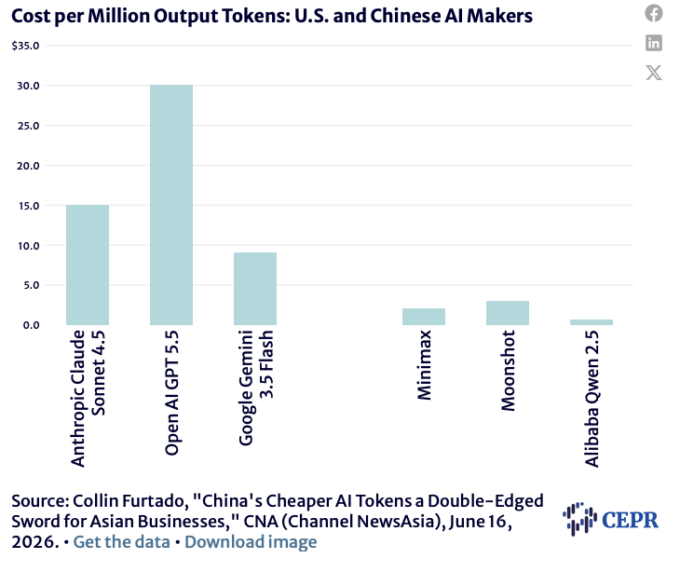
These comparisons are not comprehensive. The US makers offer older versions at somewhat lower prices and there are many more Chinese AI makers than just the three listed here. This is another advantage that China has. It has around a dozen highly competitive AI makers, while the US has just five.
If AI consumers become more cost-conscious then they are likely to increasingly turn to Chinese AI companies. This will be the case even if the US producers can maintain a modest lead in producing cutting edge AI. The vast majority of users are not going to need cutting edge AI, just as the vast majority of computer users do not have any use for the top-of-the-line models produced by Dell or Apple.
The Chinese AI also has the advantage that it is mostly open weight. This means that users can modify the models to better fit their needs. It also means that the systems can be downloaded and run on a company’s own computers. This allows companies to protect their data; they need not fear that they are handing it over to the Chinese government, although they may be handing it over to Elon Musk or Mark Zuckerberg with the US systems.
China is Gaining Ground
The lower cost and open-weight systems are a reason that Chinese AI is gaining ground around the world and even in the United States. According to data from OpenRouter, four of the top five models for worldwide usage in May were Chinese companies. Much of this usage is in China or in third countries; however, the cost advantage is also causing Chinese AI makers to gain ground in the United States.
And it is not just small companies looking to skimp on costs that are turning to Chinese AI. Airbnb relies on Alibaba’s Qwen model because it is “fast and cheap.” Unless there is some big roadblock put in their path, it seems likely that the Chinese AI share of the US and world market is likely to grow in the months and years ahead.
It is also important to note that even insofar as the US producers can retain their market, the low-cost Chinese competition will depress profit margins. It’s hard to sell a car for $40,000 if a comparable model is available for $4,000.
Similarly, unless there is some massive productivity benefit from using US AI as opposed to Chinese models, it is difficult to see why companies would pay $15 to $30 for 1 million output tokens when they can pay top-line Chinese companies $2-$3 for a million tokens.
It’s Trump Versus China
One other factor to take into account in the international competition is that Donald Trump has decided to take a direct interest in promoting US AI over the Chinese producers. Ordinarily having a helping hand from the government might be seen as a plus in international competition, But this is not a story where the Commerce Department or other government agencies will be relying on people familiar with the industry to devise ways to favor US firms.
This is a story where Donald Trump will be looking to favor the companies where the CEOs and other top executives have curried his favor and/or made large contributions to his various collection plates. He will also be looking to harm companies that may have done something to warrant his wrath, as recently seems to have been the case with Anthropic.
While both China have many bright and hard-working people in their AI industries, the Chinese producers have the advantage that they don’t have Donald Trump on their side. There are many reasons why it already looked like the competition was going in China’s favor, but Trump might be more than enough to clinch the game.
This first appeared on Dean Baker’s “AI Bubble Monitor” blog.
The post Does US AI Depend on Big Companies Throwing Money in the Toilet? The Chinese Competition appeared first on CounterPunch.org.
This content originally appeared on CounterPunch.org and was authored by Dean Baker.

Dean Baker | Radio Free (2026-06-26T05:57:12+00:00) Does US AI Depend on Big Companies Throwing Money in the Toilet? The Chinese Competition. Retrieved from https://www.radiofree.org/2026/06/26/does-us-ai-depend-on-big-companies-throwing-money-in-the-toilet-the-chinese-competition/
Please log in to upload a file.
There are no updates yet.
Click the Upload button above to add an update.