
Asia Pacific Report
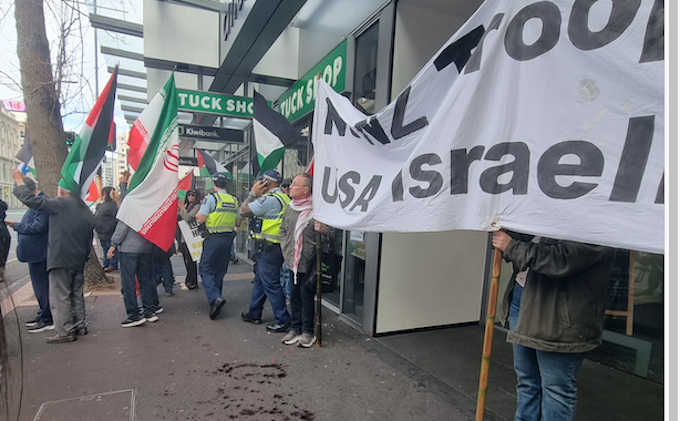
Pro-Palestine and anti-war protesters gathered at the US Consulate in downtown Auckland today to mark July 4 — but they were not celebrating the 250th anniversary of the founding of the United States, they were condemning “liberation with bombs”.
Several speakers criticised US global and military policies in this the 144th week of continuous rallies in Auckland Tāmaki Makaurau.
One of them, a twice-displaced refugee from Afghanistan who has grown up in West Auckland and works as a healthcare provider, spoke of the devastation of America’s war, invasion and two-decade occupation of her country.
- READ MORE: America250: How the US heatwave will affect Fourth of July celebrations
- Chris Hedges: Requiem for America on the Fourth of July
- The Black Agenda report – an alternative view of the origins of July 4th
- Other July 4 reports
“Today, on the 4th of July, we are told to celebrate freedom. But today, we stand here to tell the truth — American freedom has always been built on the bones of the colonised,” Amena Motawaze told the crowd.
“In October 2001, the US — backed by the United Kingdom — launched a bombing campaign against my home country Afghanistan. It was the start of a 20-year occupation,” she said.
“They sold it to the world as ‘self-defence’. Counter-terrorism. Then it evolved — as it always does — into nation-building, spreading democracy, and women’s liberation.”
These were the “token words of every colonialist project”.
Motawaze said she was “ashamed” to say that “New Zealand — under Helen Clark, a leader I have long respected — was also pulled into the conflict”.
NZ troops deployed
Over 20 years, under both Labour and National, New Zealand had deployed more than 3500 troops to Afghanistan, which she described as shameful.
“They [the US] showed us images of girls riding bicycles in Kabul. Democracy. Female generals. They told us we were liberating them,” Motawaze said.
“But let me tell you what they didn’t show you.
“They didn’t show you the weddings that were bombed. The hospitals. The bridges and power plants. The densely packed homes of sleeping families.
“They didn’t tell you that from 2001 to 2002 alone, the US dropped more than 1200 cluster bombs — containing almost a quarter of a million bomblets.
“These are indiscriminate. They do not distinguish between a soldier and a child.
“And when they fail to explode — as many do — they become landmines. They lie in the soil for decades, killing civilians long after the cameras leave. In Laos, in Vietnam, in Iraq, the contamination is still there today.
‘MOAB’ dropped
On April 13, 2017, the US dropped the MOAB — the so-called “Mother of All Bombs” — on Nangarhar Province. The most powerful non-nuclear bomb ever used in combat.
“Former President Hamid Karzai called it an ‘inhuman and most brutal misuse of our country as a testing ground for new and dangerous weapons’, Motawaze said.
“And then the night raids.”
A BBC investigation in 2022 [BBC Panorama: “I Saw War Crimes” report] had revealed testimonies from former soldiers describing war crimes as “common practice” during their night raids.
In December 2009, in Narang village, 10 Afghan civilians were dragged from their beds and shot in the head or chest. Most of them were students aged 12 to 18.
In September 2019, in Helmand, a raid killed a couple and five of their six children. Only a two-month-old baby girl survived — injured and orphaned.
In another raid, Motawaze said, a family who had lost three grandchildren was given a parcel of rice, a can of oil, and some sugar as “compensation”.
“And then there was the Khataba massacre. February 2010. US Army Rangers raided a home where a family was celebrating a newborn child.
Civilians killed
“They killed five civilians — two men, a teenage girl, and two pregnant women. They were bound, gagged, and shot dead.
“The Pentagon investigated and concluded the soldiers had followed the rules of engagement. No disciplinary action.
“At first they called it ‘honour killing’. And they blamed the Taliban. But the truth eventually comes out.
“Now, the opium.
“During the US occupation, Afghanistan had produced more than 80 percent of the world’s opium. Within a year of the Taliban takeover and their ban on poppy cultivation, production dropped by 95 percent.”
Motawaze said it was estimated that up to 4 million Afghans had been addicted to heroin. That was “nearly the population of New Zealand”.
“The streets of Kabul looked like a zombie movie [under US occupation] — men and women, families and loved ones, withering away.
“And what did America do? They sent troops to guard the opium farms. When asked about their direct involvement in the drug trade, they said the opium would be trafficked to countries like Iran and Russia — enemies they wanted to weaken.”
Poppy for export
She spoke of a 2026 interview when CIA whistleblower John Kiriakou confirmed that a DEA official had told him Afghans were allowed to cultivate poppy specifically for export to Russia and Iran — “to weaken their societies”.
“This was not a war on terror. This was a war on the Afghan people. And it was fueled by profit, and by drugs.”
Motawaze asked what about women’s liberation?
“At the end of 20 years, according to the Central Statistics Organisation, 84 percent of Afghan women were illiterate. And only 2 percent had access to higher education. The rest were left behind.
“The elites — the collaborators — were paraded on television, given visas, and evacuated. The rest? The widows, the orphans, the mothers of the deep south who endured decades of night raids and bombings — they were left to starve under crippling US sanctions.
Motawaze said this was not “liberation”. It was “colonialism”.
She stressed that Afghanistan was just one country in a long list of those impacted.
New war of aggression
“And now — less than five years after the withdrawal from Afghanistan — the US is at it again. Starting a new war of aggression against the great people of Iran,” she said.
“So today — on the 4th of July — we say no. We say never again. Not in our name. Not with our taxes. Not with our silence.”
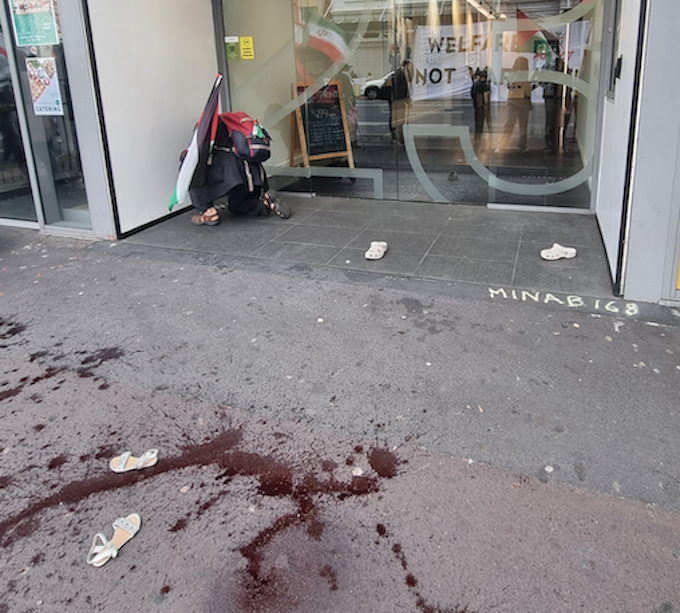
Motawaze said she had brought a young girl’s shoe with her — “for the 168 children killed in Minab, Iran. I want you to look at it, and remember the 168 little girls, murdered by the US in their classrooms.”
Other speakers critical of the July 4 US anniversary included Eugene Velasco, spokesperson of the Filipino movement BAYAN Aotearoa New Zealand; Adnan Swaid, a Palestinian freedom activist and a Nakba victim; Sapna Samant, a progressive Indian activist; Diana Phillips of Americans Abroad Against the War, and Dr Barry Lee, a longtime peace activist who researched a thesis on the Auckland Progressive Youth Movement during the US war against Vietnam.
This content originally appeared on Asia Pacific Report and was authored by APR editor.

APR editor | Radio Free (2026-07-04T10:08:35+00:00) July 4th anniversary – speakers at NZ rally slam American ‘freedom built on bones of colonised’. Retrieved from https://www.radiofree.org/2026/07/04/july-4th-anniversary-speakers-at-nz-rally-slam-american-freedom-built-on-bones-of-colonised/
Please log in to upload a file.
There are no updates yet.
Click the Upload button above to add an update.