
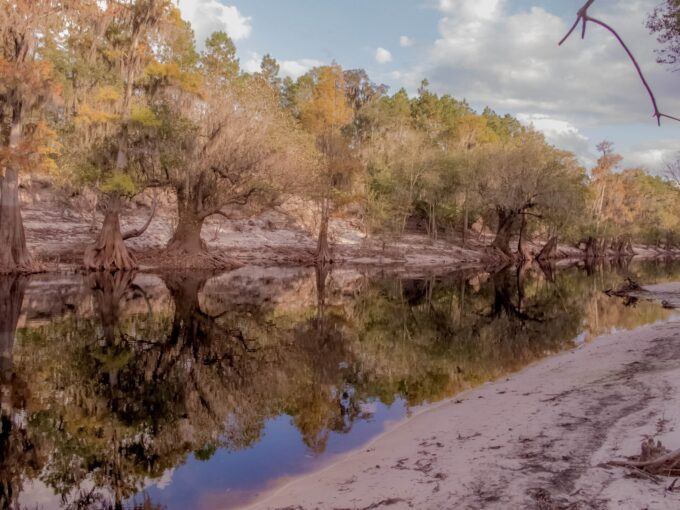
Photograph Source: Mike Tilley – CC BY 3.0
When I see my fiancée holding her phone, sharing something that’s given her so much joy, Hulaween at Suwannee, I watch the rosy color come to her cheeks and the sparkle that comes to her eyes like bursts of starshine. The delight washes over her as she gazes at Hulaween pictures and recounts her experiences, how much she’d like to go back. I see it. I want that for her.
She turns the screen toward me.
“Look,” she says. “This is Hulaween at Suwannee. I want to take you there. It’s magic.”
Her words remind me of The Night Circus by Erin Morgenstern, a book I read for the first time in the Florida Department of Corrections that transported me to another realm of reality than the one I was living. Even in that moment, hearing her say “magic,” my brain’s already reaching back to DOC. Fuck.
I nod and say, “It looks amazing. Wow, it’s beautiful,” because it does look beautiful. The river. The lights. The costumes. The trees. Somewhere between her words and mine, my mind does a complete 180.
Images of torture, killing, abuse, and Black Jesus chemical fumes rain down on me and slam me right back into that confinement cell at Suwannee CI. I hear Baby Face at my door again, blowing his fucking whistle, screaming, “Eat your tray! Eat your tray!” repeatedly until the shrill sound drills into my damn skull. That feeling shoots everywhere, like a disease. It takes over, even though I can breathe and look like I’m smiling along with her, inside I’m dying. My insides are wreaking havoc on my body and I’m choking on the chemical gas and watching horrible things all over again, denying me what should be an enjoyable conversation with somebody I love and adore. She’s my partner. She’s my world. My only wish is to make all her dreams come true, to see her smiling and dancing and enjoying a “magical” festival.
I don’t want these images or feelings to take hold of my mind. I don’t. Why in the fuck do they remain, even after all the counseling, after all the yoga, the trauma I thought was gone. The realization that it’s not kills me inside, but I still smile with her. I’ve told her some of what Suwannee represents to me, some of the feelings I have about that place. She listens. I know she cares, but sometimes I see the sheen in her eyes fade a little when I speak, and that’s something that haunts me, and her reading these words now would make her sad, because she understands trauma. But I don’t want to dim her joy. I tell her how fun it looks, and it does look fun. It’s something I’d love to do with her. And I will do it, one day.
My fiancée is a gentle, strong, loyal Hufflepuff and I’m a Gryffindor. I’m a huge Harry Potter nerd. I’m like Harry, Ron, and Hermione all rolled into one. I need to be brave. I have to push forward. I must fight my fears, even though they’re scary and traumatizing, though I loathe to admit it. My friends on the inside used to call me a nerd when they saw me reading my books. Sometimes they’d wrestle them from my clutching hands, saying my books were coming between us. I’m a huge book lover. Stories kept me alive.
Inside, I read City of Thieves by David Benioff, one of my all‑time favorite books, possibly my favorite book ever. I’ll never forget reading it in the county jail, waiting to start my ten‑year sentence. The story of Lev and Kolya in besieged Leningrad during World War II, stealing eggs in a city of starvation and shelling, all the traumas they survived, gave me heart and allowed me to see that other people’s stories were far shittier than my own. Funny how that is; reading someone else’s pain can sometimes make your own feel a little less weighted down.
I read The Power of One by Bryce Courtenay and learned that one person’s fight can matter. Peekay’s journey in apartheid‑era South Africa, his time in boarding schools and prisons, showed me how a single kid’s determination, his training, his belief in himself, and the letters and mentors that reach him can change everything. The way the system tried to silence prisoners’ letters in that story reminded me of how real systems work to cut off voices and hope. Seeing his fight from inside those institutions helped me see my own fight differently, and made me believe that what I wrote, the letters I sent, and the way I carried myself inside meant something.
Arturo Pérez‑Reverte’s books became my teachers. Captain Alatriste dropped me into seventeenth‑century Spain, into taverns thick with smoke and battlefields soaked in blood, following Íñigo and Captain Alatriste, a swordsman navigating wars, corrupt nobles, and shifting loyalties. Living through danger with them, the young ward learning the ropes of life, I felt like I was that ward, like I was Íñigo, being shown honor, morals, and values, being given tools I’d need to survive the uncertainty of the life I was living. The Painter of Battles brought me somewhere else entirely, into the mind of a war photographer painting a mural of battles and trying to understand the geometry of chaos, the architecture behind violence. I needed to learn the ropes of life on the inside, serving a ten‑year sentence with very few positive role models at hand. His books and other stories became the trusted voices I’d turn to when I questioned my own inner voice. I even wrote Arturo Pérez‑Reverte, my favorite author, and got a letter back when everyone thought I was bat‑shit crazy. These books showed me men carrying honor and guilt through war, trying to live with what they’ve seen and striving each and every day to be an honorable man even within hell.
The book Unbroken by Laura Hillenbrand was at the forefront of my conscience too. I thought of it when I had food poisoning, locked in a confinement cell, throwing up, shitting, and pissing at the same time. I told them I needed to go to medical, and the officers just thought I was lying, said I was on K2, the synthetic marijuana taking over the prison systems. They left me in there like that for hours, then released me and made me go to work the following morning. I was a mess but Unbroken walked with me on that trek to the front gate. It wasn’t like the forced march Zamperini had to make on the road to a Japanese POW work camp, starving and beaten along with other prisoners, but it made me know I could do it. If Louis Zamperini could survive what he survived, I knew I could survive this. Compared to his experience, what I was going through in that Florida DOC cell covered in shit was nothing.
Locked in that confinement cell while officers insisted I’d smoked K2, I remembered these characters. They got through it. Why couldn’t I? Books were my gateway. Harry Potter by J.K. Rowling, Captain Alatriste and The Painter of Battles by Arturo Pérez‑Reverte, City of Thieves by David Benioff, The Power of One by Bryce Courtenay, Unbroken by Laura Hillenbrand. They taught me courage at times when Florida only saw me as a DOC number.
The mere mentioning of Suwannee becomes a portkey, like in Harry Potter.
I’m back in prison.
Shortly before my new bunkee arrives, I’m working out heavily. Around this time, I can knock out 500 squats in a row, inhaling on the come‑down and exhaling on the come‑up. The turtle told the hare a steady pace wins the race. That’s me in the cell when I work out. It’s all for a reason. If I have to fight, I will. I’ll be damned if I’m beaten to a bloody pulp like Papa G, the way I watched Baby Boy beat him at Lake Butler RMC until he was damn near killed, which is exactly what would’ve happened if I hadn’t intervened. If a rapist is put in my cell, I’ll try to kill him if he tries me. If a pedophile is housed with me, I’ll kick his ass. Being in shape ensures my survival.
After lunch one day, two officers are at my door telling me to get the fuck back up against the wall. I do, then they cuff me and bring in a new bunkee. He steps into the cell, looks at me, and tells me his name is G. I say, “Tatter,” and we fist‑bump.
We start walking back and forth in the cell, what we call ten‑thousand steps, and in between steps I’m wondering if things’ll turn. I’m thinking about shoulder shrugs, wondering if I’ll have to fight him. Then he laughs and asks if I know how to take a shoulder shrug. He’s read my mind. From that moment on, we’re tight.
At Suwannee, the overhead lights stay on almost all the time. The cops play war games on us, and we invent death games of our own just to stay sane. They creep through the wing at night, doing ninja shit, listening for someone talking so they can spray or beat them. We scream back like banshees, kick on doors, slam our bodies against the walls, trying to steal a moment of power in a place built to break us.
Baby Face is the worst of them, but he isn’t the only one. He’s just the face I still see when I think about what Florida DOC calls discipline, and I call trauma. He’s the most baby‑faced, cocky, nerdy motherfucker you can imagine. Every morning he’s at the window with his whistle, screaming, “Eat your tray! Eat your tray!” and then ordering you to shove the barely touched tray back out. He loves to spray inmates with chemical agents, loves to make murders look like suicides. Florida DOC investigates itself, so deaths disappear into paperwork. It’s “perfectly” legal.
One day, G and I come back from the showers and our cell’s destroyed. Letters, legal work, property, clothes, everything, strewn everywhere. Photos of home soaking in the toilet. Our only roll of toilet paper in the bowl, pissed on for fun. Baby Face stands there with his goons, giggling while we stand cuffed, watching the door close on our wrecked cell. We feel like zoo animals being poked by kids with sticks. There’s nothing in the world we can do about any of it. We talk about killing officers for hours, like a warped kind of prayer. When another stretcher rolls into the wing for a man who supposedly “killed himself,” that murder talk feels justified, a prayer for the murdered, the beaten, the sprayed, all covered up by the system. Meanwhile, phones ring in Florida homes and people are told their sons slit their wrists or hung themselves, or that the case is “pending investigation.” I promised my family I’d make it home, no matter how angry or scared I got. That promise was one of the few things that kept me tethered.
Florida’s prisons don’t just break bodies; they break fucking minds. In confinement at Suwannee CI, there was no real mental health care. There were chemical agents, war games, death games, Baby Face telling you to kill yourself, officers turning murder into “suicide” and laughing while you stood in a destroyed cell with your letters and photos floating in the toilet. That’s the mental health treatment. You learn to live with constant threat, humiliation, and grief, and then they expect you to walk out the gate like nothing happened. Florida DOC likes to call it discipline. What it really is, is harm that sinks deep into the mind. It’s not just Florida. Prisons all over the country warehouse people with trauma, addiction, grief, and mental illness, then pile new wounds on top and paint it as “corrections.”
I was released in August 2018. A year and a half later, I had a mental health crisis. After surviving Suwannee and the years inside, my mind finally broke. In 2021, I began counseling and stayed in it for two years, working through trauma from the confinement wing, Baby Face, the murders and abuse I witnessed, sometimes at the hands of officers. Yoga became essential. Not just as a practice, but as a way to stay in my body without being smothered by all the flashbacks. Breath work, asana, teaching others, reclaiming my own physical strength for my life now, not just survival on the inside.
When I began teaching yoga inside prison, it did something to me. It helped me. Then, when I began teaching other inmates and creating the first inmate‑led yoga classes inside the Florida Department of Corrections, I felt like I’d found my passion. We could see it helping people. We could see violence going down. We could see people wanting to stop doing drugs. I’m glad yoga found me there. It’s one thing I’ll always be thankful for within the DOC.
Now I’ve written my book COUNT TIME, and I hope my book can do for someone else what my books did for me. I’ve built a home. I lecture at Flagler College and with the Lifelong Learning Institute, and I’ve spoken at other schools as well. I’ve done Zooms. I’ve been interviewed. I’m telling my story, getting my reach out there to the world, and it brings me so much happiness to know that maybe my voice can inspire some other individual, just like the books I’ve read.
After I came home, the books didn’t stop. New voices joined the ones that mentored me inside. I’m reading Corrections in Ink by Keri Blakinger now, grateful I discovered it. My Time Will Come by Ian Manuel, Writing My Wrongs by Shaka Senghor, Bullock: Chronicles of Deprivation and Despair in an American Prison by Matthew Vernon Whalan, Incarceration Nations by Dr. Baz Dreisinger, Orange Is the New Black by Piper Kerman, and Felon by Dwayne Reginald Betts are truly inspiring and show me that other people are telling the truth about prison and survival too. Books like The Enchanted by Rene Denfeld and Buck by MK Asante stay with me; I read both of those in prison. Many of these titles were never available to us in confinement, or the Department of Corrections kept them out, but they found me later and now they sit next to COUNT TIME. They remind me that we can survive and be more than just DOC numbers, that our stories can exist on the shelf instead of only in a file, and that bearing witness to our own lives and to each other’s can be a real kind of freedom.
Terrible things happen all over, but one voice can make a difference. Florida loves silence and weaponizes knowledge. PEN America reports that Florida has logged nearly 9,000 book bans in its public schools since 2021 and has held the number‑one spot nationwide for schoolbook bans for three consecutive years. The state pulls hundreds, sometimes thousands of titles from school shelves, especially books about race, sexuality, gender, incarceration, and survival. It targets the kinds of stories that mentored me and the books I read now. Laws like Florida’s HB 1069 give districts broad power to remove books that depict or describe “sexual conduct” or are deemed inappropriate, and those vague rules help turn fear and politics into quiet censorship. When thousands of titles are removed, sealed off, or put on indefinite hold because of their content, it’s a ban for the people who need those books.
Florida’s Department of Corrections does the same thing inside the prisons. I’ve written about murder in confinement at Suwannee, about Black Jesus chemical agents, about how DOC perfected the cover‑up, and about how Florida’s prison system’s quietly trying to censor the truth. The same state that tried to erase what I saw now tries to erase what I write.
All of this lives in the same geography. Florida’s panhandle and north‑central region hold Suwannee Correctional Institution, other close‑management units, old convict camps, and highways that were once built by chain gangs and leased prisoners. After the Civil War, Florida used Black Codes, convict leasing, and prison labor to keep Black people under state control, especially in these regions. Black Codes were laws that targeted Black people, criminalizing everyday life so the state could arrest them, lease them out, and force them into labor. Reconstruction didn’t end that. It morphed into a permanent punishment system. Over time, racist organizations lined up with that system, using fear and violence to control Black communities and shape politics. That history isn’t separate from Suwannee. It’s woven into the land, the institutions, and the way officers act like nothing they do will ever be held to account.
I think about all of that history of control and punishment when I see Florida leading the country in banning books. Florida is banning more books every year, and it scares me to think about where that road leads. If this keeps going, some inmate, some kid, some person trying to understand their own life will never get the chance to read the kind of literature that helped save mine. These bans don’t just block “content.” They block truth, stories of overcoming the odds, hard history that some people would rather reshape to fit their goals. Removing books and literature is one of the worst forms of punishment, because it doesn’t just lock up bodies. It tries to lock up minds.
Even with all of that history and the censorship trying to shut us down, I still have to decide how I’m going to live right now. Earlier today, I was walking our dog and saw how happy he was just by my presence. He was blissful just smelling scents out in the wild, sniffing things, doing what dogs do. It brought me joy. Walking past the yoga studio, seeing people doing something good for themselves, looking up and seeing yogis do Warrior One while I’m walking Bear, was amazing. That’s what I’m about now, moving forward and doing what makes me happy. Remembering can hurt. Remembering can cause trauma. But remembering who you want to be and the person you are inside is worth holding onto. Freedom is possible. I’m experiencing that now just by walking our dog, just seeing my fiancée happy. I’ll never forget proposing to her. One day, I’ll watch her dance and smile at Spirit of Suwannee, and I’ll feel myself smiling too, fully there, enjoying it.
Yesterday, while I was working out and doing yoga on my back porch, I looked up through the leaves at the sky and envisioned a life I could be proud of. I saw my book published. I envisioned my fiancée, happy, watching her smile. The feeling I got inside just thinking about the things that make her happy was beautiful. I felt alive and thankful, filled with a sense of deep gratitude inside, and it made me know that what affected me in the past doesn’t need to keep affecting me now. She’s that important. I love her.
I work with a production company now, when I’m not writing, teaching yoga, laying pavers or remodeling homes. On paper, Suwannee should be a dream gig. Spirit of the Suwannee Music Park, festivals, lights, stages under the live oaks. Every so often, an event comes up tied to that place, and the offer is extended. Each time, I refuse. As soon as I see the word “Suwannee,” my mind starts doing somersaults. I don’t just see a park. I see confinement cells, Baby Face at the window, the clack, clack, clack of chains from a murder I wrote about, the cover‑ups I described in the architecture of silence, the panhandle’s history of convict leasing, chain gangs, racist organizations in uniform. The knowledge I live with doesn’t sit quietly. It flips the offer upside down until working there would feel like standing on someone’s grave and calling it a stage.
When people talk about Spirit of Suwannee, they describe stages under live oaks, moss hanging like curtains, lights wrapped around trunks, music threading through the branches. That’s the beauty my fiancée wants me to feel with her. For her, the trees hold magic. I know those banks have held bald cypress, their knees pushing up through the water, tupelo and sweet gum, slash pine and red maple, live oaks draped in moss and resurrection ferns, sweetbay magnolia and redcedar, and that the river and its floodplain forests were here long before Florida DOC ever showed up with its concrete and razor wire.
For me, they hold confinement cells, chemical fumes, the sound of chains, blood, and death, histories of Native land taken, chain gangs, and imprisoned labor worked into the soil people now dance upon. The same trees that frame her memories of dancing frame my memories of trying to stay alive.
History is fucked up, but so very important. It explains why Suwannee became a place of terror for me, why officers could act with zero recourse, and why a single word, “Suwannee,” can still knock the wind out of my chest. Oof. It shows how punishment, racism, and silence braided themselves into the land and the institutions, and why telling the truth now feels like the only antidote I have. Standing on a stage at Suwannee would feel less like working at a festival and more like standing in a graveyard, and it’s no accident that image keeps returning when I think about that place.
Right down the road in Tallahassee, the hands of enslaved people built the foundations of Florida State University. Florida State University itself has officially documented this. In 1854, political leaders in Tallahassee used enslaved labor to construct the school building they wanted designated as the Seminary West of the Suwannee River, the institution that later became FSU. Black workers kept that building running before and after the Civil War, while Black students were barred from attending.
Part of this article is personal, but part of it is much larger than me. This whole country, including Florida and the Suwannee region, was built on burial grounds, on Native land taken through war and removal, on enslaved and imprisoned labor under our stages and campuses, on people whose names never made it into the history books.
Like, what the fuck.
My fiancée sees Hulaween at Suwannee and smiles. She wants to share what makes her eyes sparkle with me. She’s overcome so many of her own obstacles. She deserves to dance and be with her partner and show me what’s made her happy. I don’t want my trauma to stop her from being able to do that. I’m learning how to hold both truths. Suwannee as a site of terror and Suwannee as a place of music. My past and her joy. The DOC number I was and the Gryffindor I still feel like inside, holding my Hufflepuff’s hand in my own, dancing to the tunes underneath the trees and stars.
It’s 2026 now. I teach yoga. My memoir COUNT TIME is finished and waiting for the right agent and publisher, while my articles and essays are finding their way into the world. I stand at podiums and talk about mass incarceration, criminal justice, and prison reform. I’m building a life I’m proud of. And still, one word, Suwannee, makes me pause. Suwannee gives me flashbacks that years of therapy haven’t been able to prevent. Festival or not, it carries the weight of the panhandle, the abuse and death I witnessed, the mental‑health damage, and the silence and lies that tried to bury the truth and devour the lives of men inside Suwannee and other prisons who were beaten, sprayed, or killed and written up as “suicides,” along with the minds and futures of people inside and out damaged by trauma, censorship, and book bans. I can’t pretend I don’t know what I know. My healing must include telling the truth, even if it means turning down work and saying no to places that look beautiful in photos but feel like hell within the marrow of my bones. One day, I hope I can stand at Spirit of Suwannee with my fiancée, watch her dance, and feel my own smile as a sign that I survived, that stories and yoga and love made me more than a DOC number, and that we’re both free enough to be there.
She says, “Babe, you’re gonna love it.”
The post Suwannee, Portkeys, and the Silence Beneath the Trees appeared first on CounterPunch.org.
This content originally appeared on CounterPunch.org and was authored by Emmett Tatter.

Emmett Tatter | Radio Free (2026-07-08T05:31:27+00:00) Suwannee, Portkeys, and the Silence Beneath the Trees. Retrieved from https://www.radiofree.org/2026/07/08/suwannee-portkeys-and-the-silence-beneath-the-trees/
Please log in to upload a file.
There are no updates yet.
Click the Upload button above to add an update.