
Asserting that there was no law that prohibited eating chicken on the Ganges, Justice Ujjal Bhuyan of the Supreme Court on Saturday, July 25, criticised the arrest of 14 young Muslim men in Varanasi in March this year.
While delivering the fourth Justice GP Singh memorial lecture at the National Law Institute University in Bhopal, Justice Bhuyan remarked, “I’m sure consuming chicken biryani is not an offence. It can’t be an offence. There’s no law that prohibits the consumption of chicken over the Ganga River.” He expressed his dismay that these young people were arrested for this reason and had to remain in jail for three months, adding, “It took three months for the court to grant them bail.”
The relevant party can be heard at the 2:05:45-minute mark in the following video.
Addressing the audience, Justice Bhuyan remarked, “It will not be an exaggeration to say that public space for expressing divergent opinion is shrinking in India.” He underscored that the right to express one’s views and to demonstrate peacefully are fundamental freedoms guaranteed to citizens and that “Debate and dissent are the essence of democracy.” He added, “Unfortunately, even normal activities are being criminalised”. [2:03:46]
Referring to the environmental protests and student demonstrations, he said, “People who come to voice their anguish over environmental degradation, which is a reality, are chased away as if they are criminals.” [2:04:11]
He continued, “Students protesting on campuses are arrested, and they do not get bail for 30 to 40 days. They are suspended, for which they have to go to the court. It takes time. These issues raise serious questions.” [2:04:25]
While acknowledging that courts ultimately grant bail in many such cases, Justice Bhuyan questioned whether delayed relief and stringent bail conditions were themselves discouraging democratic participation. “These issues raise serious questions… though the courts are responsive and do grant bail, many a time it is belated. But it is the restrictive conditions which are imposed while granting bail that are causing the greatest concern. By such restrictive orders, are the courts indirectly telling the citizens or discouraging the citizens not to express their dissent?” he said. [2:04:34]
He also referred to a case involving a minister who had called a serving Indian Army officer ‘the daughter of a terrorist’ solely because of her faith. An FIR was lodged against the minister, who later sought anticipatory bail. Although bail was granted, Justice Bhuyan questioned the conditions imposed, including the requirement to deposit the passport, refrain from posting on Facebook, and avoid attending public meetings or delivering speeches on the matter. [2:06:06]
He said people were justified in asking whether such restrictive bail conditions send a message discouraging citizens from participating in public life. Referring to a young student activist who had spent a long period in incarceration, he said, “While the court granted them bail, they were directed not only to surrender their passports but also not to participate or address any public meeting whether in physical form or virtually.” He added, “Imposition of such restrictive conditions severely undermines their fundamental freedoms and liberty.” [2:07:42]
At the outset of his speech, Justice Bhuyan said, “Though I am a part of the Supreme Court, I am an insider. I am critical of the functioning of the Supreme Court to a great extent, and I don’t mince my words.” Paying tribute to Justice G P Singh, he described him as one of India’s finest judges who, unfortunately, was never elevated to the Supreme Court, adding that “such omissions continue to plague the Indian Supreme Court even today.” [1:08:12]
Universities must Encourage Criticism, Including of Judgements
Justice Bhuyan urged universities to foster intellectual independence by encouraging students to think critically and question established institutions, including the judiciary. “Our universities should have that much academic autonomy to venture into uncharted territory.” He stressed that judicial decisions should be subject to rigorous academic scrutiny. “Our students need to be critical, need to question, including the judiciary. Judgments after being delivered are required to be critically examined and criticised if necessary. Criticism of a judgement does not amount to criticism of a judge.”
As an example, he referred to the Economically Weaker Section (EWS) judgment, saying that, as a student of law, he believes the verdict contains “fundamental flaws” that warrant critical examination. “ I am saying that there are fundamental flaws in this judgement. It needs to be analysed.” He added, “Unless we do that, how do we improve? If everyone goes ot a judge and says, ‘Wonderful judgement, what you say is excellent sir, you are a great jurist’ then how will the system improve?” [1:29:05]
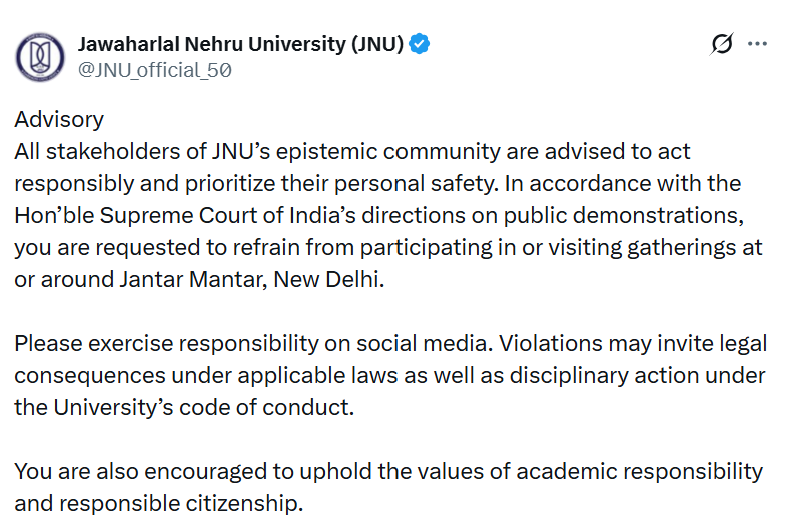
Questions Bombay HC’s Palestine protest Order
Referring to the Bombay high court’s refusal to permit a demonstration in solidarity with Palestine, Justice Bhuyan said, “Traditionally, India has always recognised Palestine, and we have a Palestine embassy in India.” He described the court’s observation asking why people wanted to protest over events in Gaza when India had its own issues as “very, very amusing”. Recalling the order, he said, “I found it very amusing when in Bombay Shivaji Park, a group of people wanted to demonstrate in solidarity with the people of Gaza. The permission was not granted by the government, so they moved to the Bombay HC. The learned judge said, don’t you have issues in India? Why do you have to go that far to agitate? It’s really very, very amusing to say the least on this.” He argued that such judicial responses should provoke critical engagement among students and researchers. “These are the issues that should agitate the minds of the young research students. You must read, you must question”, he suggested. [1:30:04]
He also urged universities to cultivate debate rather than suppress it. Referring to reports that punitive action had been taken against a student for asking questions, he said, “to allow this critical aspect of a student… I’m told one of the enelus has taken punitive actions against a student for asking questions. Universities should be seen as encouraging students to engage in debates, to engage in uncomfortable questions. Comfortable questions: everybody can ask, everybody can answer. These uncomfortable questions are not seen as curbing or stifling such voices.” [1:39:09]
Separation of Powers and Judicial Independence
Referring to the concept of trias politica, coined by the French political philosopher Montesquieu, Justice Bhuyan explained that it describes the checks and balances among the legislature, the executive, and the judiciary. Using the analogy of a three-legged stool, he questioned whether such a stool could remain stable if its legs differed in alignment, strength, or distance. He warned that any imbalance could cause the stool to collapse, arguing that this is the fundamental principle underlying trias politica. [1:35:48]
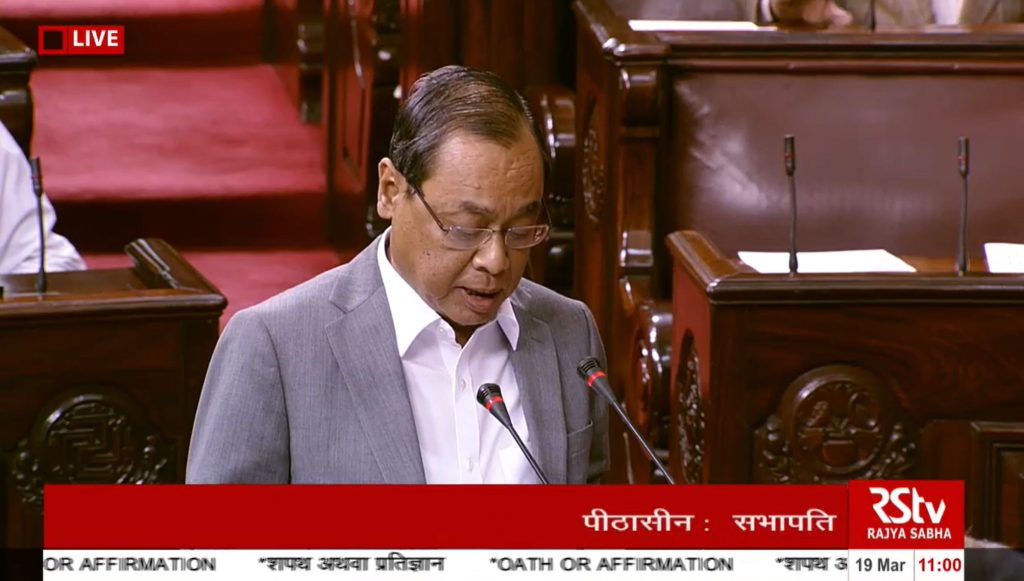
Building on that premise, Justice Bhuyan criticised the decision of a former Chief Justice of India to join the executive, calling it “fundamentally wrong”. He said, “Therefore, when a former CJI says I am going to the Rajya Sabha, to bridge the gap between the judiciary and the executive. It is fundamentally wrong. It is completely wrong. Fundamentally, it goes against the principle of separation of powers. It is a fundamental fallacy there.” [1:37:12]
Speaking about Chief Justice Kania in 1950, Justice Bhuyan said “his words signify that the Supreme Court was meant to be more than a legal body, as it is to serve as the moral compass and the constitutional conscience of the nation. Insisting on independence ensures that the judiciary can check the misuse of power by the legislature and the executive, safeguarding democracy and individual rights.” He added, “Finally, the emphasis on earning public respect underscores that judicial power relies not just on law but on trust and legitimacy, making accountability, integrity and transparency essential for a judiciary to function effectively in a democratic society. [1:41:49]
He maintained that safeguarding the Constitution ultimately rests with the judiciary, particularly the Supreme Court. “Though it is the constitutional duty of all the three organs of the state to uphold the Constitution by ensuring that the basic structure of the Constitution does not suffer any assault. Ultimately, it is for the judiciary and more particularly the Supreme Court to ensure that these essential features are protected.” He added, “I ask myself if the judges do not protect the independence of the judiciary, who else will protect? If the judges do not enforce the rule of law, who else will?” [1:51:31]
On Hate Speech and Bulldozer Justice
Questioning the prevalence of hate speech, Justice Bhuyan asked what had led to the apparent impunity with which people take the law into their own hands. “Today we find many people taking the law into their own hands. Making hate speeches, doing that with impunity. Why is it? We need to ask ourselves; the judges need to ask themselves.” [1:51:56]
Recalling a conference at the Constitution Club in New Delhi on November 18, 2024, Justice Bhuyan said he had praised Justice B R Gavai’s bulldozer judgment prohibiting demolitions carried out with bulldozers. While calling it “a good judgement no doubt,” he argued that “it has come two years too late”. According to him, the judgment’s impact was “practically nil- zero”, because “With virtually zero impunity, residential houses and small business premises are being demolished by using the might of a bulldozer.” He concluded, “when you use a bulldozer, it is like bulldozing your constitution. It’s like bulldozing over your constitution.” [2:00:00]
Having begun his legal practice in 1991 at the Gauhati high court, Justice Ujjal Bhuyan served in several important government roles, including standing counsel for the income tax department for 16 years, additional government advocate for Meghalaya, special counsel for the Arunachal Pradesh government, and additional advocate general of Assam. Designated a senior advocate in 2010, he was appointed an additional judge of the Gauhati high court in 2011 and became a permanent judge in 2013. He later served as a judge of the Bombay high court and the Telangana high court before being appointed Chief Justice of the Telangana high court in 2022. He was elevated to the Supreme Court of India in July 2023. Justice Bhuyan has also held key positions in legal education and judicial administration, including as executive chairman of State Legal Services Authorities and as a member of the governing councils of leading national law universities.
This content originally appeared on Alt News and was authored by Ankita Mahalanobish.

Ankita Mahalanobish | Radio Free (2026-07-27T04:33:59+00:00) Eating chicken on Ganga can’t be an offence, no law bars that, says Justice Ujjal Bhuyan. Retrieved from https://www.radiofree.org/2026/07/27/eating-chicken-on-ganga-cant-be-an-offence-no-law-bars-that-says-justice-ujjal-bhuyan/
Please log in to upload a file.
There are no updates yet.
Click the Upload button above to add an update.