
ANALYSIS: By Johnny Blades of RNZ Pacific
We could be about to find out whether a part of the Pacific Islands will become the world’s newest nation.
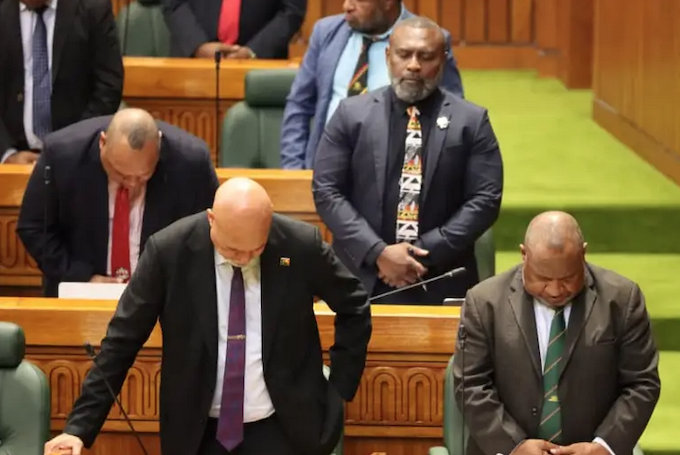
After a seven-year wait, Papua New Guinea’s Parliament is today (Thursday, August 27) expected to finally table the question of whether to approve of independence for the country’s autonomous region of Bougainville.
In a 2019 referendum, an overwhelming 97.7 percent of Bougainvilleans voted for independence — but the referendum was non-binding and PNG’s national Parliament has the final say in whether to ratify this result.
- READ MORE: ‘This is a difficult task’: PNG parliament to finally address Bougainville vote
- Flashback: Bougainville: New Zealand’s part in a guerilla war — David Robie
- Other Bougainville independence reports
They are to debate the matter from today, before later putting it to a vote, with support from a three-quarters majority of MPs being the threshold required for ratification.
The decision is no small thing. Bougainville is around 2 percent of PNG’s total landmass, or 2.7 percent of PNG’s total population.
It may seem small, but in the New Zealand context, this would be a bit like giving up, in land mass terms, the Auckland region or, in population terms, like letting go of Dunedin City.
So it is a big call for a bunch of MPs to make.
Brutal civil war
No country is comfortable with ceding some of its territory. But in this case, the context is the legacy of a brutal civil war and ensuing crisis that played out during the 1990s, which brought not just Bougainville to its knees, but PNG too.
New Zealand played a central role in mediating a lasting peace — 2001’s Bougainville Peace Agreement ultimately provided for the referendum that took place in 2019, in which over 200,000 people from an overall population of around 300,000 cast their vote.
The tabling of the referendum result in Parliament has been a long time coming, and follows a series of consultations over the years between the PNG government and the Autonomous Bougainville Government (ABG) over how the result would be processed.
It is already clear there is some reluctance among PNG MPs to set a precedent for other parts of the country to look to break away. But it is not easy to ignore the clear call for independence from almost 98 percent of Bougainvilleans.
However, PNG’s Prime Minister James Marape has pointed out that without economic independence, Bougainville would not be able to stand on its own feet. He has hinted at allowing for a period of time in which the region works on developing that economic self-reliance before the Parliament might then revisit the question of political independence.
In the eyes of many, economic self-reliance means re-habilitating Bougainville’s large Panguna copper mine, conflict over which sparked the civil war in the first place.
Development of Panguna
ABG President Ishmael Toroama is already pursuing the development of Panguna, and has signalled Bougainville’s intention to declare independence in 2030.
The Burnham Accord, signed by both parties last year in Christchurch, included an agreement for PNG and Bougainville to be bound by any decision of the Parliament and to maintain dialogue after that over the way forward.
So if Bougainville is not granted independence now, it does not necessarily mean it will not get independence at a later point. Either way, it could be the world’s next new country.
This story was first published on

This content originally appeared on Asia Pacific Report and was authored by APR editor.

APR editor | Radio Free (2026-08-27T05:30:23+00:00) Long time coming: After decades of struggle, is Bougainville on the brink of statehood?. Retrieved from https://www.radiofree.org/2026/08/27/long-time-coming-after-decades-of-struggle-is-bougainville-on-the-brink-of-statehood/
Please log in to upload a file.
There are no updates yet.
Click the Upload button above to add an update.