
By Lauren Crimp of RNZ
New Zealand’s Green Party has pledged to make public transport free for eligible groups and cap bus and train fares at $2 for everyone else.
It says its transport plan offers fast, frequent and affordable services.
Under the Greens’ policy, public transport would be free for children, students, apprentices, Community Service Card holders and Total Mobility users, while everyone else would pay a maximum fare of $2.
It would also build mass rapid bus and light rail services in Auckland, Wellington and Christchurch, offer more frequent inter-regional bus services, strengthen rural bus services and allow councils to pedestrianise more inner-city areas and increase safe walking and biking spaces.
The party has also promised overnight passenger trains from Auckland to Wellington, as well as bringing back the Southerner between Christchurch and Dunedin and extending Te Huia to Tauranga.
“In the middle of a fossil fuel crisis, these common sense investments will save New Zealanders money, stress and time,” said co-leader Chlöe Swarbrick.
“It’ll cut emissions and improve quality of life.”
Million+ CRL trips
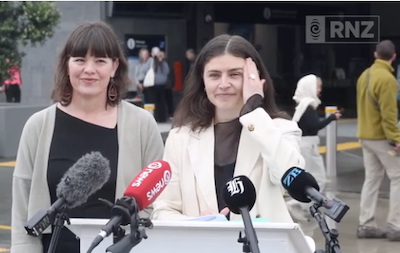
Swarbrick and transport spokesperson Julie-Anne Genter addressed media in Auckland on Sunday from outside Maungawhau City Rail Link station.
Swarbrick referred to the more than a million trips that have been taken on the CRL since it opened last month.
“What that tells us and shows us so clearly is that when we build transport infrastructure that makes it easy, affordable, and even fun to get around, people will use it.
“But right now, too many New Zealanders are driving around with the fuel light on, hoping and praying that petrol prices will drop,” she said.
Swarbrick said the government could not control oil shocks like that caused by the Middle East war — but it could make investments that reduce the cost of living and reduce dependence on fossil fuels.
She described the party’s plan as “straight up common sense”.
Swarbrick said meaningful change could be made immediately, but some parts of the plan like light rail networks could take a decade or so.
Infrastructure Commission assurance
The major investments would go through the Infrastructure Commission’s assurance process, she said.
The entire plan would cost around $23.9 billion: $21 billion for mass rapid transit and rail investments, $1.3 billion for capped and free fares, $75 million for electric buses, $290 million for councils to expand walking and biking spaces, $824 million for public transport improvements and $406 million for inter-regional buses.
“What we are proposing today is to meet the needs not only of our immediate cost of living crisis, but also our medium and longer term needs to build infrastructure that is fit for purpose for the future. Yes, that will cost money,” Swarbrick said.
She cited the Greens’ wealth tax as a way of paying for some of it, but said the party’s full fiscal plan would be laid out in the next few weeks.
But Public Transport Users Association national co-ordinator Jon Reeves questioned the viability of the Greens’ plan.
He supported cheaper fares, but said the proposal sounded like wishful thinking.
“I’d like to see some of these things come true. On a $2 fare for everyone, it’s good, it may change the attitudes of some people into using public transport but how many is the question,” he said.
“The other area is who is going to fund it?
NZ ownership
“When we do give out free transport to someone, someone else has to pay for it. Does it come at the cost and the expense of running services?” he said.
Reeves said one way to reduce the cost of public transport would be to bring services back into New Zealand ownership to keep profits in the country.
“In New Zealand multinational corporations are pretty much the ones who operate all the services, whether it’s Auckland or Wellington trains or the bus services around the country. They’re all majority owned by overseas foreign companies,” he said.
“We need to bring it back to New Zealand and cut out the middleman, bring that money back and make it stay here so we can invest in more public transport and give cheaper fares to users.”
This story was first published on

This content originally appeared on Asia Pacific Report and was authored by APR editor.

APR editor | Radio Free (2026-10-04T06:46:25+00:00) Greens eye free, fast and reliable public transport with NZ election promises. Retrieved from https://www.radiofree.org/2026/10/04/greens-eye-free-fast-and-reliable-public-transport-with-nz-election-promises/
Please log in to upload a file.
There are no updates yet.
Click the Upload button above to add an update.